| |
The Fayetteville Precinct CourthouseRecorded
Texas Historic LandmarkBy
John Troesser |
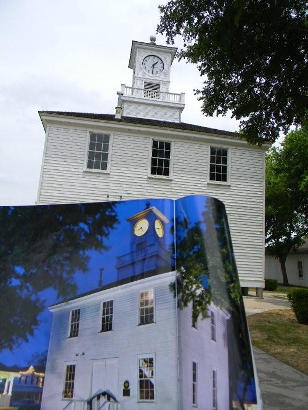
Night
and Day
Courthouse at night by J. Griffis Smith
TE photo, May 2010 |
The
Texas Legislature once passed a law stating that county seats be centered within
5 miles of the geographic center of the county. This was to equally distribute
the distance people had to travel to conduct business, vote or attend hangings.
Like most laws in Texas, it was met with varying degrees of compliance.
In counties like Fayette
where the population was equally dispersed, it made sense to have separate voting
precincts in the population centers. Sometimes court was held or voting was conducted
in local stores or public buildings. Citizens of Fayette
County went a step further by voluntarily building entirely separate buildings
for voting and conducting county business. They were also used for a variety of
town functions. |
| The
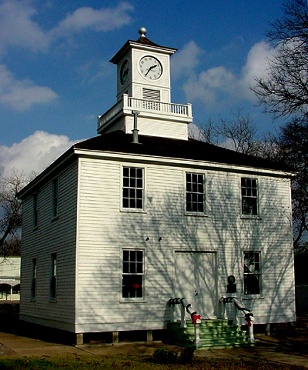
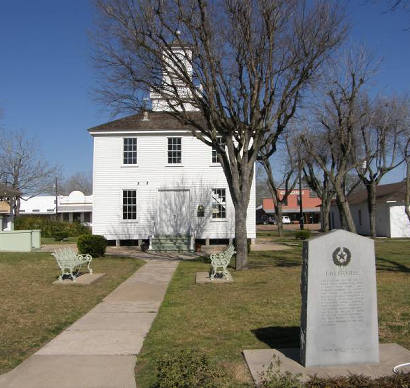
Restored Courthouse was re-dedicated in June of 2002. TE Photo 12-02 |
Three
towns in Fayette County built precinct courthouses - Fayetteville,
Round Top and Winchester.
A fire destroyed the Round Top building,
which has been replaced with a replica, and Winchester's
has long ago turned into a barn. Only Fayetteville
has an original structure - making it the only one in Texas.
The Fayetteville
Precinct 2 Courthouse was built in 1880 for the cost of $800. $600 was raised
by citizens themselves while the balance came from county funds. A ball was held
to raise money to paint the building. |
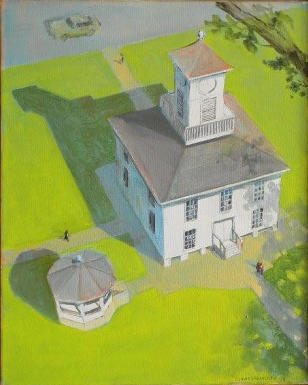
| The
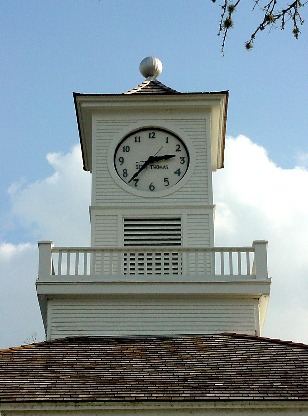
Courthouse Clock was added in 1934 with funds raised by the Do-Your-Duty Club
|
Robert
Ripley once reported Fayetteville as being
the smallest town in America having a chiming clock on it's square. The story
of how Fayetteville got its clock is worth
mentioning since it sparked a war of words between the women of the town who raised
the money for the clock and the men who (after the money was raised) wanted to
spend it on sidewalks. Sidewalks eventually appeared, but the clock was installed
first.
A few feet beneath the clock tower - on the building's second
floor are two cells which were added in 1887. These were usually occupied by over-imbibing
saloon patrons - almost every one of them from out of town. Detainees facing more
serious charges were transferred to La
Grange.
You needed to start drinking early if you wanted to be sure
of getting a cell in Fayetteville. A chain
bolted to the floor in front of the cells held inmates who arrived after the cells
were occupied.
Legend has it that a prisoner was once shot dead in his
cell by someone firing a gun through the window. |
 |
| Rudolph
Spacek, kept his office in the courthouse - his sign now a permanent part of the
interior. TE photo, 12-02 |
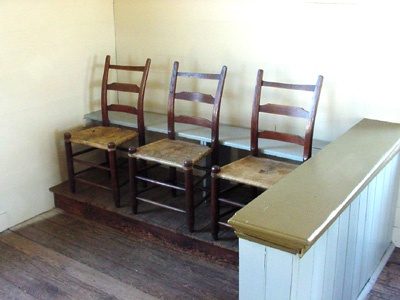
Jury
seating seems to have been appropriate to the courthouse's size.
TE photo
12-02 |
| The
walls of the courthouse are cedar boards and the windows are original poured sheet
glass. A utilitarian staircase leads to the two jail cells and the clock is reached
- only if it's really necessary. |
|
Fayette Co. JP Office on the Square now houses The Rural Art Guild of Texas. TE
photo, 12-02 |
The
foundations of the old water tower on the square
TE photo |
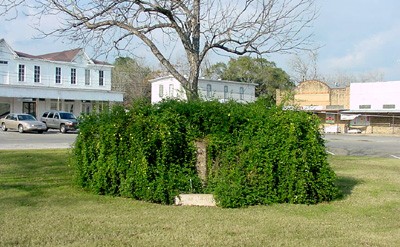
| The foundations of
the old water tower remain in place on the NE side of the square and a metal tower
still supports the old fire siren which until recently always announced 12 noon.
|
Historical
Marker TextFayette
County Precinct No. 2 CourthouseFayetteville
citizens raised $600.00 in private funds, received $200.00 in tax money from the
County Commissioners' Court, and built this Victorian precinct Courthouse in 1880.
A ball held in the new building netted funds for painting. The 2-cell calaboose
upstairs was completed in 1887. A ladies' club donated the clock in 1934. In early
Texas, precinct Courthouses were very rare.
Recorded
Texas Historic Landmark - 1977 |
© John Troesser
TE thanks Fayetteville historian Louis
Polansky for providing information on the courthouse and opening it
upon short notice. | |
|