|
|
Texas
| Columns
When Samuel
Clemens met U. S. Grant
or
Whoever the Twain Shall Meet
From Mark
Twain’s Autobiography
|
| Editor’s
Note: This anecdote recalls Bill
Cherry’s recollection of his two meetings with Stanley
Marcus and Harold
Bell’s reciting of James
H. Farley’s legendary memory. Both Farley and Marcus could recall
with ease the names of people they had met years earlier – despite
the insignificance of the occasion. Perhaps society would be wise
to pay attention to young people with excellent memories – and remember
their names for “they” are most likely to become the future’s Twains
and Grants. |
Although
several of Mark Twain’s works are semi-autobiographical, his actual
autobiography wasn’t published until after his death. He spent the
last months of his life dictating the book from his deathbed. Indeed,
the reader is advised by an entry in Twin’s own script: “I am writing
from the grave. On these terms only can a man be approximately frank.
He cannot be straightly and unqualifiedly frank either in the grave
or out of it.”
As an autobiography, it’s most unusual in that it doesn’t follow chronological
order. There is hardly any of the traditional “I was born at an early
age…” Twain’s concept – and a good one – is that events should be
recorded when they are best remembered – not put on a mental shelf
(and forgotten) for the sake of chronological order. |
| Mark
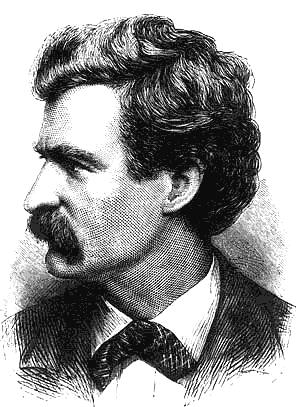
Twain "thoroughly notorious." |
Mostly dictated
in the morning hours of the winter of 1906, the book does contain
earlier entries. The event described in the title was actually recorded
in 1885.
Twain describes seeing Grant for the first time in 1866 when Grant
was still General of the Army and was considered by the world to be
the man who preserved the Union. But the role Twain played here was
merely that of observer. Hands were shaken but no words were exchanged.
|
| U.S.
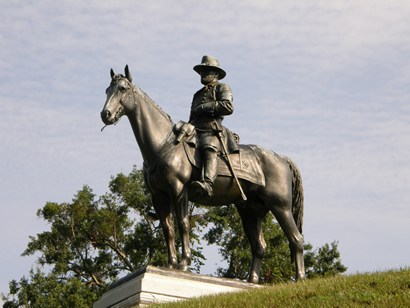
Grant in Vicksburg, site of his greatest victory. TE photo |
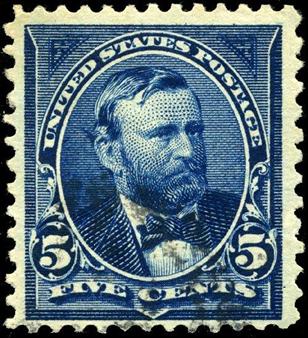
The second meeting
between the two men was in the White House when Grant was serving
his first term as president. Twain was introduced by Senator Bill
Stewart of Nevada, a friend of both men. By that time Twain had “acquired
some trifle of notoriety” but was far from being what is now known
as a “celebrity.”
After this, their second handshake, there was an awkward silence.
As Twain put it: “I couldn’t think of anything to say. So I merely
looked into the general’s grim, immovable countenance a moment or
two, in silence, and then I said: “Mr. President, I am embarrassed.
Are you?”
Twain continued: “He smiled a smile which would have done no discredit
to a cast-iron image, and I got away under the smoke of my volley.”
|
 |
Ten years passed
and Twain admits that “In the meantime I had become thoroughly notorious.”
Finally, in 1879 the two men were both speakers at a Chicago reunion
of the Army of the Tennessee – Grant’s first command of troops.
Again, both men were introduced by a mutual friend (this time it was
the Mayor of Chicago). The mayor said: “General, let me introduce
Mr. Clemons.”
Twain recalls: “We shook hands. There was the usual momentary pause
and then the general said: “I am not embarrassed. Are you?”
"15 Minutes of
Separation" - September 17, 2009 Column
© John Troesser
Related Topics:
Columns | People
| Texas | Texas
Books | "Of Books
I Sing" |
|
|