| |
JOHN
TRLICAby
Clay Coppedge
GRANGER
- Every picture tells a story only as long as people know the story.
A visit with Dan
Martinets is in order if you want the story on the photographs collected in
the book "Equal before the Lens: Jno. Trlica's Photographs of Granger, Texas"
by Barbara McCandless. |
|
John
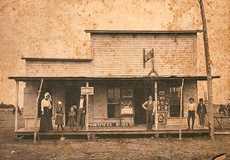
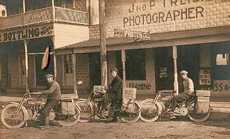
Trlica operated his Granger studio from 1924 until the mid-1950s. He photographed
people and places, but mostly people - regardless of race or religion. This was
a time when most rural businesses in Central Texas closed their doors to black
and Hispanic citizens.
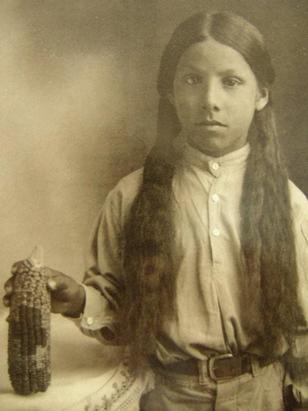
The book's cover is a picture of a young girl
with long black hair holding an ear of corn. This is no ordinary ear of corn;
this is the most famous ear of corn in Williamson County history because it carries
the symbol of a cross. |
| Louis
Escobedo with the ear of corn |
Martinets, 85, says
he was stunned to see the book's cover. He remembers the little girl and that
ear of corn. "The girl's name was Louisa Escobedo," he says. "She was quite the
little tomboy. You'd hear a big whoop and it was her chasing one of her brothers
down the street." (See update:
It is actually Louis Escobedo. Uncle Louis is still living...more)
"Equal before the Lens" author Barbara McCandless writes that the corn
was grown by Louisa's father, Jose, on the R.R. Cole farm near Hearne in 1932.
Martinets would have been 12 years old.
Jose Escobedo said the sign of
the cross on the corn meant a big war was coming soon. The prophecy came nine
years before Pearl Harbor but about the same time Hitler came to power in Germany.
|
McCandless notes in
her book that Trlica went to work on the farm owned by Dan Martinets' grandfather,
Josef, the day after he arrived in Granger in 1900.
"The
Martinets family was to become very important in Trlica's growth, influencing
his life in the church, in retail business, and, most importantly, in photography,"
McCandless writes. |
Trlica's
belief in photography as something that should be available to everyone, not just
the upper class, set him apart in his day. "For his time, I guess you would have
to say he was avante garde," Martinets says. "He photographed black folks, Hispanic
folks. He might not have known it, but he probably took pictures of the Ku Klux
Klan too."
Dan Martinets' father appears in several of the book's photographs,
as Trlica liked to photograph Czech social events as well as the social events
and businesses of Granger.
One man in a picture with Dan Martinets' father
is identified by Martinets as a man who went on to become a lobbyist in Washington
- not that there's anything wrong with that. "He represented Granger in Washington,"
Martinets notes, then recalls seeing the man drive to market with a couple of
filthy, squealing pigs in his car. "The next thing you know, he's riding a limousine
in Washington."
The picture doesn't tell that story; it take Dan Martinets
to do that. |
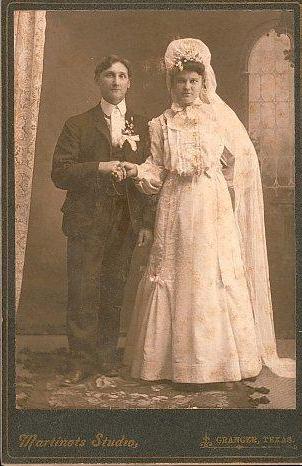 |
The
Photographer in front of the lens:
The Trlica wedding photo
Photo courtesy
Dan
Martinets |
Martinets remembers Trlica as a pleasant and precise man with an interest in a
lot of things. Even so, he could be aggressive when it came to promoting his business.
If you ever passed Trlica on the road, Martinets says, he would pass you right
back. "He wanted you to see that spare tire cover he had on the back of the car."
The covers advertised the name of Trlica's studio and carried the slogans:
"Photographs Live Forever" or "Photographs Tell The Story."
In the process
Trlica not only promoted his business but also the democratic benefits of photography.
Maybe that's why he saved those thousands of negatives. Or maybe he knew his photographs,
taken as a whole, contained artistic and historical merit.
Whatever the
reason, his grandson's donation to the University of Texas of John Trlica's photographs,
negatives, equipment and surviving business records provides a rare glimpse not
only into his business, but also into the life and activities of a small Texas
town.
© Clay Coppedge
"Letters
from Central Texas" -
November 1, 2005 column | |
|