|
When
Colonel Charles DeMorse -- widely acclaimed as the father of Texas
journalism -- died at Clarksville
in 1887, he left behind what has become one of Texas' rarest buildings.
The DeMorse house, Clarksville's
oldest structure, was originally built as a two-room log cabin with
a central hallway in 1833, three years before Texas won its independence
from Mexico.
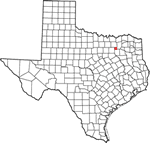
The Red River County Historical Society has embarked on a $1 million
fundraising effort that could lead to the restoration of the early
Greek revival home as an educational museum of early Texas
architecture and the remarkable life of Colonel DeMorse. "This
structure is in danger of complete demise without immediate intervention,"
said the Society. |
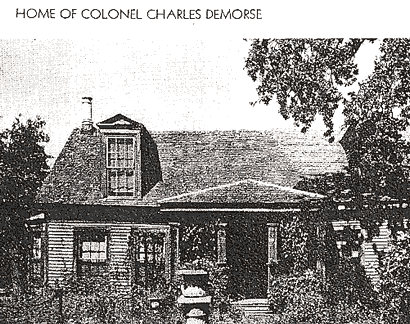
DeMorse
Home as it appeared in 1936
From "Monuments Commemorating the Centenary of Texas Independence",
State of Texas, 1938. Courtesy Sarah
Reveley |
| Anyone
who has read a history of Texas in the 1800s will find many references
to the Clarksville Standard, which DeMorse founded as the Northern
Standard in 1842. It was one of Texas' foremost newspapers, largely
because DeMorse not only recorded Texas
history; he was one of the principal makers of it. |
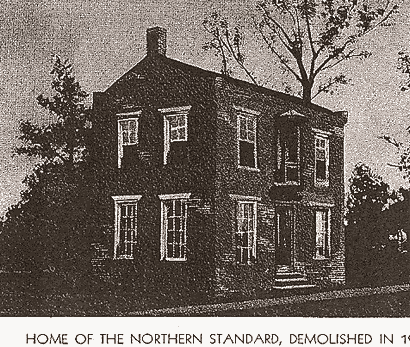
Home
of Northern Standard
From "Monuments Commemorating the Centenary of Texas Independence",
State of Texas, 1938. Courtesy Sarah
Reveley |
|
DeMorse
was born Charles Denney Morse at Leiceser, Massachusetts,
in 1816, and came to Texas in 1835
to help Texans in their fight for independence. While traveling
to Texas he was detained by British
agents at Nassau. They mistakenly listed his name as Charles DeMorse,
but he liked it so much that he adopted it permanently.
He served numerous
roles for the new Republic of Texas, first in the Texas Navy and
then the Army, as a commissioner of public debt, and as a reporter
for the House of Representatives in the Republic Congress.
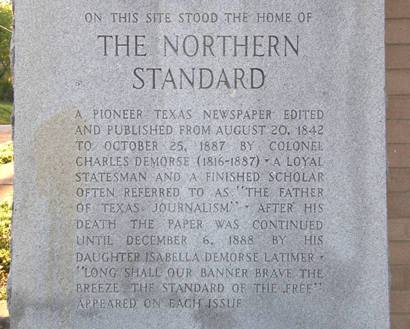
When he founded the Standard, its first issue bore the motto, "Long
May Our Banner Brave the Breeze--the Standard of the Free."
The sparsely settled East
Texas area, the lack of roads and mail routes, and the numerous
streams and rivers that could not be crossed during floods created
serious problems for DeMorse, but he persevered -- and by 1846 the
paper was doing so well that it was enlarged. In 1852, he changed
the name to The Standard and built a cylinder press. The only other
such press in Texas was at the Galveston
Daily News.
In the following years, the Standard was second in circulation among
Texas newspapers and had agents as far away as Philadelphia, Boston
and New York.
Recognizing its influence, early Texans used the Standard as a forum
for their views on statehood, the Civil War and other major political
events. DeMorse often had something to say about non-political issues,
too. If a particular event such as a lynching or murder caught his
attention, his readers were likely to be get a good dose of his
views.
|
 |
Morse
ran the paper from its birth to his death in 1887. Only during the
Civil War, when DeMorse rode off to become a colonel with the 19th
Texas Cavalry, was he absent and John R Woolridge took over the paper.
Even upon his death, his daughter continued the publication of the
paper for about a year.
The Standard was unique for 45 years because it was edited and published
by a single individual whose personality, opinions and hopes it reflected,
and neither DeMorse or his family wanted its control to pass to anyone
else. |
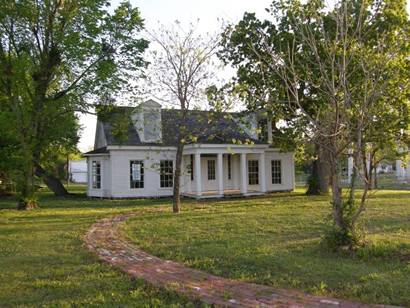
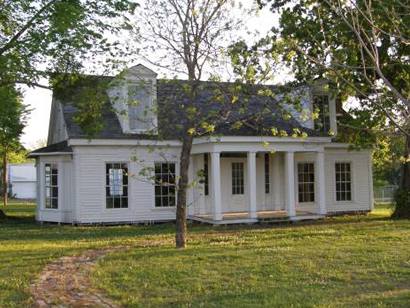
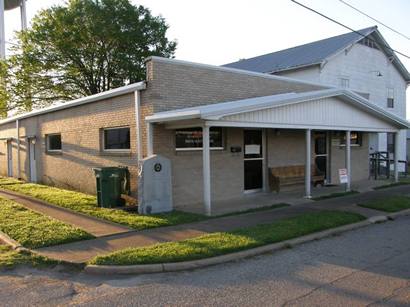
Home of Colonel
Charles DeMorse
Photos courtesy Barclay
Gibson, April 2009 |
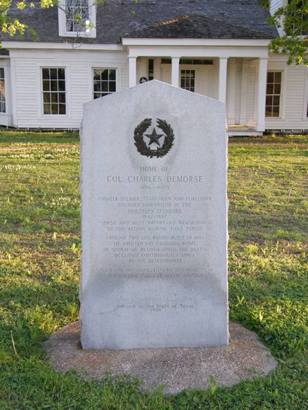
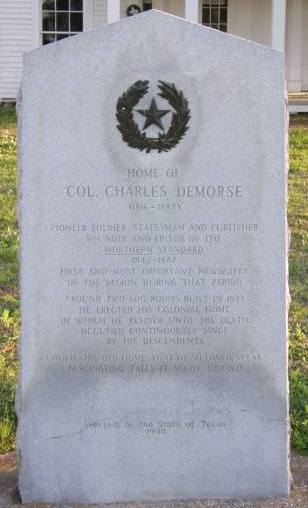
DeMorse Home
Centennial marker
Photos courtesy Barclay
Gibson, April 2009 |
All
Things Historical
February
12, 2004 column
Published with permission
A weekly column syndicated in 70 East Texas newspapers
Bob Bowman's East
Texas
(Bob Bowman
of Lufkin is the author of 40 books about East Texas history and folklore.)
|
|
|
 HOME
HOME