|
The residents
of New London,
located in northeast Rusk County, had monies to erect a new school
building because of the boom economy produced by the EasTex oil
field. To save money, however, they ceased obtaining natural gas
to heat the building from United Gas Company and connected directly
to a line transmitting "green" gas from the field. The gas, which
was odorless, leaked from a faulty connection and collected beneath
the schoolhouse.
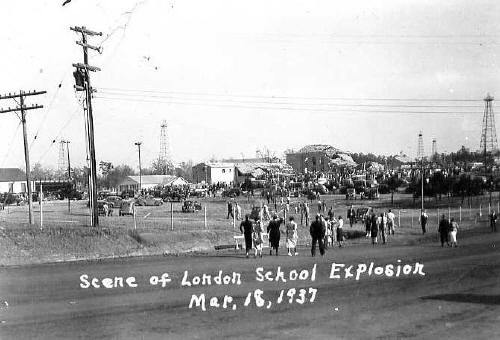
As school ended for the day on March 18, about 500 students and
teachers remained in the building, and a PTA meeting was in progress
in the gymnasium. At 3:05, shop teacher Lemmie Butler turned on
an electric sanding machine, sparking an explosion of the natural
gas. The blast lifted the building, which then settled into rubble.
Rescuers responded immediately, and kept coming from as far away
as Dallas. Mother Francis
Hospital, a new medical facility in Tyler,
had scheduled ribbon cutting ceremonies that day but cancelled the
celebration and devoted their efforts instead to caring for injured
students and teachers.
Governor James Allred sent public safety officials to help, and
twenty-five members of the Texas Funeral Directors Association arrived
to provide their professional service. Searchers continued to look
for victims by floodlight all night.
The explosion cost the lives of 298 students and teachers and altered
the lives of everyone in New
London; indeed, in all of Texas,
because after the tragedy the Texas legislature required natural
gas companies to add an odor to their product so that leaks could
be detected more easily.
Bobby's play left audiences quiet, many in tears. It would have
been even more poignant if all had known how much of the play was
autobiographical. Bobby, only two years old in 1937, had not yet
started to school in New
London, where the family lived. His father was one of the men
who looked all night for other men's sons and daughters.
© Archie
P. McDonald, PhD
All
Things Historical
September 25, 2006 column
A syndicated column in over 40 East Texas newspapers
This column is provided as a public service by the East Texas Historical
Association. Archie P. McDonald is director of the Association and
author of more than 20 books on Texas.
|
 HOME
HOME