|
|
Except
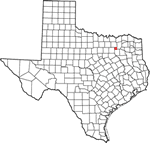
for a rural cemetery, little is left of Chickenfeather in the once-rolling
hills of eastern Rusk
County. Its distinctive name was long ago forgotten and its history
was compiled only from the remembrances of its former residents.
One of those residents was John Wilson Lee, who came to Rusk
County around 1901 after hoboing his way on freight trains from
the Illinois-Indiana area.
According to an interview with Lee when he was in his declining years,
a group of young boys decided to go hunting one autumn night around
1910, but failed to bag any game.
Late in the night, feeling hungry, they swiped a couple of chickens
from a farmer, built a fire behind New Hope Church, and roasted the
chickens.
To hide the evidence of their theft, they tossed the chicken feathers
and viscera into a well where churchgoers and schoolchildren drew
their water each day.
Contaminated with the chickens’ remains, the well had to be cleaned
out and salted to restore the water to drinkable quality. Thereafter,
New Hope was better known as Chickenfeather.
Lee, a native of Kansas, came to Texas
in 1899 and made his way to Timpson,
where he helped built the Blankenship Hotel as a skilled bricklayer.
He also helped build the First National Bank on Henderson’s
square around 1902.
Lee returned to the Chicago area later in 1899 to marry his sweetheart.
They moved to Whitewright,
Texas, in 1900 and a year later moved to the area around New Hope
Church, where Lee bought a 100-acre farm.
New Hope, which would later become Chickenfeather, began as
a community around 1901 when C.B. and Bonnie McLemore donated land
for the New Hope Community School and a church.
In the 1930s, a preacher from Waco
often drove to the community, held services on Sunday, and received
as his payment a ham, a slab of bacon, buckets of homemade syrup,
and a small amount of money.
Chickenfeather was soon applied to the road which ran through the
community and, as the years passed, the town acquired a blacksmith
shop, whose owner, Wylie Lee, was one of the first blacksmiths to
use lignite coal in his forge. The lignite, found in abundance in
the area, would later lead to the end of the community. In 1983, Texas
Utilities Mining Company came to Chickenfeather to mine lignite and
bought most of the land in the community and surrounding areas.
Today, the rolling hills around Chickenfeather have been smoothed
away by giant lignite mining scoops. Little remains from the community’s
existence.
But on each second Sunday in July, former residents of Chickenfeather
gather at New Hope cemetery to share recollections of the days when
the community was still alive.
All
Things Historical
December 8, 2008 Column.
Published with permission
A weekly column syndicated in 70 East Texas newspapers
|
| Texas
Escapes, in its purpose to preserve historic, endangered and vanishing
Texas, asks that anyone wishing to share their local history
and vintage/historic photos, please contact
us. |
|
|
 HOME
HOME