|
|
When
the first steam locomotive made its way into East
Texas more than a century and a quarter ago, it changed the economy
and future of the region in ways that were never imagined.
Today, however, many of the old
railroad depots that became community landmarks have vanished--the
fallout of a new wave of progress brought about by automobiles and
highways.
Some of the depots
that characterized the monumental changes in East
Texas are still standing, but rotting away in fields, where they
were moved to allow for new buildings in town.
Some towns, however, have kept their depots
as reminders of the era when everyone used the railroad.
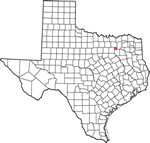
One such depot stands at Tyler,
where it is now revered as a National Historic Landmark. |
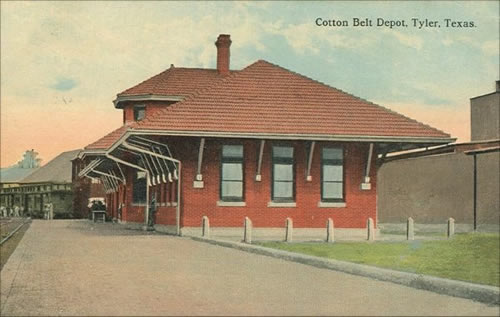
Cotton Belt
Depot, Tyler Texas
1914 Postcard courtesy www.rootsweb.com/ %7Etxpstcrd/ |
Located
in a downtown area known simply as “The Levee,” the depot was built
in 1905 to serve the Texas & St. Louis Railway -- later known
as the Cotton Belt - which had arrived in the city 25 years earlier.
With a population of less than 2,500, Tyler
soon became a railway
hub and Smith County
moved from a largely agricultural economy to one with the transportation
links to send its raw materials to markets all over the country. Peaches,
strawberries, potatoes, plums and tomatoes went to distant markets
like St. Louis, Denver, Omaha and Milwaukee.
The Cotton Belt not only established in Tyler
a roundhouse and machine shops, but located its executive offices
here, as well as a hospital known for its efforts to wipe out smallpox,
malaria and typhoid fever. |
Tyler
businessmen also saw growth from the Cotton Belt. Railroaders found
rooms at the old St. Charles Hotel and Sam MarDock, Tyler’s
first Chinese businessman, opened a restaurant that served as the
unofficial eating place for Cotton Belt hands.
By 1924, the railroad provided nearly 1,300 jobs, generated a payroll
of nearly $2 million, and paid almost $40,000 in local taxes for Tyler.
But with the arrival of the Great Depression, the railroad -- like
most other businesses and institutions -- fell on hard times. And
as roads and automobiles improved in the forties, trucking took away
much of the Cotton Belt’s customers. Travelers stopped using railroad
passenger cars.
In 1956, the last passenger train arrived in Tyler
and the railroad depot was used for storage and offices until it was
boarded up and abandoned in 1987.
But
Tyler’s
love for all things historical soon embraced the old depot and, with
a gift of the building to the city by the Cotton Belt, Tyler
purchased the land on which the depot rested and began a revitalization
effort funded by a half-cent sales tax, the generosity of the Vaughn
Foundation, and federal grants.
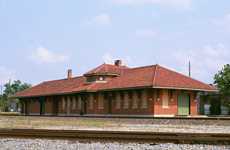
The restoration was completed in four phases and a year ago the depot
returned to life as the headquarters of the city’s public transportation
services.
And on June 4, a city-wide celebration unveiled a plaque that establishes
the depot as a National Historic Landmark.
Since its restoration, the depot has become a landmark for Tyler
and attracts railroad
enthusiasts and others almost every day. The depot also houses an
exhibit of rail-related memorabilia, much of it linked to Tyler’s
early years when the steam locomotive was king.
All
Things Historical -
October 31, 2005 Column
Published with permission
(Distributed by the East Texas Historical Association. Bob Bowman,
of Lufkin, is a past president of the Association and the author of
more than 30 books about East Texas.) |
| Texas
Escapes, in its purpose to preserve historic, endangered and vanishing
Texas, asks that anyone wishing to share their local history, stories,
landmarks and recent or vintage photos, please contact
us. |
|
|
 HOME
HOME