|
While
Galveston
and Houston have always
been rivals, there has never been a time when wisdom didn’t show it
to be in both cities’ best interest to work together.
When construction on an electric railway was begun March 28, 1910,
to connect the two cities, Galveston
had a population of about 40,000. Houston
was just twice as big.
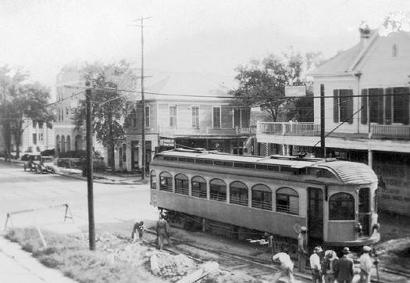
The new electric train was called the Interurban, a made up word,
and it was built in just one year, and that included laying the tracks
and building the large plants that generated the electricity that
fueled it. The cars, much like trolleys, ran down a single track for
just over 50 miles, and at a speed of 60 miles per hour. They hauled
passengers and freight from downtown Galveston
to Houston and back until
October 31, 1936. |
Galveston Houston
Interurban
Photo courtesy Rosenberg Library |
“Galveston’s
historic Interurban line between Houston
and Galveston, once the fastest in the nation, gave away last night
to the march of time, and ceased operation after 25 years of almost
continuous service,” The Galveston Daily News said the next morning.
Just three years later, the Houston Electric Co. that owned and operated
Houston’s downtown streetcar
system shut down. Because the Interurban shared some of its tracks
in Houston-proper, through some intercompany trade-out, Houston Electric
ended up owning a major portion of the Interurban’s right-of-way that
connected Galveston
with Houston. To be allowed
to shut down, Houston Electric was legally responsible by their contract
for removing the tracks.
Houston’s Mayor Oscar Holcombe told Houston Electric that rather than
pull them up, a task that would be extremely costly, he would let
them just pave over them if they would donate the right-of-way to
the city. The deal was cut.
Holcombe said in 1952, “I felt sure we would be able to use that right-of-way,
and equally confident that someday a major, multilane highway would
be constructed there.” When the state opened the first section of
the proposed super highway connecting Houston
and Galveston
in 1948, it was built on that right-of way.
The first business on the highway opened up a few days later. It was
a service station. When the owner applied for mail service, the highway
had no name. The postmaster called Mayor Holcombe and told him the
road needed to be formally named. A contest was quickly put together,
and Sally Yancey, a Houston bank clerk, won a hundred bucks for naming
it, “the Gulf Freeway.”
The Gulf Freeway was officially proclaimed completed in 1952. Four
years later, Houston’s
first enclosed shopping mall opened. Called Gulfgate, it was anchored
by Sakowitz’s and Joske’s. Galveston’s
E.S. Levy’s also had a store there. |
|
|
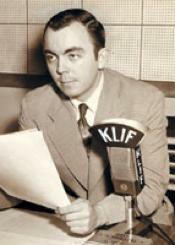
Gordon McLendon
Photo courtesy Liberty Broadcasting Co.
|
The following
year, Dallas’ Gordon McLendon,
the radioman who stole broadcasting from network stations with his
Top 40 format and personality disc jockeys, bought back Houston’s
KLBS, an AM radio station he had previously owned. To build interest
in the new format he planned for it, he had a disc jockey lock himself
in the shack at the station’s transmitter and play nothing but Ray
Anthony’s “Dragnet” for several days before the call letters were
changed to KILT and the new Top 40 was introduced.
And then with the salvaged frame of an oil derrick he had put on the
corner of the Gulfgate parking lot, Don Keyes become a flagpole sitter,
attempting to break the world record for KILT.
Keyes was not just some silly DJ trying to make a name for himself.
He was McLendon’s right hand man in the development of the Top 40
concept from the very beginning, and he had personally come to Houston
from Dallas’ KLIF to put
KILT on the air and win over the market.
The personality disc jockeys that opened KILT included Joel A. Spivak,
Red Jones, Bob White, Leaping Lee Perkins and Bill Slater. Shortly
thereafter, legend Rascal McCaskill
joined as the host of the all night show, “Milkman’s Matinee,” and
a few years later one of the now most noted names in Top 40 radio,
Chuck Dunaway, was brought in to take over a shift and pump up and
stabilize the numbers. Under the name Van Anders, Galveston’s
Vandy Anderson did news there for awhile.
As
unusual as it may seem today, driving to see the KILT flagpole sitter
did more to get people from Galveston County to have their first experience
with the new freeway and the enclosed shopping mall than any of the
advertising and promotions the stores and the mall owners had done.
So with the opening of the Gulf Freeway, Gulfgate and the KILT flagpole
sitter working congruently, traffic began building faster than anyone
had predicted. The highway department built a crude, tripod duck blind
looking affair and moved it up and down the freeway from Gulfgate
to the Galveston
causeway. It kept two employees on top of the thing to take photos
of the traffic. |
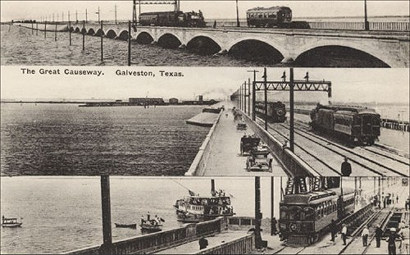 |
Galveston causeway
Postcard courtesy www.rootsweb.com/ %7Etxpstcrd/ |
Several places
along the way, they constructed traffic counter mechanisms that were
attached to thermometer-looking signs. This was for public relations
purposes, to show everyone how popular the new roadway was.
But it was those fellows taking photos from atop the tripod and the
traffic count thermometers that were the basis for 100% of the research
that the highway engineers used to remold sections of the roadway
over the next twenty years. No one had dreamed up a scientific methodology.
The advent of Top 40 in Houston; Don Keyes, the flagpole sitter; and
the Gulf Freeway being set on top of the old Interurban right-of-way
did more to get Galvestonians to explore the world off of the island
than anything had before or has since.
And McLendon’s KILT, with its zany disc jockeys, fast paced and tight
programming, station ID jingles, listener contests and rhythm and
blues music, moved teenagers into a dimension that no way reassemble
that of the teens of the past.
© William
S. Cherry
June 19 , 2012 column
All rights reserved
More Bill Cherry's
Galveston Memories |
Related
Topics:
Galveston
Music
People
Columns
Galveston Hotels
Bill
Cherry, a Dallas Realtor and free lance writer was a longtime
columnist for "The Galveston County Daily News." His book, Bill
Cherry's Galveston Memories, has sold thousands, and is still
available at Barnes and Noble and Amazon.com and other bookstores.
|
|
| Texas
Escapes, in its purpose to preserve historic, endangered and vanishing
Texas, asks that anyone wishing to share their local history, stories,
landmarks and vintage or recent photos, please contact
us. |
|
|
 HOME
HOME