|
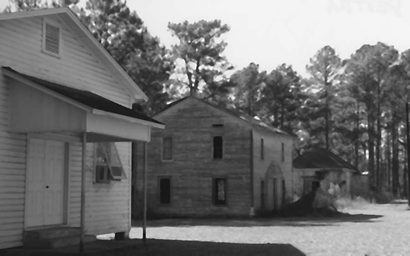
Only a few buildings
and homes remain at the old settlement of Dextra.
Photo courtesy Bob Bowman |
Finding
Dextra
by Bob
Bowman
Doris,
my wife of more than 51 years, loves researching old East
Texas communities as much as I, but driving down muddy county
roads frightens her as much as a growling bear.
On a trip to Rusk recently,
we ran across a friend, realtor Ike Frazier, who told us about a cluster
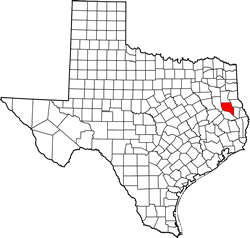
of buildings that once constituted an agricultural community in Nacogdoches
County. But he didn’t know the name of the settlement.
Following his directions, we struck out in Doris’ PT Cruiser trying
to find the place.
The first leg of the trip was down a couple of paved state highways,
but then Ike’s directions said we should turn on a dirt road. At this
point, Doris had some serious misgivings, especially when we had to
cross an old wooden bridge spanning the Angelina River.
But she continued like a good soldier and, finally, the red dirt road
turned into an oiltop surface and Doris heaved a sigh of relief.
|
We
turned a bend and, just as Ike explained, a cluster of buildings and
homes stood on a hilltop.
We found that the community was once called Dextra, which was settled
before 1900. In the mid-1930s, the community had a school, a church
and several stores. After World
War II, many of Dextra’s residents moved away, but as late as
the mid-1960s, the community had a store and two churches. In the
early 1990s, Dextra was little more than a dispersed community.
An inscription on a plaque at old Hopewell Mount Zion Baptist Church
said the church was organized by Rev. J.A. Price in 1898 and rebuilt
in 1957.
Many of Dextra’s people were buried in Ward Cemetery about a half-mile
away.
We
found out the hard way there is an easier way to reach Dextra.
It stands south of Sacul
at the intersection of FM 1648 and County Road 898. And you don’t
have to traverse muddy dirt roads. |
Bob
Bowman's East Texas
May 5, 2009 Column.
A weekly column syndicated in 109 East Texas newspapers
Copyright Bob Bowman |
| Texas
Escapes, in its purpose to preserve historic, endangered and vanishing
Texas, asks that anyone wishing to share their local history, stories,
landmarks and recent or vintage photos, please contact
us. |
|
|
 HOME
HOME