|
|
“Art’s a luxury,”
Charlie Bullock says. And who would know better than an artist like
Bullock who, every day, waits patiently for any of us to decide that
we crave such an indulgence?
Of course, Bullock is talking for us non-artists. For himself, art
is as much a necessity as eating. Charlie Bullock picks up a paintbrush
with the same alacrity as the rest of us would a fork or the telephone.
His is that rare talent that the rest of us only dream of, the demonstration
of extraordinary ability that is spoken of with awe and witnessed
with wonder. A short time ago my wife and I visited with the Bullocks
and saw, first-hand, the extraordinary workings of this Texas artist.
The Bullocks, Cindy and Charlie, live in Malakoff,
Texas. Malakoff, being one of the few towns in the state with
a Russian name (Odessa, Sebastopol, Moscow among the others but, as
some will undoubtedly tell you, Odessa is Ukrainian, not Russian.)
and a modest population of around 2500 is home, according to Mr. Bullock,
to “several fantastic artists.” This magazine, in fact, on its Malakoff
page, lists a couple of these artists. However, the magazine’s mention
of Bullock is misleading. The entry describes Bullock as a “muralist”
and leaves the story there and bare. Truth of the matter is, Charlie
Bullock will paint, draw, sculpt, sketch or print on just about any
material and if a wall is what today’s canvas might be then well,
so be it. Bullock’s eye is his inspiration and whatever is handy is
the preferred material. In fact, according to Bullock, ordinary house
paint has, on more than one occasion, risen to preferred status on
the materials hierarchy. |
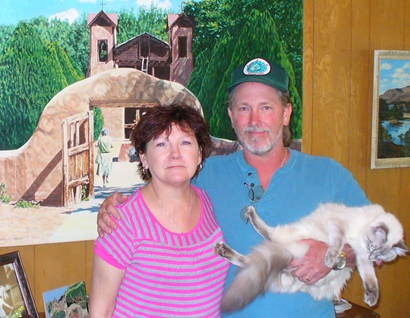 |
| Cindy and Charlie
Bullock |
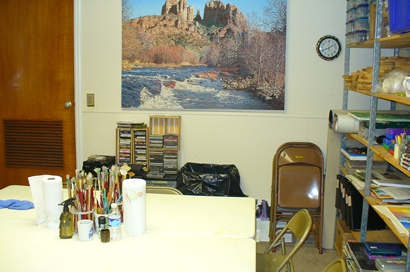
| Studio, School
and Gallery |
 |
| When we first
arrived in Malakoff,
meeting at the local Brookshire’s market, the Bullocks loaded us into
their SUV and headed, just up the street, to Athens,
Texas where Mr. Bullock’s art studio is located. The studio, just
east of the town’s main square, is a long, rectangular space comprised
of a couple of classrooms and a single office area that doubles as
Bullock’s personal work area. The larger of the classrooms, in the
back of the building, was stocked with art supplies and the work of
several of Bullock’s students. As we wandered around the area both
Mr. and Mrs. Bullock remarked to each other about the artwork and
progress of the student’s work. The comments were those of proud teachers.
It was clear that they regard their students as family and the
work of their students, as it was in varying stages of progress throughout
the space, propped on easels and spread atop tables and shelving,
showed real development as led by a talented and caring hand. It was
around this large workspace table that we sat and discussed Mr. Bullock’s
career and its meanderings through Texas, Mexico, Colorado, Arizona
and New Mexico. |
 |
| “I kinda’ paint
in series. I get into a groove of one subject and stay with that for
some time,” Bullock remarks as he tells us about his time in San Miguel,
Mexico and then in South Texas painting landscapes, ranch hands and
cowboys. And the work in his office area and the hallway bears out
this Southwestern theme. There are several paintings of mountain landscapes
from Colorado and Arizona, cowboys at work on the range, etc. and
Bullock is quick to point out that this is what he associates himself
with, i.e. the western art themes that are so prominent in this part
of the country. Indeed, when asked for artistic influences Bullock
first declares an affiliation with the Cowboy Artists Association
and several of the artists that are members. He appears to define
himself, if even somewhat loosely, on the principles of outdoor, Western
scenes reanimated on canvas. However, his education (he obtained his
degree in Art in 2002 from UT Tyler) and his recent work reveal a
more modern and eclectic style. In the hallway of his studio are a
few, oversized collages made of newspaper clippings, photographs,
oil paint and pencil; representational and themed works centered around
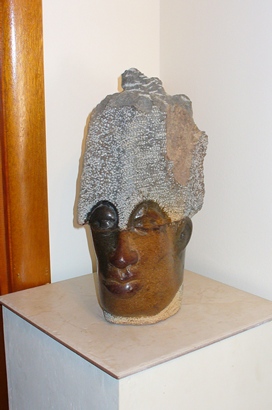
the 9-11 tragedy. In the corner is a wonderful rock bust of an African
man, carved during an association with a group of visiting Zimbabwean
artists a couple of years ago. Additionally, many of the newer pieces
that he has catalogued in his portfolio illustrate portraits and drawings
that involve the use of vivid, base colors that are reminiscent of
such modern artists as John Wesley or Roy Lichtenstein. All of which
are clear departures from the Southwestern genre however, I suspect
that the switch in aesthetic is not so much a planned redirection
in artistic intent as it is the result of Bullock applying the materials
necessary for whatever project he is involved in at the moment. As
he stated, “If Cindy shows me a photograph I might say ‘That needs
to be a watercolor or maybe if I see a landscape I’ll think that it
needs to be oils or acrylic. Whatever is right for the scene.” And
yes, that could include ordinary house paint. |
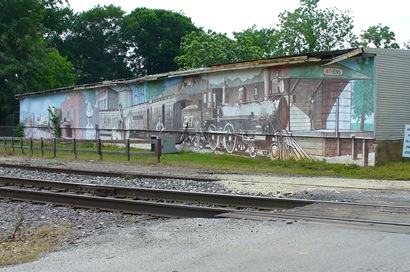 |
| Even while fading,
the mural is still a bit more than the building deserves. |
| We left the studio
and began to drive around Athens
in search of those murals that have, for some, defined Bullock as
an artist. We first came on the mural painted onto the old Athens
train depot. This is an enormous painting, stretching the entire reach
of the building, depicting a nineteenth century Athens
as the depot area itself may have appeared with a colossal train steaming
into the foreground. Much faded now, Mr. Bullock remarked that
he should return soon and remove some shrub that has grown up at one
point, obscuring a portion of wall where he had painted an image of
himself. (There was a sort of pattern to this, i.e. Bullock, like
Caravaggio, furtively re-signing his works by incorporating an image
of himself and or his wife into the canvas.) As we drove through town
it seemed that there was no part that did not have some point of relevance
for him. Passing an office building Mr. Bullock remarked, “Oh! And
I have an oil painting in that attorney’s office.” A little further
on, “See that door over there? The one with the ark and Biblical scenes
painted on it? That’s mine.” This event repeated itself many times
during our drive through the area; it seemed that each segment of
town was represented by Bullock’s work. |
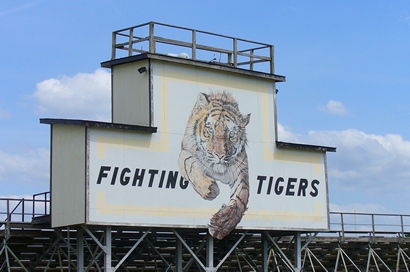 |
| We came to the
local high school and Bullock showed us the enormous lion mascot that
he had painted onto the back of the grandstand of the football stadium.
Literally picture perfect, the animal leaps from the wood and, in
fact, reaches beyond the boundary set by the frame of the space. Charlie
described how he had had to paint the pressboard canvas inside the
school’s gymnasium, straddling the wood, Pollack-like. Like the train
depot mural, the school’s mascot is sun-blanched and faded and it
seemed a shame that so much quality work had been left to the elements.
|
 |
Back in the
truck and a phone call later, we came to a home of one of Bullock’s
patrons. Commissioned a couple of years ago to give some life to a
downstairs bath area, Mr. Bullock had painted a prairie landscape
onto all four walls of the room. The effect is that the room’s area
is seemingly opened to the outsid. In fact, opening the door to the
room is almost equivalent to opening the back door onto the expanse
of grasslands that were the grounds of this enormous home.
When we left this gated community we drove a few blocks back towards
town and Mrs. Bullock detoured through a neighborhood to show us a
mural that Mr. Bullock had painted onto the façade of an outdoor tool
shed. Mr. Bullock tried a couple of times to get the resident of the
home on the telephone so that we could have access to the backyard
and a closer look at the painting. Having no success with the phone,
we drove past the house to have a look from the street. Unfortunately,
the door of the shed, that portion that holds the focal point of the
work, was open and the majority of the painting was hidden from view.
Nevertheless, we did get a decent look at the mural as it exists on
the walls and the vibrancy of the colors and the equine scene that
it featured fully demonstrated Bullock’s experience and talent for
the pastoral.
As we passed the house my wife noticed the cause for the home’s occupant
not answering the telephone - he was asleep, sunbathing on the roof.
|
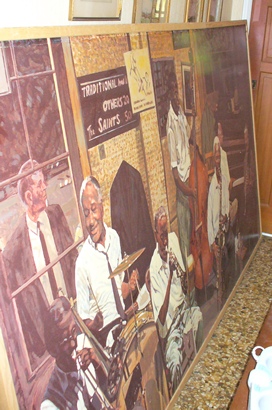 |
| The last stop
on the tour was the Bullock’s own home. We were intent on viewing
Bullock’s first mural, a life-sized portraiture of a scene in a New
Orleans jazz club. The painting is of a group of musicians in full
sway and, in what would become, literally, a signature move, Bullock
painted himself off in the corner, peering into the club through a
side window. Originally commissioned for and residing in a
restaurant, the restaurant has closed and the painting is now placidly
waiting, in the Bullock’s hallway, for a new home. Bullock showed
us the postcard that had been the model for the work and I was reminded
how he had told us earlier in the day how some of his commissions
have been to paint replicas of famous and or extraordinarily expensive
works of art so that the owners can more easily insure the paintings
by keeping the originals safely stored somewhere besides the living
room wall. The representation of the postcard was flawless. |
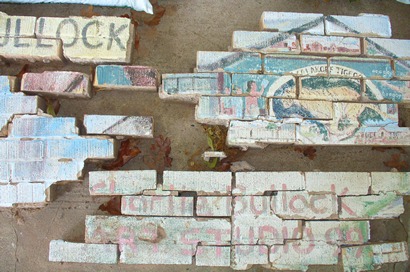 |
| Salvaged bricks
from the Malakoff Jr.
High School |
Near the bottom
of the page of this magazine’s entry
for the town of Malakoff
is a picture of Bullock’s mural for the Malakoff
junior high school. Near the top of the driveway at the Bullock home
is a small pile of colored bricks. These are, of course, the same
entity. The junior high school demolished the building holding the
mural some time ago during renovations. The Bullocks were able to
salvage some of the bricks but most, sadly, were hauled away like
so much detritus. For many years the icon of the town, this mural,
like so much of Bullock’s public work, has been discarded. Several
other pieces of Bullock’s work seem threatened by the same spirit
of indifference. Nevertheless, Charlie Bullock continues to teach,
inform and create. Every day Mr. Bullock teaches his students, engages
himself in those projects that he is drawn to produce and waits for
the letters and phone calls asking for the portrait of the children
or the landscape of the new home. He seems perfectly patient in these
endeavors because, as he stated, “Everything I’ve ever done has been
to get back to where I can just paint.”
© Byron Browne
Notes From Over Here May
27, 2009 Column
Byron Browne can be reached at Byron.Browne@gmail.com |
|
|
 HOME
HOME

