|
|
| Perhaps
the most enigmatic figure in Texas and
the West is not Johnny Ringo of maybe-suicide/maybe-not, nor the deliberately
mysterious Mysterious Dave Mather, but rather 2LT Henry O. Flipper,
10th US Cavalry. Flipper’s early life is fairly well documented. Born
a slave in Georgia, he was emancipated in 1865 while still a child.
He had an apparently-impressive mentality and was well-educated. He
was appointed from Georgia to the US Military Academy at West Point,
New York. |
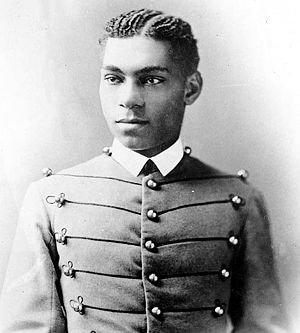 |
Flipper was
by no means the first Black ever appointed to West Point, but he ws
the first to complete four years and graduate as a commissioned officer
in the US Army. The fact that he completed the course is a tribute
to his tenacity, for his years at West Point were not happy ones.
The Corps of Cadets has a treatment known as ‘the silence’ for those
who offend gravely against the cadets’ own unwritten code of conduct.
It consists of—silence. No cadet will speak to a cadet under ‘silence,’
nor even acknowledge his existence. No one will communicate with him
in any way other than through official orders, which may be given
orally. He will be ignored—as though he doesn’t exist.
Flipper was
given ‘silence’ from the day he entered the academy. Cadets given
‘silence’ usually resign. Some have committed suicide. Flipper endured
four full years of ‘silence’ and graduated.
|
 |
Once
he graduated he found himself between the proverbial rock and hard
place. As the only Black officer in the 10th, he had no social life.
Except for official functions he was frozen out of the life and society
of his fellow officers, all of whom were white. As an officer, he
was forbidden under the Army’s ‘no fraternization’ policy to socialize
with enlisted men. At FT
Davis, 5,000 feet high in Texas’ Big
Bend country, nearly 300 miles southeast of El
Paso and over 300 miles northwest of San
Antonio, he was in an area where the only other Blacks were the
enlisted men and the prostitutes who gathered to accommodate them.
In addition, he had no future in the Army and he had to know it. In
the 19th Century US Army it was possible to make Captain—barely possible—on
merit alone, but even that was extremely difficult. Promotion beyond
1LT was the result of patronage or pull. A young 2LT who attracted
the favorable eye of his regimental commander or a General officer—as
2LT George A. Custer attracted the attention of MG Phillip Sheridan—could
rise fairly quickly. Custer went from 2LT to Brevet MG in less than
two years during the War Between the States, was reduced to CPT in
the 3rd Cav after the War, transferred to the newly-formed 7th Cav
in 1866, and rose from CPT to LTC and effective command of the regiment
in the next ten years. Most of that was due to Sheridan’s influence.
Pull—family, military, or political connections--helped assure promotion
and other advantages. MAJ George Schofield of the 9th Cav became a
primary wholesaler for Smith & Wesson revolvers before he patented
his improvements on the S&W #3 that won S&W a major military contract
largely because his older brother was chairman of the Army’s Small
Arms Selection Board.
Henry
Flipper had nothing going for him but brains, and the fact that he
was Black caused that to get far less consideration than it might
have otherwise. While stationed at FT
Davis Flipper was apprehened, detained, and tried by court-martial
for misappropriation of the Company Fund.
The Company Fund, in the frontier Army, was what made life bearable.
The Army furnished a wooden cot with a cotton sack to be filled with
grass and two blankets for bedding. Rations consisted of coffee, salt
beef, pork, or mutton; hardtack biscuits, blackstrap molasses, dessicated
potatoes (they looked like brown sugar), and a ‘vegetable block’—a
ghastly compressed block of dried vegetables—two meals a day, not
three. Everything that made life endurable—seeds to plant a post garden
for fresh vegetables, sports equipment, magazines and books for the
post library, games like checkers and dominoes for off-duty time—were
purchased from the Company Fund, which was collected from both officers
and EM. A Cavalry 2LT made $55 a month, base pay, and after 1869 a
private’s base pay was $13 per month. A contribution of from $2 to
$5 to the Company Fund, required of each officer and soldier each
quarterly payday, was a substantial portion of a soldier’s pay.
Several reams have been written—and no doubt more will be written—purporting
to ‘prove’ Flipper did or did not commit the offense with which he
was charged. All available historical record and evidence, however,
indicates he was guilty as charged. There was, though, a definite
peculiarity involved.
LT
Henry O. Flipper was tried by court-martial for the offense of theft—misappropriation
of Company Funds. Under the Articles of War he could be dishonorably
discharged, stripped not merely of his commission but of his Army-earned
civil engineer’s credentials, and sentenced to as much as ten years
in a federal prison. He was dishonorably discharged and stripped of
his commission—but nothing else. Numerous white officers, convicted
of the same offense, had been stripped of their credentials and sentenced
to prison. Why not Flipper?
When Flipper walked out of FT
Davis amidst the turned backs of the troops, with ‘Rogue’s March’
playing in the background, his next stop was El
Paso. There, waiting for him, was a fully-equipped civil engineer’s
office. On the desk were contracts for civil engineering work—most
particularly surveying across Western
Texas, New Mexico, and Arizona. Many of those contracts came directly
from the War Department and involved work to be done for the US Army.
From those contracts—which could not have been let without the consent
and approval of some of the same officers who approved the findings
of his court-martial—Henry O. Flipper emerged with a comfortable nest
egg and a reputation as a competent civil engineer. Obviously, someone
was taking very good care of former 2LT Flipper. Who? And why?
Those questions remain unanswered to this day. There are indications,
though, that Flipper, knowing his future in the Army was 30 years
with nothing higher than the single silver bar of a 1LT on his shoulder
straps and a $37.50 per month pension at the end, voluntarily took
a fall for a cabal of junior—and perhaps senior—officers in the 10th.
The fall was greatly sweetened by the prospect of very light consequences—no
penal servitude, no fine, no restitution, no loss of civil engineering
credentials—and a ready-made cash cushion in the form of some very
lucrative government surveying contracts waiting for him in El
Paso. |
| Details
of Flipper’s life after the Army are sketchy. He was rumored dead
long before his actual death at the home of his Baptist-preacher brother
in Atlanta in 1940. J. Frank Dobie, writing in the mid-1930s in his
classic APACHE GOLD AND YAQUI SILVER, says that Flipper, “if he is
still alive,” could probably shed much light on the probable locations
of the legendary lost mines and treasure troves of Tayopa and El Naranjal.
Likely he could have. |
|
|
Flipper
seems to have been a born linguist—one of those fortunate people
who can ‘pick up’ a language easily. He spoke English, Spanish,
French, and German fluently by the time he was assigned to FT
Davis. He also ‘picked up’ quickly on several Indian languages,
including the almost-impossible Athabaskan language of the Apaches.
By the time he was drummed out of the Army he was fluent in the
Apache tongue.
Flipper worked out of El
Paso for several years after his discharge, then moved into
northern Mexico to do survey work for the Mexican government. Many
of the surveys still used in northern Chihuahua and Sonora were
done by Henry O. Flipper and his oddly-assorted crews of Indians,
Mexicans, and Anglo-American expatriates. Not a few of the latter
seem to have been ‘expatriated’ by virtue of flyers reading WANTED
on the American side of the border.
It is known that Flipper kept his field notes in French. Neither
the native Mexicans—those who could read—nor the American expatriates
could make use of them, since they didn’t read French. There may
have been a reason for that. Flipper is the only non-Yaqui ever
to view the Yaqui Easter ritual and survive.
The Yaqui are an Athabaskan-speaking tribe who live in the far western
reaches of northern and western Sonora, high in the Sierra Madre
Occidental. They are also quite possibly the most warlike and pitiless
tribe in the Americas. Chiricahua Apache (Geronimo was a Chiricahua)
women frighten their noisy children into silence with “The Yaqui
will get you.” My friend Chico Dyke, who grew up on the Chiricahua
reservation in Arizona in the company of his father’s people, tells
me his grandmother and aunts effectively silenced him and his cousins
with threats of the Yaqui.
About the only ‘yori’—the word can mean enemy, demon, or white man—ever
to penetrate Yaquiland without taking heavy casualties were Jesuit
priests, and they took casualties before they won the trust of the
Yaqui. “Which goes to show you,” says Chico, who doesn’t like Jesuits
any more than he likes Yaquis, “just how weird those people are.”
For about a century before their expulsion from Mexico in the late
1700s Jesuits held total religious sway among the Yaqui. When they
were forced out they left a lot behind. Among them was a peculiarly
Christian-influenced, primarily Pagan worship that includes Christ
and the Christian saints, merged with much older native rituals,
and rumors of rich mines of gold and silver hidden and rich hoards
of bullion buried. At least two of those mines—Tayopa and El Naranjal—are
documented as existing.
Into
Yaquiland in the late 1880s and 1890s came surveyor/civil engineer
Henry O. Flipper. He already spoke the Apache dialect. Since the
Yaqui dialect is also Athabaskan, it was easy for him to make himself
understood. He was not white and he had a personal history of evil
suffered at the hands of the ‘yori.’
It would be impossible to prove unless Flipper recorded it in his
notes and they were preserved, but rumor holds that he was adopted
into the Yaqui tribe. It is known that he is the only non-Yaqui
ever to witness the Yaqui Easter ceremony and live to tell about
it. The ceremony is a bizarre ritual which, if practiced today,
is practiced entirely in secret. The centerpiece is a dead man.
How the corpse is provided is a Yaqui secret. The corpse represents
Pontius Pilate. During the ceremony the corpse is defiled—spat on,
urinated on, defecated on, kicked, and pummeled. After the ceremony
it disappears—and where it goes is another Yaqui secret.
Henry O. Flipper, sometime around 1900, both photographed and filmed
the Yaqui Easter ritual. The film was a staple in college-level
American Indian anthropology courses in the 1920s but seems to have
vanished over the years, as have all but a few muddy prints of Flipper’s
still photographs of the rite.
If Flipper was trusted to view, photograph, and survive the Yaqui
Easter ritual, what other secrets might the Yaqui have trusted him
with? The lost mining town of Tayopa, object of extensive and enthusiastic
horseback searches in the 19th and early 20th centuries, was eventually
found via aerial search in the 1930s. El Naranjal, both a hacienda
and a gold-mining complex—famed both for gold with a peculiar orange
hue and for its groves of tiny, bitter Seville oranges—remains hidden
even today, somewhere in the vastness of Yaquiland. Yet occasionally,
on the lower end of the Yaqui River in Sonora,
one may find rotten Seville oranges that have obviously floated
from a long way off.
We
know Flipper went often to Mexico City. Though his family, at his
death, insisted he lived and died a bachelor, there is—or there
was, a generation or so ago—a Flipper family in Mexico City that
exhibited distinctive African-mixed facial features and claimed
to trace its descent from an Enrique Flipper. If the union was a
legal one he would have been required, at some point, to profess
Catholicism. Since the family in Georgia is staunchly Baptist it
is very likely they would have denied he had ever been married.
We also have reason to suspect that, sometime in the 1920s, Flipper
was in South America, specifically in Brazil. Rumor holds that he
was searching for João Aranzel’s fabled Lago del Oro—the lake with
the shores of gold dust in Brazil’s Sertão (back country) that was
the legendary source of Aranzel’s vast wealth. Although every indication
of Flipper’s perspicasity tells us he was far too canny to be taken
in by the Lago del Oro yarn, Aranzel did have a source of raw gold
in the Sertão that has never been identified. Flipper’s talent for
acquiring fluency in Amerindian dialects in a few weeks, added to
his long experience in friendly dealing with tribes in the American
Southwest and Mexico, would certainly have given him an advantage
over most searchers for such a treasure.
We know Henry O. Flipper returned to the US sometime in the late
1930s. We know he died in Atlanta, an old man, at the home of his
Baptist preacher brother. We know he was the first Black to graduate
from West Point. We know he was dishonorably discharged from the
Army. What we don’t know for certain about Henry O. Flipper—where
he went and what he did from the time he was drummed out of the
Army in the 1880s until he turned up, an old man, in Atlanta in
the 1930s—would make a fascinating book.
The nucleus of that book may exist. Flipper kept copious field notes—that
we know. We know he kept them in French to keep others from reading
them. What went into those notes—and where are they now?
© C.
F. Eckhardt
"Charley Eckhardt's Texas"
May 14, 2007 column
|
|
|
 HOME
HOME

