|
This
story came to me from an old friend, James Earl Rudder, Jr., known
as 'Buddy' when we were in O. Henry Junior High in Austin
at the same time. We became acquainted because at one time we dated
girls who were best friends.
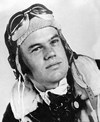
Buddy's father, when he retired, was MG James Earl Rudder, Sr.,
USAR, President of and Commandant of Cadets at Texas A&M University.
He was a decorated WW
II veteran and one of the first Army Rangers. Then-CPT Rudder
went through the very first cycle of Ranger training at Fort Benning,
Georgia, graduated with honors, was promoted to LTC-skipping 'the
Major's corner' entirely-and took a battalion of Ranger hopefuls
through the school. He commanded that battalion when it was sent
to England for training prior to Operation Overlord on 6 June 1944.
To understand what happened, you have to be aware of a man known
as 'The German Zane Grey.' His name was Karl May (pronounce it 'my').
He was a German writer in the late 19th and early 20th centuries,
and he wrote Westerns. Herr May had never been to the United States,
let alone to the American West. That didn't keep him from writing
stories set there. At least at first he didn't really know much
about the subject. In one of his early novels he had a coyote 'winging
its way across the prairie.'
Herr May had a thing about Texas Rangers. Once the Rangers showed
up in a May novel, it was time to bring out the shovels, because
a whole bunch of bad guys were going to need graves very shortly.
According to Herr May, one Ranger was a match for a platoon of badmen,
two could handle a company, and three could take on a regiment without
breaking sweat.
Karl May's novels were, to several generations of German children-and
still are, to some extent-what Zane Grey's and Clarence E. Mulford's
novels were to several generations of American kids. Everybody read
Karl May novels. Even Adolf Hitler, in his youth, was a Karl May
fan, devouring his 'Old Shatterhand' mountain-man novels voraciously.
In fact, after becoming Chancellor of Germany in 1933, Hitler quietly
purchased about 40,000 acres in western Colorado, where the Old
Shatterhand novels are set.
The
US Army Rangers, including LTC Rudder's battalion, were assigned
the toughest job on D-Day. They were to scale the cliffs facing
Omaha Beach and silence the resistance at the top. The tops of those
cliffs were heavily fortified, with dug-in machinegun nests, heavy
artillery in reinforced-concrete bunkers, and pillboxes for infantry
to fight from. The Rangers were light infantry, equipped with M-1
Garand rifles, M-1 carbines, Thompson submachineguns, and pistols.
Their task of climbing the cliffs with ropes and scaling ladders
under fire pretty much mitigated against carrying anything heavier-like
the best light machinegun of the war, the Browning Automatic Rifle
or BAR, which weighed over 20 lbs. Carrying a 10 lb Tommygun was
about as heavy a piece as a man could manage on a rope ladder. At
least one sixshooter, a Colt New Service model 1917, in .45 ACP
caliber, went up the cliffs. It was in LTC Rudder's shoulder holster.
Resistance, at first, was murderous. It continued to be heavy as
the Rangers reached the base of the cliffs. However, as Rudder's
men went up the cliffs, resistance faded. By the time his men reached
the top they found the bunkers and pillboxes deserted.
Being good Rangers they didn't stop to scratch their heads and wonder
where the Germans went. They fanned out to the sides and attacked
the other positions from the flanks, disrupting organized resistance
at the clifftop and assisting other Ranger battalions in taking
the objective.
It was several weeks before LTC Rudder found out what happened to
the troops facing his men. A wehrmacht feldwebel-a sort of 'first
corporal'-who had been in the unit facing Rudder's men was captured.
It seems that the Abwehr, the German intelligence service, was very
efficient. Perhaps a little too efficient. It identified the unit
as a battalion of Rangers. It also identified their commander-LTC
James Earl Rudder. It also identified his home. He was from Texas!
Every German there grew up on Karl May novels. They added it up:
Battalion of Rangers + commander from Texas = Battalion of Texas
Rangers!
The Germans were brave men, but they weren't foolish. They knew
from Karl May what they were facing. They executed a strategic withdrawal
rather than face the men May painted as the most ferocious fighters
on the face of the earth, men who took no prisoners and gave no
quarter. And that's how the Texas Rangers helped win WW
II.
© C.
F. Eckhardt
"Charley Eckhardt's Texas"
September
6, 2006 column
|
 HOME
HOME