|
| In
May of 1856, at Powderhorn, Texas, the US Army's most successful experiment
in overland transportation before the development of four-wheel-drive
vehicles powered by internal combustion engines began. By the end
of May, 1866, the experiment was dead. |
The
idea of using camels as overland transport in the deserts of the American
Southwest was the brainchild of then US Secretary of War Jefferson
Finis Davis. Horses and mules, the Army's only transportation at the
time, had to be fed on corn or grain to stay alive and functioning,
and had to have water on a daily basis. Neither was readily available
in the vast reaches of the Southwest. Camels, however, were desert
animals. They could survive, even prosper, on desert vegetation. Though
they required tremendous amounts of water when they drank, they could
go days without drinking, hence they could cross the vast distances
between water supplies in the desert without dying of thirst. As beasts
of burden, they could carry far more than the 300 lbs that was considered
a 'mule load.' They were simply ideal for the purpose-making regular
routes across the desert Southwest an actuality rather than a remote
possibility.
Jefferson Davis realized this in 1855 and sent a delegation from the
US Army to the Middle East to observe and report on the feasibility
of using camels in the American deserts. The officers reported seeing
camels being used in every environment from the Sahara to the Alps,
carrying loads that would crush even the biggest mules, and making
trips between waterholes in deserts that would leave horses and mules
dead of thirst. Camels were ideally suited, they reported, for the
American Southwest. Davis authorized the purchase of some 30 camels
and their transport to the United States.
A problem arose. Camels needed handlers, and none of the officers
or men of the delegation were competent to handle camels. Camels can
make even the most stubborn of Missouri mules seem submissive, if
improperly handled. As a result, a number of camel-handlers were employed.
They included Christian Syrians and Lebanese, as well as Muslim Arabs.
One of the former, a man whose surname was Calease or Kalease, eventually
married in Mexico. His son, Plutarco Elias Calles, served as President
of Mexico in the 1920s. Another, a Muslim Arab, remained in Arizona,
where he is remembered as 'Hi Jolly' (Haj Ali) one of the most beloved
characters in early Arizona Territory history.
While at sea between the Middle East and Powderhorn, Texas, one of
the female camels- they are known as 'cows'-gave birth, so the expedition
landed with one more camel than it left with. Immediately upon landing,
a discovery was made. Camels frightened horses. This was considered
a mixed blessing. While US horses and mules would have to be trained
to accept camels-which might take some time-Indian horses would certainly
shy away from these strange, ungainly-looking beasts, making camel
caravans across hostile territory far safer than wagon trains.
The
US Camel Corps was established at Camp
Verde, Texas, in the hill country north of San Antonio. Buildings
were constructed, one of which-the camp's headquarters building-still
stands. The chimney is marked 'Pisé Work, 1856.' (This is not a misspelling
of 'piece work.' Pisé is the French word for adobe.)
Almost immediately tests began to find the animals' capabilities and
limits. Of capabilities they had many, but they seemed to have no
limits. They were observed eating-and apparently relishing-the foliage
of Texas mountain cedar. No other animal would touch it. On one notable
occasion, the camels made a freight haul from the supply depot in
San Antonio to Camp
Verde in a driving rainstorm that would have halted wagon freight
operations for days, until the ground dried enough for wagons to move
without bogging down in the mud.
Eventually a long overland trek was organized, from Camp
Verde to California. The camels not only carried freight and supplies
for the troops, they carried corn and grain for the horses as well.
The camels ate-and apparently relished-the foliage of the creosote
bush, also known as 'greasewood.' Nothing else would eat greasewood
leaves. While in California the camels were used to rescue a snowbound
wagon train high in the Sierras.
Time,
unfortunately-in the persona of American politics-caught up with the
camels. In 1861 the Southern states seceded and Jefferson Davis was
elected President of the Confederacy. The camels, based in Texas,
were in the possession of Davis' government, but there was little
use the Confederacy could make of them. Once the Confederacy surrendered,
anything with Jeff Davis' stamp on it was anathema to the Union. The
Camel Corps was a Davis idea. Therefore it cannot have been good.
Of course, a purely West Point-trained officer corps in the Army and
the US Cavalry Corps were also Davis' ideas, and they weren't dispensed
with. However, the Camel Corps was a distinctly visible Davis innovation
that could be disposed of with some publicity.
The camels were sold at auction. An Austin attorney bought at least
one, which he used for transport between Austin
and San Antonio. He
took his breakfast at Austin's Driskill Hotel, mounted his camel,
and arrived in San Antonio
in time for opening of court at 9 AM-some 70 miles to the south.
Many
fictions were concocted to justify the dismantling of the Camel Corps.
One was that the rocky desert of the American Southwest cut the feet
of the camels so badly that it rendered them useless. None of them
were true. The camels were, without question, ideally suited for the
purpose for which they were imported. Only the fact that the man who
decided to organize the US Camel Corps later became the President
of the Confederate States of America rendered them unpalatable to
the post-War Between the States US Army. Politics, not unsuitability,
killed the Camel Corps.
As a sidenote, some of the camels were simply released to wander in
the deserts. In the mid-1870s one wandered into Fort Selden, New Mexico
Territory. The young son of the post commander saw it and ran, terrified,
to hide behind his mother. The post commandant was COL Arthur MacArthur.
The terrified child grew up to be General of the Army Douglas MacArthur.
|
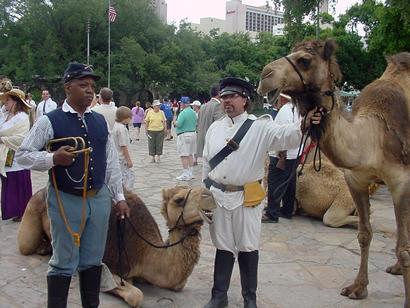 |
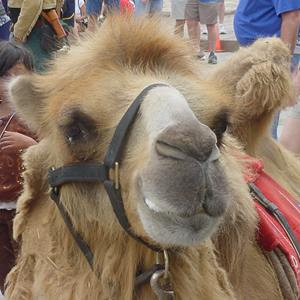
| Reenactors pose
with camels in front of the Alamo
celebrating the sesquicentennial of their arrival in Texas
|
|
|
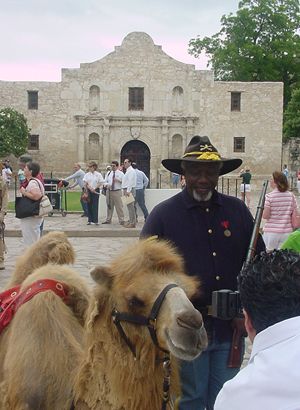
Buffalo
Soldier Reenactor. |
| |
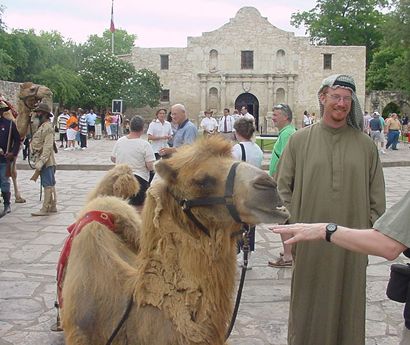
Doug Baum of
the Texas Camel Corps with friend.
TE photos, 2006 |
|
|
 HOME
HOME