|
|
|
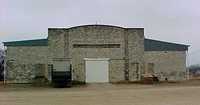
Proctor
Community Center
Photo Courtesy Jim and Lou Kinsey |
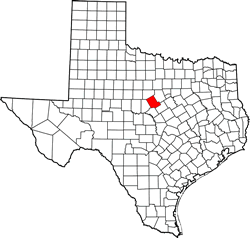
Proctor, Texas
History
From the Handbook
of Texas Online:
Thomas O. Moore established it in 1872 when he came west for his health.
He decided to open a store, bought a small tract of land, and returned
to Galveston
to move his family. He found them all ill and realized there would
be a delay in moving. Moore formed a partnership with his friend Alexander
Watson Proctor, after whom the town was named, and sent him ahead
to start the mercantile building. Moore purchased a stock of merchandise,
sent it to Waco by rail,
and freighted it by wagon to the place soon known locally as Mooresville.
The family occupied three rooms built for them on the back of the
store. A building erected in 1876 near Moore's store was used as a
community center and school. It was probably the source of the often
published claim that A. W. Proctor donated land for a school campus.
Deed records do not show a property for a school. A post office was
established in 1874 but discontinued in 1881. The community was moved
in the early 1890s, when the route of the Fort Worth and Rio Grande
Railroad missed the old town by a mile. The old Proctor subsequently
disappeared when Alex Chisholm bought the site to use as ranchland.
The point where the railroad stopped was at first called Camden
and later renamed Proctor. A new townsite with some thirty-eight
blocks was surveyed there, and the sale of lots began in 1891, one
year after the Proctor post office reopened. Proctor became a shipping
center and was even at one time considered for the county seat. By
1915 the town had its own bank, a population of 300, two drugstores,
three mercantile stores, two gins, four grocery stores, two barbershops,
a lumberyard, a livery stable, a hotel, two blacksmith shops, three
doctor's offices, three lodges, and a newspaper. Although it was consolidated
with the Comanche schools after World
War II, the Proctor school once served over 400 students and occupied
an imposing two-story building. Proctor began to decline around 1930,
after U.S. 377 was paved and the route passed north of town.
After the boll
weevil wiped out cotton
as an important crop around Proctor, peanut cultivation and dairying
became important in agriculture. Proctor Reservoir, a federal flood-control
lake, was impounded by a dam finished in 1963 on the Leon River. It
provides water for nearby towns and for irrigation and serves as a
recreation area. Stores for sportsmen, campers, and travelers have
sprung up nearby. The Methodist and Baptist churches continued to
function in the 1980s. The community reunion and meeting of the strong
cemetery association were still held in June. From the mid-1970s through
1990 the population was 220. A historical marker at the site of the
old town well on U.S. highway 377 honors Mary Evelyn Moore Davis,
a Texas author and sister of Proctor's first postmaster, T. O. Moore;
she often enjoyed visiting the family at Proctor.
BIBLIOGRAPHY: Comanche County Bicentennial Committee,
Patchwork of Memories: Historical Sketches of Comanche County,
Texas (Brownwood, Texas: Banner Printing, 1976). Kathleen E.
and Clifton R. St. Clair, eds., Little Towns of Texas (Jacksonville,
Texas: Jayroe Graphic Arts, 1982).
- Margaret Tate Waring |
|
|
The gym in Proctor
Photo Courtesy Jim and Lou Kinsey
|
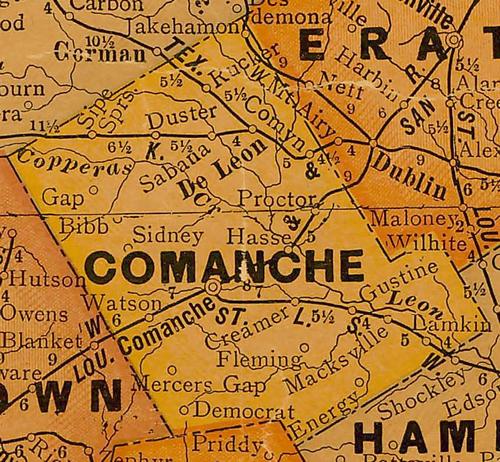
Comanche
County 1920s map showing Proctor
(NE of Comanche)
From Texas state map #10749
Courtesy
Texas General Land Office |
| Texas
Escapes, in its purpose to preserve historic, endangered and vanishing
Texas, asks that anyone wishing to share their local history, stories,
landmarks and recent or vintage photos, please contact
us. |
|
|
 HOME
HOME