|
|
THE
GROVE
People
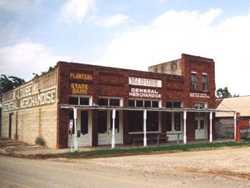
who drop by Dube's General Store here expecting to see a ghost town
might leave disappointed. But if proprietor Moody Anderson is there,
the visitor won't leave uninformed.
Anderson is the owner of the store, which he bought lock, stock and
cracker barrel in 1972. Then he stocked it with everything from candles
to coffins. The only place you are likely to find more one-of-a-kind
antiques is at his private warehouse west of Austin.
|
Writer
T. Lindsay Baker included The
Grove in a book he wrote on "Ghost Towns of Texas." Anderson tried
to dissuade him of the notion. "I told him that his idea of a ghost
town and my idea of a ghost town must be about 180 degrees different,"
Anderson says. "A ghost town is abandoned. Nobody ever goes there.
That's not the case here."
Indeed, The Grove
is the scene of a lot of pickin' and grinnin' especially on Jamboree
night the third Saturday of each month. Once a year, when The
Grove celebrates itself with The Grove Homecoming the town swells
to many times its normal size. This year's celebration begins October
8 and continues the next two days; Saturday the ninth is the big day,
when a parade kicks off the celebration.
Residents - real ghost towns don't have residents - marvel that the
76-year old Anderson conducts all the business on Jamboree night himself,
including the lifting and toting. He stays until people are ready
to go home, then puts up the chairs and closes up. More often than
not, he sleeps upstairs in a restored turn-of-the-century doctor's
office.
Anderson started his extensive and unique antique collection about
fifty years ago with some antique blacksmith tools.
Today a partial inventory reveals cigars, Arbuckle's coffee, cholera
tablets, chill tonics, cough syrups, collars and hairnets, pots, pans,
singletrees, tethers, tobacco powder and grits and groceries of every
description, all of it dating back to 19th or very early 20th century.
Anderson's collection has provided movie companies with an almost
endless supply of props, especially for projects with a historical
setting like "Lonesome Dove" and "The Newton Boys."
Cary White, a production designer for the movie "American Outlaws,"
said in a 2000 Austin Chronicle interview that he has been working
with Anderson since 1988, when Anderson opened a little shop on South
Congress called The Texas Trader. "Moody's a wonderful guy, and because
of him it's been possible to make movies in this town," White said.
"I credit Moody with a lot of the success the film business has had
in this town."
Anderson likes working with the movie companies but said he much prefers
the laid-back and down home atmosphere of The
Grove to Hollywood.
The
Grove, named for its large stand of live oak trees, sits just off
Highway 36 on the fertile, flinty edge of the Leon River Valley.
Anderson notes that the town's first well was dug with a pick and
crowbar by Jim Whitmore in 1872. Anderson says the first 12 feet consisted
of almost solid rock, but at 28 feet Whitmore hit a source of water
that has never run dry, not even during the most severe droughts.
The town soon grew to more than 400 people and had three cotton gins
and a slew of stores.
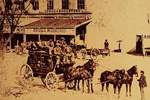
"I've got pictures of the cotton wagons lined up from Wolfe's gin
all the way down this road," Anderson says.
In 1936, the Texas Highway Department (now the Texas Department of
Transportation) told the people in The
Grove that they would have to cover the well if they wanted Highway
36 to run through town.
People in The Grove
refused to cap the well, which still provides water today. That's
why The Grove sits
a little way off the main highway.
The town held on, but was hit with a double whammy. First, Fort Hood
took about 250,000 acres from area farmers and ranchers. Then 50,000
more acres disappeared under the waters of Lake Belton. Still, the
town has survived. In addition to about forty residents, the community
has a post office, bank, ice house and meat locker, all circa 1900.
The upstairs doctor's office is dedicated to J.J. Mitchell, the town's
first doctor. Other buildings include Holcomb's blacksmith shop and
the Cocklebur Saloon.
For a few years now, Anderson has talked about hanging it up. But
so far all he has done is talk.
"I can see selling it in a few years, but I want to sell it to somebody
who will keep it going," he said. "I'd hate to see all this auctioned
off a piece at a time."
© Clay Coppedge
April 1, 2005 column
More
"Letters from Central Texas"
|
|
|