|
|
There
is a day in Texas
history that quite possibly could be considered one of the most
tragic. On that day, March 27, 1836, General Santa Anna ordered the
execution of some 380 Texas army soldiers - they were prisoners of
war. The men were part of the command of Col. James W. Fannin, Jr.
and they had surrendered to the Mexican army on March 20, 1836, at
the battle of Coleto Creek. Fannin had received assurances from the
Mexican field commander, Gen. Jose Urrea, that the Texans would eventually
be paroled and sent to New Orleans. Although Urrea probably had good
intentions, Santa Anna over-ruled him and commanded that the prisoners
be slaughtered.
A young German by the name of Hermann
Ehrenberg was in the Texas army and was one of the few that escaped
the Goliad
massacre. Ehrenberg wrote about his experiences in the Texas Revolution;
selected passages from his work, "A Campaign in Texas" appeared in
The Gonzales Inquirer in 1853.
Ehrenberg was an eyewitness and participant in this historic event
- he wrote about it 17 years later. I'm of the opinion that his memory
was still very clear and I'd be inclined to believe his description
of what really took place on that terrible day.
Following are excerpts of Ehrenberg's article as he tells of his experience
on that tragic Palm Sunday in 1836. (Note: The spelling and grammar
is that of the author, nothing has been changed in the article). |
|
|
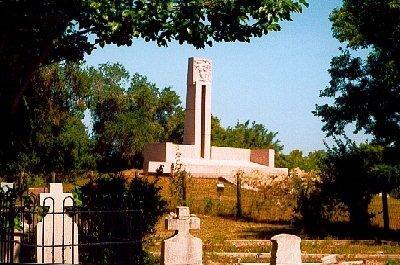
Mass
Grave of Fannin and his men, view through an adjoining cemetery
TE photo |
A Survivor's
Account of the Goliad Massacre
The Gonzales Inquirer
- December 3, 1853
By Hermann Ehrenberg |
After
the names had been called, the order to march was given, and we filed
out through the gates of the fortress, the Greys [New Orleans Greys,
a volunteer unit from Louisiana] taking the lead. Outside the gate
we were received by two detachments of Mexican infantry, who marched
along on either side of us, in the same order as ourselves. We were
400 in number, and the enemy about 700, not including the cavalry,
of which numerous small groups were scattered about the prairie.
We marched in silence, not, however, in the direction we had anticipated,
but along the road to Victoria.
This surprised us but, upon reflection, we concluded that they were
conducting us to some eastern port, thence to be shipped to New Orleans,
which, upon the whole, was perhaps the best and shortest plan.
There was something, however, in the profound silence of the Mexican
soldiers, who are usually unceasing chatters, that inspired me with
a feeling of uneasiness and anxiety. It was like a funeral march,
and truly might it be so called. Presently I turned my head to see
if Miller's people had joined, and were marching with us. But to my
extreme astonishment, neither they nor Fannin's men or the battalion,
were to be seen. |
|
|
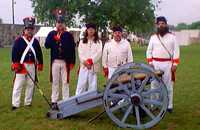
Mexican
soldier reenactors at Goliad
Photo
courtesy Jerry Tubbs |
They
had separated from us without our observing it, and the detachment
with which I was marching consisted only of the Greys and a few Texan
colonists. Glancing at the escort, their full dress uniform, and the
absence of all baggage, now for the first time struck me. I thought
of the bloody scenes that had occurred at Tampico, San
Patricio, and the Alamo,
of the false and cruel character of those in whose power we were,
and I was seized with a presentiment of evil.
A quarter of an hour had elapsed since our departure from the fort,
when suddenly the command was given in Spanish to wheel to the left,
leaving the road: and as we did not understand the order, the officer
himself went in front to show the way, and my companions followed
without taking any particular notice of the change of direction.
We were marched along the side of the hedge towards the stream, and
suddenly the thought flashed across us, "Why are they taking us in
this direction?" The appearance of a number of lancers, cantering
about in the fields on our right, also startled us; and just as the
foot soldiers who had been marching between us and the hedge, changed
their places, and joined those of their comrades, who guarded us on
the other hand.
Before we could divine the reason of this maneuver the word was soon
given to halt. It came like a sentence of death; for at the same moment
it was uttered, the sound of a volley of musketry echoed across the
prairie. We then thought of our comrades and our probable fate.
"Kneel down!" Now burst in harsh accents from the lips of the Mexican
commander. No one stirred. Few of us understood the order, and those
who did would not obey. The Mexican soldiers, who stood at about three
paces from us, leveled their muskets at our breasts. Even then we
could hardly believe that they meant to shoot us; for if we had, we
should assuredly have rushed forward in our desperation, and, weaponless
though we were, some of our murders would have met their death at
our hands.
The sound of a second volley, from a different direction then the
first just then reached our ears, and was followed by a confused cry,
as if those at whom it had been aimed, had not all been immediately
killed. A thick cloud of smoke was wreathing and curling towards the
San Antonio River.
The blood of our lieutenant was on my clothes, and around me lay my
friends convulsed with their last agony. I saw nothing more. Unhurt
myself, I sprang up and, concealed by the thick smoke, fled along
the hedge in the direction of the river, the noise of the water for
my guide.
On I went, the river rolled at my feet, the shouting and yelling behind.
"Texas forever!" And without a moment's hesitation, I plunged into
the water. The bullets whistled round me as I swam slowly and wearily
to the other side, but none wounded me.
Whilst these horrible scenes were occurring on the prairies, Col.
Fannin and his wounded companions were shot and bayoneted at Goliad,
only Dr. Shackleford and a few hospital aids having their lives spared,
in order that they might attend the wounded Mexicans.
Lone Star Diary
March, 2001 Column
Published with permission. |
Massacre
at Goliad: A Texas Tragedy by Jeffery Robenalt
The massacre at Goliad branded Santa Anna as an inhuman despot and
the Mexican people, whether deserved or not, with a reputation for
cruelty. As a result of the needless slaughter, a burning desire
for revenge arose among the people of Texas, and Americans became
firmly united behind the Texas cause of independence.
The
Life and Times of a Goliad Survivor by Murray Montgomery
The story of Hermann Ehrenberg
A
Soldier's Story by Bob Bowman (From "All Things Historical")
Milton Irish, one of only 28 survivors of the massacre.
Thomas
Deye Owings of Maryland, Kentucky and Texas by W. T. Block Jr.
"He was a colonel and hero of the War of 1812 [and] was Kentucky's
original industrialist and iron master, also holding several political
offices. He was also commissioned by Stephen F. Austin in Jan. 1836
to raise 2 regiments of Kentuckians to fight for Texas Independence
from Mexico, sacrificing as a result the life of one of his sons
during the Goliad Massacre..."
Goliad,
Texas
|
|
|
 HOME
HOME