|
 |
This
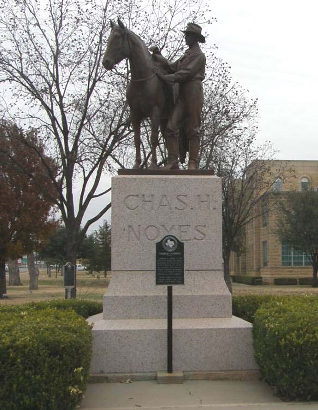
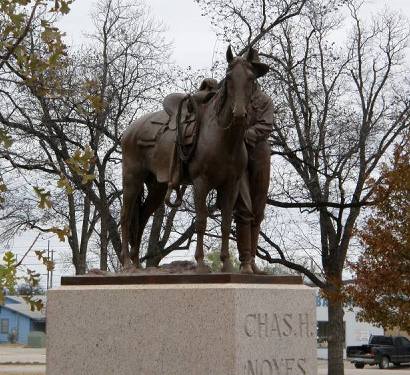
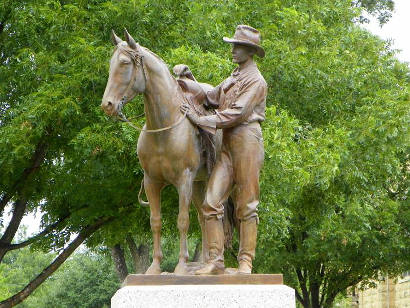
handsome and arresting statue stands out even to the most unobservant
casual tourist. It's prominent location at the intersection of Hwys
83 and 67 make it hard to miss.
It was erected where the subject of the statue had attended school
just a few years before his life ended in a freak ranching accident.
The only son of a local rancher, Charles H. Noyes was a cowboy
with the emphasis on boy. His neck was broken when a calf he was roping
collided with his horse and caused both horse and rider to fall. He
was taken to the hospital at Brady
where he died. Originally, the statue was to be erected where he had
fallen.
Waldine Tauch, of Flatonia,
Texas had moved to nearby Brady
as a girl. Her talent for sculpting chalk (and butter) led the Tuesday
Study Club of Brady to raise the money necessary for her to study
under Pompeo
Coppini, who was then living in San
Antonio.
She was first offered the Noyes commission, but instead referred it
to her mentor, Coppini,
who was then experiencing a period of slow cash flow.
Coppini
suggested that the boy who had stood at six-four should be dismounted.
This follows traditional rules of equestrian statuary and also fits
in with other funereal motifs symbolic of a life cut short.
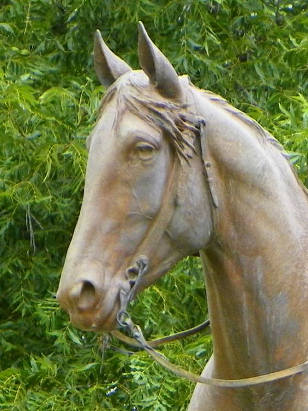
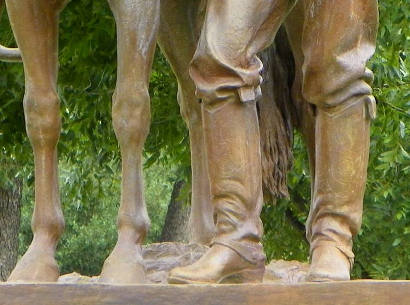
The boy's actual bridle, saddle and boots were sent to Chicago to
help the sculptor work. |
 |
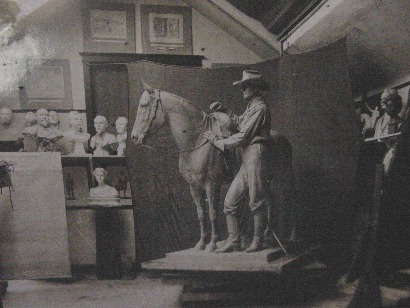
The statue in
Coppini's
Chicago studio
Photo courtesy Texas Collection, Baylor University |
The
clay statue was nearly complete when one of Chicago's notorious blizzards
blew into town. Coppini
lived several miles from his studio and he trudged for two hours to
get to the unheated studio. The clay had frozen and as the room warmed,
horse and rider fell into a pile of gray flour.
Since the boy had been photographed only three times in his life,
and the prints were of poor quality, Mr. and Mrs. Noyes came to Chicago
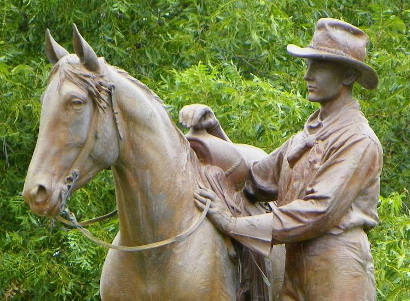
when it was time to sculpt the face. After a few adjustments on the
cheekbones and jaw, Mr. Noyes said to Coppini,
"Please do not touch his face again, for that is our Charlie."
The mold was made a second time and the statue was cast. The three-ton
base was made ready. Coppini
returned to Ballinger
for the unveiling, however Mr. and Mrs. Noyes felt they could not
bear to see their boy again. They had since sold the ranch and moved
to Florida.
|
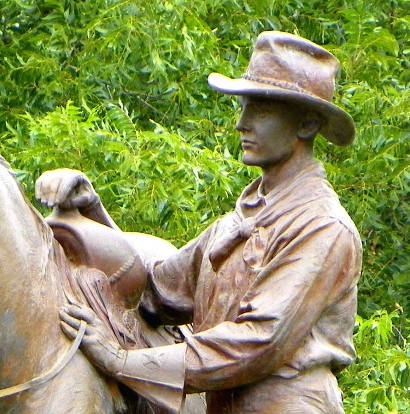
"Please do not
touch his face again, for that is our Charlie."
Photo courtesy Barclay
Gibson, September 2010 |
"Pompeo
Coppini of Chicago studied horses two years before sculpturing statue."
Photo courtesy Barclay
Gibson, September 2010 |
| The boy's bridle,
saddle and boots were sent to Chicago to help the sculptor work.Photo
courtesy Barclay
Gibson, September 2010 |
Some comic
relief to a sad story:
Coppini
traveled to Menard
County by train from his Chicago studio to meet Mr. Noyes and
discuss the statue. (The Noyes ranch was nearer to the Melvin, Texas
depot). Coppini stayed in the dead boy's room.
The ranch was large, but amenities were modest. He had his doubts
about the rancher's ability to pay what was in 1919 a substantial
sum. He was reassured by everyone he met that Mr. Noyes was good for
whatever the cost would be.
He had decided $25,000 was as low as he could go, but when they rode
to the spot where the accident took place, Coppini was deeply touched
when Mr. Noyes nearly collapsed in grief.
Later that night, when the subject came up, Mr. Noyes asked the cost.
Coppini,
speaking through his heart, said he could do it for $18,000.
Without hesitation, Mr. Noyes said yes and shook hands. He added that
he had been prepared to pay twice that amount. |
On
courthouse grounds, US 83 and US 67
Photo courtesy Barclay
Gibson, December 2009 |
Historical
Marker:
Charles H.
Noyes
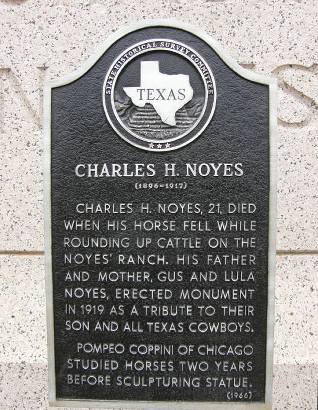
Charles H. Noyes,
21, died when his horse fell while rounding up cattle on the Noyes'
Ranch. His father and mother, Gus and Lula Noyes, erected monument
in 1919 as a tribute to their son and all Texas cowboys.
Pompeo Coppini
of Chicago studied horses two years before sculpturing statue. |
Charles
H. Noyes Historical Marker
Photo courtesy Barclay
Gibson, December 2009 |
©
John Troesser
Source:
People and Places in the Texas Past by June Rayfield Welch, G.L.A.
Press, Dallas, 1974 |
| Texas
Escapes, in its purpose to preserve historic, endangered and vanishing
Texas, asks that anyone wishing to share their local history, stories,
landmarks and recent or vintage photos, please contact
us. |
|
|
 HOME
HOME