|
| While you
might not be familiar with the name Adrián J. Vidal, you might recognize
the name of his stepfather - Mifflin Kenedy. Kenedy was, of course,
the partner and lifelong friend of Richard King. These two made large
fortunes in shipping and warehousing along the Rio Grande and then
wisely invested their money in land. Lots of land (under starry skies
above). |
|
|
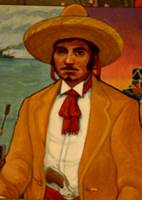
Adrián
J. Vidal
by Muralist Daniel Lechon
Photo
Courtesy Kenedy Heritage Museum, Sarita |
Adrian
was born in Monterrey, Nuevo León, Mexico in 1840. His biological
father was a Col. Luis Vidal. After the Colonel's death, Adrian's
mother Petra (Vela) moved to tiny Mier - a village on the Mexican
side of the Rio Grande. Mier is remembered primarily for being the
pivotal site of the misguided Sommervell
or Mier Expedition of the late 1840s.
One day (or night) in Mier, The widow Petra caught the eye of Mifflin
Kenedy who had come there on business. The business engagement turned
into a wedding engagement and Mifflin and Petra were married in 1852
in Brownsville.
Little Adrian was then at the volatile age of twelve. He had four
siblings.
Adrian immediately and predictably fell in with bad company. Despite
(or because of) his age he wasted no time establishing a reputation
on both sides of the river for drinking, whoring and gambling - not
necessarily in that order.
At
the age of twenty-one, the Civil War gave him the opportunity to drink,
gamble and go whoring in distant places. He traveled to San
Antonio and enlisted as a private. The Confederate "Brass" recognized
his invaluable knowledge of the border so they promptly sent him back
home as a Lieutenant of a company of militia. His primary mission
was to guard the mouth of the Rio Grande.
After capturing a Union gunboat, Vidal (since promoted to Captain)
was guaranteed a bright military future - that is, if the South won.
But still under the influence of adolescence, Vidal let his frustrations
get the better of him. Insufficient supplies, nagging military obligations,
and arguments with superiors kept Adrian in a foul mood. Finally one
order or another became the last straw and Captain Vidal and his command
mutinied in early 1863.
When General Hamilton Bee sent two soldiers to recall Vidal, Adrian
raised the stakes by shooting them. One man was killed while the other
rode back to Bee to tell the tale. The dead man happened to be the
son of the Texas Adjutant General - which raised the stakes yet another
notch. Now, seriously wanted, Vidal went for broke and turned bandit,
raiding ranches, hanging a few people and taking sanctuary in Mexico.
Vidal and his men soon grew bored so they decided to give the military
another try. By this time the area was under Union occupation. It
didn't matter a whit to the Vidalistas. They enlisted as "Vidal's
Independent Partisan Rangers" and patrolled the Nueces Strip as scouts.
But Adrian soon found out that the Union commanders were just as demanding
as Confederates. Both sides liked to receive reports every now and
then. In 1864, Vidal felt the same old frustrations coming to a head.
Although he had submitted his resignation, he didn't have the patience
to wait for an answer. He and his men crossed into Mexico
to join Benito Juarez' rebellion against the foreign-born Emperor
Maximillian.
Vidal's commanding officer here was another famous border personality
- General Cortina. Adrian never grasped the concept of a "good" reputation.
In his new command he instituted a "take no prisoners" policy. When
he was later captured at the village of Camargo by Imperial troops
- his latest bad reputation was firmly held against him.
Mifflin
Kenedy learned of his stepson's capture and quickly went to negotiate
a ransom. But his captors knew Vidal and although a ransom was tempting,
they didn't look forward to fighting him again - whatever uniform
he might be wearing. They formed a firing squad and Mifflin Kenedy
arrived in time to take Adrian's corpse back to Brownsville.
The Kenedy family became famous for raising horses and cattle - but
Adrian's entry in the family history is one of a black sheep. Nevertheless,
he has his own entry in the murals of the new Kenedy Museum in Sarita.
On the south wall of the museum - housed in the former office of the
Kenedy Pasture Company - a striking image of Adrian Vidal appears,
replete with a pistol in his waistband.
Another part of the mural illustrates his death by firing squad.
© John
Troesser
"They
shoe horses, don't they?" March 10
, 2004 |
|
|
 HOME
HOME