|
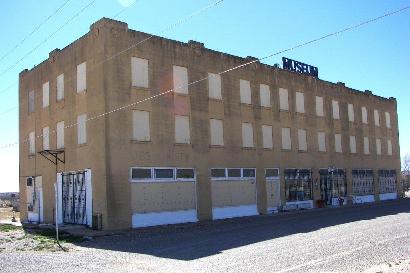
Yates
built the three-story, 46-room sandy brick hotel in 1927 at the
height of the oil boom that exploded on the Pecos
County ranch he had traded a general store for in 1915. In considering
a name for his new hostelry, he modestly thought Yates Hotel had
a nice ring to it.
“He kept an upstairs room,” Mrs. Bell says. “We haven’t identified
which room, but he played a lot of poker in it.”
Billed as the first fire-proof hotel between Fort
Worth and El
Paso, the Yates had a restaurant, drug store and barbershop.
The hotel saw many a hand-shake deal during the boom years and became
a popular stopping place for east-west travelers.
The rooms on the north side had no closets and cost less than the
south-side rooms, which caught a better breeze and had a door between
rooms so they could be used as suites. North or south-side, however,
guests had to walk down the hall to a bathroom.
By today’s standards, a room on either side of the hotel did not
cost all that much. A single school teacher who lived there in the
late 1930s paid $39 a month for a room – meals included.
“There’s a cute story about an old-maid (probably all of 25 to 30
years old) Home Extension agent from Austin
who used to stay at the Yates in the ‘40s,” Mrs. Bell says. “She
always washed her stockings at night and hung them in the bathroom
to dry. One morning she came in and found some man had washed his
socks and hung them right next to her hose. She was scandalized.”
The hotel closed in 1964 and stood vacant for a decade before the
Rankin Museum Association converted it into a museum. Though someone
vandalized the hotel about a year after it went out of business,
the Yates’ original wicker furniture still sits in the lobby with
its restored black and white checkerboard floor.
During
the Yates’ heyday, within an easy walk from the hotel lay one of
the marvels of West Texas:
Rankin Beach. That part of the state had not had any waterfront
access since prehistoric times, but Yates put in a giant concrete
swimming hole, 60 feet wide and 120 feet long. Legend has it that
he even had beach sand trucked in from the Texas
coast, though he could have gotten plenty from the sand dunes
of not-too-distant Ward
County.
People could keep cool in Yates’ pool, enjoy live entertainment
at the adjoining dance pavilion or spin around on a skating rink.
A young accordion player named Lawrence Welk and his orchestra
played at Rankin Beach in 1928-29 as did Louis Armstrong
and Jack Teagarden.
One night during the boom, while her husband toiled away in the
oil patch, his pretty wife sashayed and shimmied on the dance floor
at the nearby Skidmore Plantation with an equally light-footed male
partner.
The evening seemed magic until the woman’s husband showed up and
pulled a pistol from his oil-stained coveralls.
Seeking any port in a storm, the woman and her dancing partner hoofed
it toward the Yates Hotel, the armed husband close behind. When
they entered the hotel’s lobby, the bell hop ducked as the husband
fired several shots at the man he’d caught dancing with his wife.
None of the bullets took effect, and officers soon corralled the
jealous husband, but the flying lead left some ugly pockmarks in
the wall. For some reason, whoever repaired the bullet holes did
not bother to smooth over the one next to the stair way.
So far as is known, that was the only gunplay at the Yates. That
may be why the hotel has a scarcity of ghosts.
Almost
all old hotels come furnished with at least one restless spirit,
but Mrs. Bell says the Yates is no Hotel California. One woman claimed
to have had encounters with a lady apparition she called Gertrude,
but Mrs. Bell says she’s never heard or seen anything unusual at
the Yates other than the old bullet hole.
If anyone’s spirit is lingering at the Yates, by all rights it ought
to be Yates himself. He spent a lot of time in his hotel prior to
his death in 1939 and oil paintings of he and his wife are prominently
displayed in the lobby.
For a fellow who didn’t learn to read until he was 14, Yates obviously
had a good head for business. Folks said he did well at cards, too.
“He insisted that all his children learn to play poker,” Mrs. Bell
says. “He said poker would make them good at business.”
Knowing when to fold ‘em and when to hold ‘em sure paid off for
the old man.
© Mike Cox
- September 11, 2008 column
"Texas Tales"
|
 HOME
HOME