|
|
Thousands
of people die every year in traffic crashes, but the horse and buggy
era had its injurious and fatal accidents as well.
“Runaway scrapes” is what Bosque
County newspaper columnist Thomas Theodore Colwick called them
back in the 1880s. Colwick had a store in the small community of Norse
where he sold perfume, toiletries and patent medicines.
Writing under the pen name of “Ivanhoe,” the Norwegian-born Colwick
contributed a local news column to the weekly Meridian Alliance Sun.
Here’s one account of a “runaway scrape” from the Sept. 26, 1885 edition
of the long-defunct weekly:
“A sad and fatal accident befell Mr. Jorgen Hogensen on last Thursday,
while saddling a pony. The pony ran away, the rope become [sic] entangled
in Hogensen’s left leg, dragging him at a rapid speed for some six
hundred yards, when the horse stopped. Life being then almost extinct,
he breathed his last within a few minutes afterwards.
“Mr. Hogensen lived on Neils Creek, and was quite and [sic] industrious
farmer, a good citizen and neighbor. He was about thirty years old.
He leaves a young wife and two small children to mourn his untimely
demise.”
As is the case today with drinking and driving, the consumption of
alcohol could lead to horse trouble.
“G. Nelson had a runaway scrape lately,” Colwick reported on Oct.
2, 1887, “the result of indulging too freely in liquid Anti-liberty.”
|
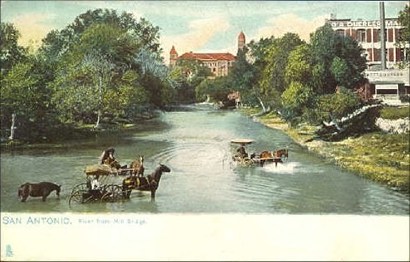 |
River Crossing
in San Antonio
Postcard courtesy www.rootsweb.com/%7Etxpstcrd/ |
A
perusal of digitized back issues of the San Antonio Daily Light and
the rival Express show runaways in the later 19th century were almost
as common as traffic mishaps are today.
Two particularly common headlines were “Thrilling Runaway” and “Exciting
Runaway.”
From the June 1, 1885 Light, an account of a “Thrilling Runaway:” |
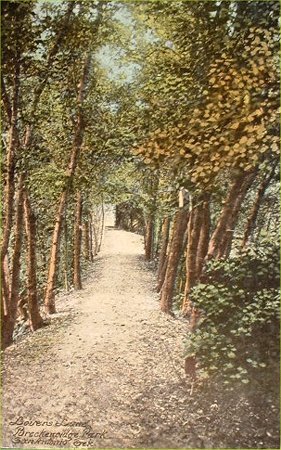
San Antonio Lovers
Lane
1916 Postcard courtesy www.rootsweb.com/%7Etxpstcrd/ |
“Hack No. 2,
driven by Henry Thompson, struck a stump last night as it was turning
into Lover’s Lane, near Feat’s Garden, on south Flores street. The
tongue broke and this frightened the horses and they ran away.”
Five passengers in the hack jumped for their lives, while the driver
was thrown from the conveyance and suffered a leg injury.
A
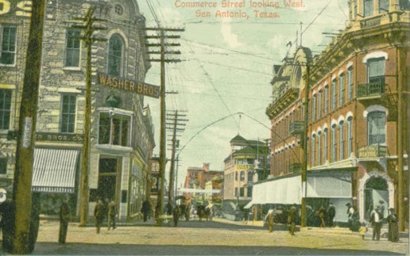
few years later, on Sept. 1, 1891, the unattended team attached to
a produce wagon ran away on Military Plaza. |
San Antonio Commerce
Street looking West
1907 Postcard courtesy www.rootsweb.com/%7Etxpstcrd/ |
|
“The marketplace
was crowed with people and vehicles at the time,” the Light reported
in a page-one story, “and as the runaways started west across the
plaza, things looked squally.”
Fortunately, one of San
Antonio’s finest, identified only as Officer Springer, jumped
onto the wagon, grabbed the reins and got the horses under control
just as the wagon was about to crash into three other vehicles “in
the narrow part of West Commerce street.”
The officer injured a leg in the rescue.
“He certainly deserves the highest praise for his prompt and fearless
act,” the newspaper continued.
The owner of the wagon was arrested for leaving his team unattended,
the 19th century version of leaving your SUV unlocked with the motor
running.
Stealing horses could lead to death by lead poisoning or sudden
onset throat trouble at the end of a rope, but sometimes the perpetrators
got away with it. In this case, the thieves had their own kind of
“runaway scrape.”
“Horse-thieves came from the south into our ‘settlement’ on their
way northward and encamped, having stolen horses and saddles from
parties living on Hog Creek,” Colwick reported on May 16, 1887.
A posse caught up with the thieves and their stolen stock on Meridian
Creek where “refusing arrest, a few shots were exchanged with them,
and they succeeded in getting away in the brush…but two youthful
accessories were captured, two horses and saddles recovered.”
The man-horse relationship also could be dangerous to horses.
The Light reported on January 21, 1890 that a horse “belonging to
Wagner & Chabot was almost instantly killed yesterday afternoon
near…Government Hill, by being impaled on the tongue of the carriage
drawn by a runaway team, belonging to private parties. The horse
was attached to a two-wheeled delivery wagon and was driven by the
firm’s collector. The pole stuck almost through the animal.”
Three years later, the May 2, 1893 edition of the Light ran this
short item:
“Yesterday some rude boys were throwing stones on Milam square and
one of the rocks struck a horse on a front limb, breaking the leg.
Mounted Officer Coy was sent for and as soon as he arrived, an order
was given to kill the horse, which he did. An endeavor was made
to find the boys but the officer did not succeed.”
© Mike Cox
"Texas Tales" July
9, 2009 column
|
|
|
 HOME
HOME