|
|
|
One
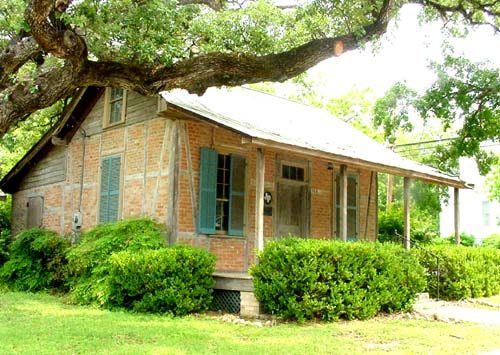
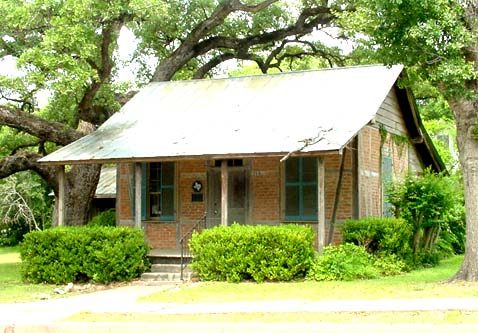
of Texas’ early libraries was opened in a small fachwerk cottage
that had been built in 1852 as a residence. Shaded by one of the
area’s huge Live Oak trees – it remains in use today - to hold art
meetings. Fachwerk buildings were once common in areas with healthy
German populations, but as times changed – the style was abandoned.
Originally it
was the home of Judge John C. Stiehl and family. Stiehl was the
first German-born Fayette
County Judge. As the initial Anglo settlers sold off their land
to the newly-arrived Germans, the vacancies in public office were
filled by men elected by the people they represented.
|
La Grange First
Library Building
AKA Judge Stiehl House
TE photo, June 2004 |
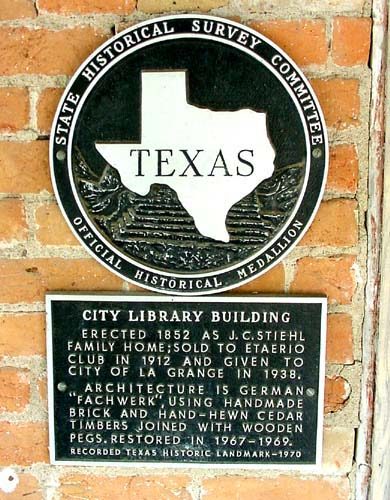
La Grange City
Library Building Historical Marker
TE photo, June 2004 |
When
the judge moved into housing more in tune with his office, he sold
his house to the literary society for $700. The library was organized
in 1888 and in 1902 it was officially “born.” The library’s very first
volume was Robert Louis Stevenson’s St. Ives (one of his lesser-known
efforts). The book's donor was mentioned only as “a doctor’s wife.”
The “Etaerio” Club formed in 1912. The Latin name means “companionship”
The society took their motto from Shakespeare’s Love’s Labor Lost:
“Learning is but an adjunct to ourselves, and where we are learning
is likewise.”
Despite their catchy motto, the Etaerio Club disbanded in 1938 but
not before they had assembled 1,500 volumes. The first librarian was
Miss Norma Willrich followed by Miss Minnie Crum and then Miss Agnes
Robson. |
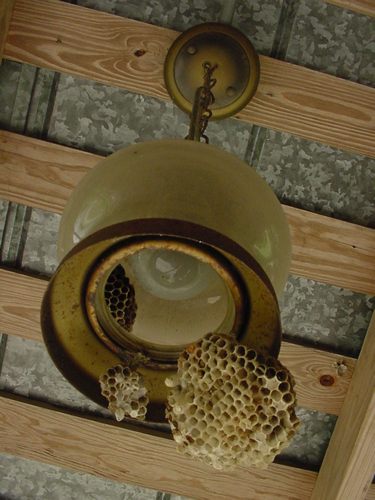
The globe of
the porch light attracts wasps each year.
TE photo,
June 2004 |
| The
structure – an excellent example of what the neighborhoods must’ve
looked like in the mid 1800s - got the attention of preservationists
and the house was rebuilt in the late 1960s. The bricks were cleaned
and all exterior boards replaced with weather-resistant redwood. |
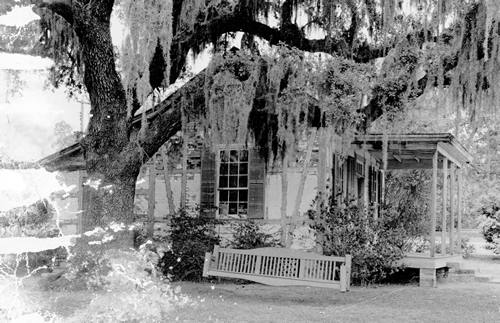
Another view
of the first library building in La
Grange
TE photo, June 2004 |
|
|
 HOME
HOME