|
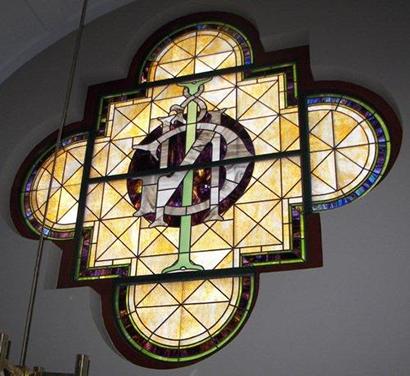
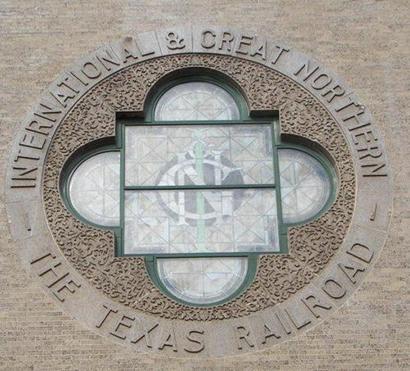
The interior
of the south side stained glass window with the I&GN logo. On a sunny
afternoon, the logo is reflected on the inner walls of the building.
Terry
Jeanson, September, 2008 photo |
October 12, 2011
Update
Subject: Update on San Antonio's Historic I&GN/MoPac
Depot
I have some interesting news regarding the former International and
Great Northern Depot in
San Antonio.
Apparently, the property has been acquired by VIA transit, and will
be the site of a large transit center, consisting of an AMTRAK/ Commuter
station (historic depot building), bus, rapid bus, light rail and
streetcar. This is essentially bringing the station back to being
used as a rail station!
The neighborhood the station is in was known historically as Cattleman's
Square, due to it's proximity to the former Union Stockyards. Few
people in San
Antonio know that information,
because the area has been largely ignored and has become dilapidated.
The whole area will be revitalized over the next decade due to the
station being brought back to life. This is a link to the publicly
available executing summary presentation. Looks promising! http://www.viainfo.net/Shared/ViewAttachment.aspx?AttachmentId=1550
As always, I love the site. Keep up the great work!
- Sam Iacullo, San Antonio |
| Over
the years, I have heard stories that my mother told me about the times
when she worked as a secretary at the Scobey's warehouse on the west
side of San Antonio next to what is
now the Union Pacific Railroad. She worked there during the
1950s and by then, the old International and Great Northern (or
I&GN) Depot, later known as the Missouri Pacific Depot (or
MoPac,) which is just south of the Scobey's warehouse, was no
longer bustling with passenger activity as it had once been. Being
a bit west of downtown and not having many options for lunch, my mother
took advantage of the former lunch counter in the old depot on many
occasions. Her memories of these times inspired me to explore the
old depot which has been a part of San
Antonio history for over 100 years. |
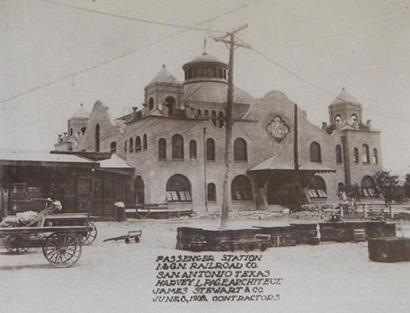
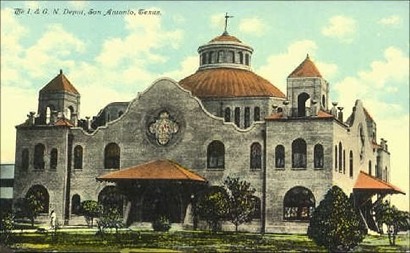
"This photo
showing the depot shortly after it was built is hanging in one of
the upstairs offices."
- Terry
Jeanson, September, 2008 |
| After
the arrival of the I&GN Railroad in 1881, San
Antonio became an important crossroads for train
travel across the state and the railroad
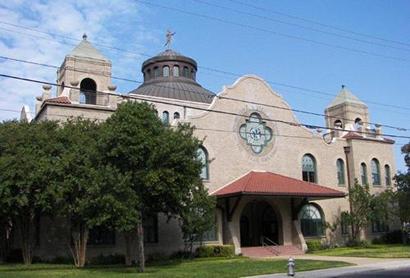
soon outgrew their first depot. Constructed in a grand fashion in
1907 and completed in 1908, the new depot was built at the intersection
of Houston and Medina streets in an area historically known
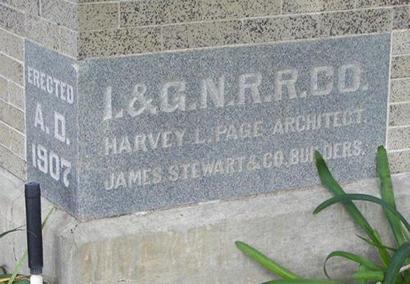
as the Cattlemen's Square. The architect, Harvey L. Page,
whose main office was on Medina Street, was greatly influenced by
the architecture of San Antonio's
Spanish missions, in particular the San José Mission. The stained
glass windows on the north, south and east sides are representative
of San José's "Rose Window" with the I&GN logo inside them. Page referred
to this building as his "Taj Mahal." The building's copper dome rises
eighty-eight feet from the ground and is topped with a bronze statue
of an Indian shooting an arrow towards the northeast, but I don't
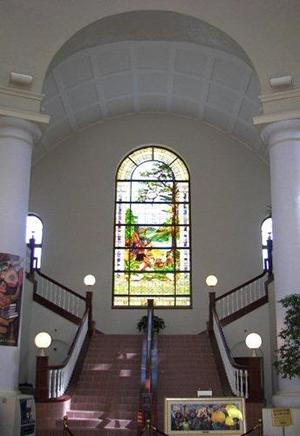
if there is any significance to the direction. The interior has a
domed ceiling with arches between large columns around the rotunda.
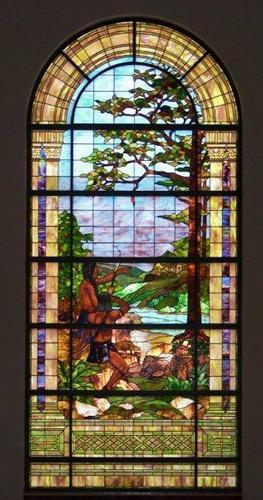
The north side staircase has a large stained glass window entitled
"Two Indians at the River" with one of the Indians in the window pointing
in the same direction as the Indian on top of the dome. |
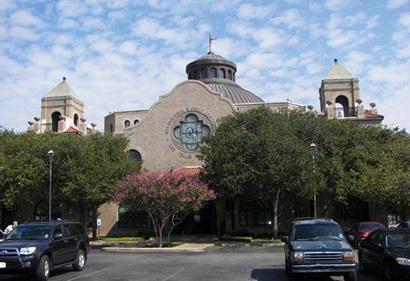 |
The front side
entrance on the south end.
Photo courtesy Terry
Jeanson, September, 2008 |
Southeast corner
detail. The design of the building was inspired by San Antonio's Spanish
missions.
- Terry
Jeanson, September, 2008 photo |
The restored
window over the east side entrance. Designed to reflect the "Rose
Window" at the San José Mission,
it is identical to the windows over the north and south side entrances.
Given the opportunity to place their company logo inside the windows
during the restoration, the credit union decided instead to have the
original windows recreated.
- Terry
Jeanson, September, 2008 photo |
The north side
staircase with the stained glass window of "Two Indians at the River."
The window is approximately 22 feet high and 10 feet wide. The center
banister on the staircase was a later addition built for safety reasons.
- Terry
Jeanson, September, 2008 photo |
The recreated
staircase window. The colors were matched by collecting shards of
the broken glass from the interior of the depot during its restoration.
- Terry
Jeanson, September, 2008 photo |
The
New Orleans, Texas and Mexican Railroad Company (an affiliate of MoPac)
bought the I&GN rail line in 1924 and then MoPac made an outright
purchase in 1925. By the 1930s, the building was then known as the
MoPac Depot. Even before World
War II, passenger train service at the MoPac Depot was in decline.
Improved roads, affordable cars and the airline industry drained away
the customers. MoPac finally sold the building in 1970. Several efforts
to turn the building into other things, like a library, a museum,
a restaurant and a center for the Veteran's Administration, all failed.
Meanwhile, the building fell into decay. The copper and brass from
the dome was stripped away by scavengers, leaving the interior exposed
to the weather. Nearly all of the building's windows, including the
decorative stained glass windows, were broken out. Vagrants took to
living in the building, starting at least one destructive fire during
their stay. The plaster on the interior columns was cracked and destroyed
and termites attacked just about all of the wooden furnishings. The
final degradation was the theft of the Indian statue on top of the
dome in 1982. He was found soon afterwards in an abandoned railroad
yard near the station with a broken bow, missing right leg and head-feathers,
a damaged posterior and multiple holes, courtesy of a BB gun.
In
1985, the San Antonio City Employees Federal Credit Union was about
to purchase a new building only a few blocks away when city officials
approached them about using the old depot. When it was determined
that the old depot would suit their needs and not exceed their budget,
the credit union purchased the building. Receiving no funding or grants,
the credit union could have restored the building any way that they
wanted, but they decided to maintain the building's historical integrity
and restore as much as they could to the original condition, but at
the same time turning it into a functional banking headquarters. All
of the stained glass windows were restored by using photographs and
shards of the broken glass found inside the building as a reference.
An addition was placed on the west side of the building where the
railroad tracks run, but it was built to match the brick of the original
structure. The bronze Indian statue, which
was kept in storage after its abduction and subsequent rescue, was
also restored and returned to its position on top of the dome. The
restoration was begun in 1987 and completed in 1988. At $3.1 million,
the restoration came in under budget and was less than the purchase
of the aforementioned new building. |
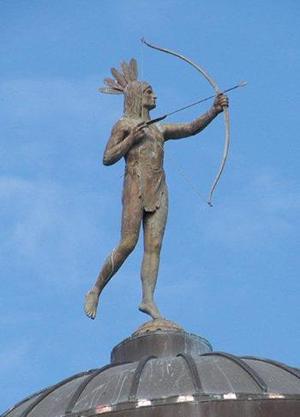 |
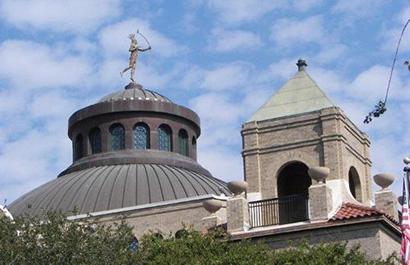
Close up of the
Indian on top of the dome. The repair work done on the right leg is
evident.
Terry
Jeanson, September, 2008 photo.
More Texas
Statues |
East side entrance
of the depot facing the Houston and Medina Street intersection.
Photo courtesy Terry
Jeanson, September, 2008 |
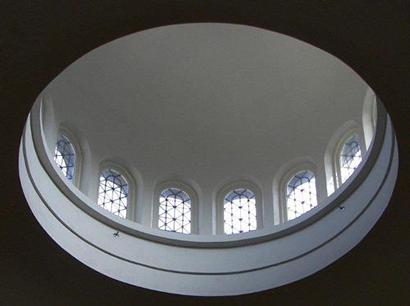
The interior
of the building's dome.
Photo courtesy Terry
Jeanson, September, 2008 |
The
old depot is now home to Generations Federal Credit Union and
the railroad is still used to haul freight. During my visit, my tour
guide Arlene escorted me around the building. (Because this building
is a financial institution, interior pictures can only be taken with
a guide present.) She has enormous pride for the fact that the building
was able to be saved and rehabilitated and is well versed in the building's
history, but she admitted that the credit union may be selling the
building soon in order to move to a location with more space. The
neighborhood is rather run down and, according to my mother, was run
down even in her day. It is in need of a major revitalization. Arlene
indicated that any future owner of the old depot would have to agree
to be responsible for maintaining the building's historical integrity.
Another employee I talked to during my visit has been working there
for about twenty years. She was telling me how she would miss working
there if the building was sold and that she sometimes took the historic
building for granted. After briefly working at a different branch
of the credit union which is in a modern style building, she gained
a new appreciation for the old depot upon her return.
Since the old depot is on the western end of downtown, it is a little
off the beaten path. Arlene said that most of the tourists she encounters
are either lost or there for a specific reason, as I was that day.
Arlene says that these "accidental tourists" are so taken with the
beauty of the building that they are encouraged to find out more about
it. It is easy to see why. Not only has the building been a San
Antonio landmark for over a century, but it has been a part of
people's lives. |
 |
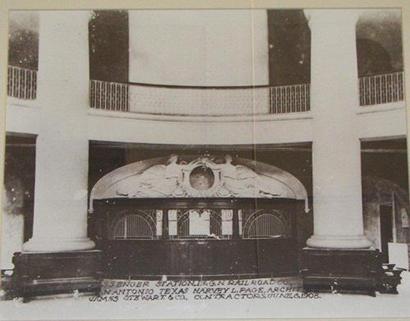
"This picture
of the original ticket counter is hanging in one of the upstairs offices
at the old depot. My mother said that the former lunch counter was
just to the left of the ticket counter."
- Terry
Jeanson, September, 2008 |
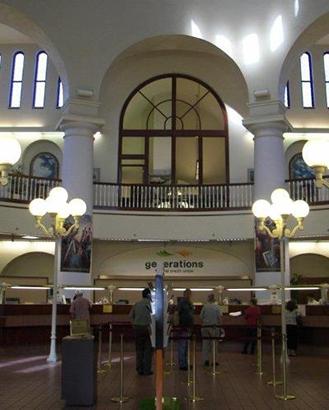
"The ticket
counter is now the bank tellers counter. My guide told me that the
original fresco that was over the ticket counter windows was one of
the things that could not be restored."
- Terry
Jeanson, September, 2008 photo |
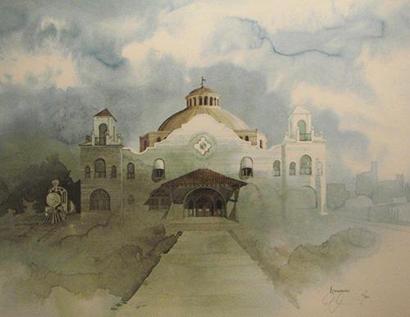
"This print
of a watercolor painting by (?) Atkinson (first name was not legible)
is hanging outside the east side conference room on the upper floor.
My guide said the artist used old postcard pictures of the depot as
a reference."
- Terry
Jeanson, September, 2008 |
Source:
The Texas Transportation Museum website at http://www.txtransportationmuseum.org/IGN.htm,
San Antonio Uncovered by Mark Louis Rybczyk and
Arlene Gauthier, Product Marketing Coordinator for Generations Federal
Credit Union.
Copyright Terry
Jeanson
October 1, 2008 |
Related Story
Uncle
Dick by Mike Cox
Better known to his co-workers with the International and Great
Northern Railroad as "Uncle Dick," Richard Adams hired on with the
company in 1871 when it was still just the Great Northern. Fifty-five
years later -- yes, a half-century plus five -- he still worked
for the same line....
Read full article
|
|
|
 HOME
HOME