|
ROMA - LOS
SAENZ, TEXAS
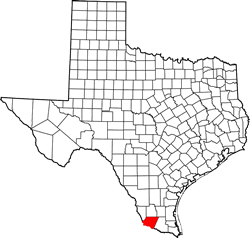
Starr
County, South
Texas
National Historic District
26° 24' 22" N, 99° 0' 20" W (26.406111, -99.005556)
Highway 83
12 miles W of Rio
Grande City the county seat
52 miles W of McAllen
91 miles SE of Laredo
On the Rio Grande
Across from Ciudad Miguel Alemán, Tamaulipas, Mexico
ZIP code 78584
Area code 956
Population: 11,490 Est. (2019)
9,765 (2010) 9,617 (2000) 8,059 (1990)
Roma Area Hotels ›
Rio
Grande City Hotels |
|
|
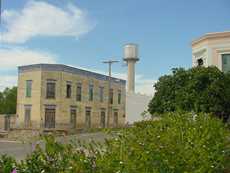
A Roma streetscape
Photo by John Troesser, 2001 |
History in
a Pecan Shell
Roma
and Los Saenz have incorporated joinly and so they are listed here
together. Corrales de Saenz was founded in the 1760s by a ranching
family named Saenz who followed José de Escandón from the Spanish
colonial city of Mier. According to the Handbook of Texas,
"it is possible that what came to be known as Roma-Los Saenz
and Ciudad Miguel Alemán were originally part of the same city,
San Pedro de Roma, Tamaulipas."
1848 was the year Roma-Los Saenz became part of the U. S. - although
that fact is thought by some to be a moot point. The only obvious
change was an opening of the first post office in Starr
County. The flavor of the city is definately 19th Century Mexico
and is certainly one of the gem cities on "Los Caminos del Rio."
|
|
|
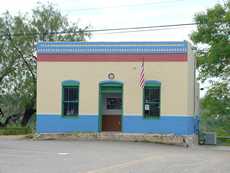
The former Roma
Post Office appeared in Viva Zapata
Photo by John Troesser, 2001 |
The
Oblates of Mary Immaculate founded a mission in the mid-1850s and
it was they who suggested the name Roma. The town was also the westernmost
port for the steamships that ran up and down the Rio Grande from 1850
to 1900.
Roma was designated a national historic district in the 1970s
and the historical museum itself is in an 1840 building. The main
plaza, was used a backdrop for the 1953 movie Viva
Zapata. Many of the downtown buildings built in the 1880s (including
the old 1880s post office) were designed by noted German brickmaker
and architect Heinrich Portscheller.
The population in 1904 was a mere 521. During the border unrest 1910-17,
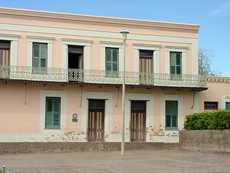
refugees from Mexico occupied the historic "Pink House." The town's
isolation ended in the mid 1920s when new roads were built and the
railroad arrived. |
|
|
The historic "Pink House" in Roma
Photo by John Troesser, 2001 |
|
|
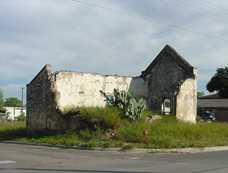
Cactus
in a Ruin in Roma
Photo by John Troesser, 2001 |
|
|
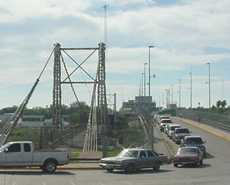
The International Bridge, one of the few remaining
suspension bridges in Texas.
Photo by John Troesser, 2001 |
Roma's green bridge - one of the few remaining suspension
bridges in Texas became Texas' international bridge when it was built
in 1927. A recent restoration has painted and reenforced it, although
it has yet to be reopened to pedestrian traffic.
In 1931 Roma's population was 1,000 - and the businesses were all
clustered in the few blocks around the bridge. With the construction
of Falcon Dam in 1953, the threat of periodic flooding was
removed.
Since 1979 the town's infrastructure has been improved with a new
water plant, water tower and new fire and police stations. The town
is surrounded on three sides by 100,000 acres of irrigated river bottom.
|
|
|
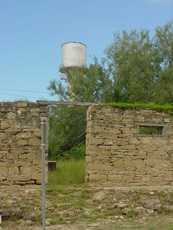
Roma water
tower painted with "Home of the Gladiators"
Photo by John Troesser, 2001
|
Roma, Texas
Attractions
Falcon State
Park - 800-792-1112
14 miles NW via US 83, FM 2098, and Park Road 45. Admissions.
http://www.tpwd.state.tx.us/park/falcon/
The Roma National
Historic Landmark District -
1848 to 1928 historic structures under restoration can be viewed
from the city plaza.
Roma Historical
Museum
|
| Texas
Escapes, in its purpose to preserve historic, endangered and vanishing
Texas, asks that anyone wishing to share their local history, stories,
landmarks and recent or vintage photos, please contact
us. |
|
|
 HOME
HOME