|
Page
1
In other words, the foundation’s board and city officials hope the
trail will become a travel destination. And that could translate into
big bucks. City leaders have only to look east to Tyler
and Palestine for shining
examples of how well similar trails have paid off.
Tyler’s
Azalea Trail has been a travel destination in March and April for
46 years. Susan Travis, Tyler’s Convention and Tourism Coordinator,
says the annual Azalea Trail does a lot for the city. “The 2005 trail
had a total economic impact of more than $3.5 million dollars. More
than 123,000 people visited our city during those three weeks in the
spring, specifically to either walk or drive The Azalea Trail. It
really is stunning.”
Almost simultaneously in Palestine,
just an hour away, three weekends in March and April brought 30,000
visitors to the city for this year’s annual Texas Dogwood Trails Festival.
Susan Leonard, Director of the Palestine Convention and Visitors Bureau
says the 67th annual event brought more than $2.3 million visitor
dollars into the city.
Leonard says, “I think it’s such an important festival for the city,
from a cultural and heritage standpoint. But it also has a tremendous
economic impact. It’s very important to our economy.”
McKinney’s not there yet. But the dream
is alive and well and growing.
“Right now we’re only planting medians but we’re in the process of
negotiating with the city of McKinney to
house the world collection of crape myrtles. We would really like
to have it happen by the fall of 2006. We’re still working out the
details,” Owens said. “Nowhere in the world are all crape myrtle varieties
planted in one place. McKinney is going
to have them all.” The hope is that the city will have them all in
an eight acre world class crape myrtle arboretum. |
|
|
Multiple
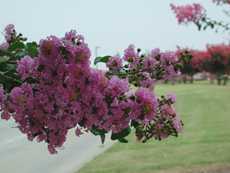
colors of Crape Myrtles in bloom on El Dorado Parkway in McKinney.
|
There are hundreds
of varieties of crape myrtles, but only about 100 are currently in
commercial plant production. Brainerd says McKinney
has planted 15 to 18 varieties. Dr. Raul Cabrera, Associate Professor
of Ornamental Horticulture at the Texas Agricultural Experiment Station
in Dallas, is one of
three horticulturists in residence at the center who participate as
liaison members on The Crape Myrtle Trails of McKinney horticulture
subcommittee and regularly attend board meetings. Cabrera says, “The
crape myrtle collection at the Dallas Center serves as an important
research and education base for the Crape Myrtle Trails of McKinney.
Many of the hybrid crape myrtle developments since the mid-1970’s
were evaluated at the Dallas center before being released to the public.”
Cabrera is also leading the effort to create a comprehensive collection
of crape myrtles at the Dallas Center. He currently has 45 varieties,
all miniatures and dwarfs, which reach a height of 10 feet or less.
By next year, Cabrera plans to add the medium sized varieties, which
range in height from 10 to 20 feet. After that, the large varieties
of 30 feet or more will be brought in to complete the collection.
Cabrera says because this is a research project, there will be a minimum
of four of each variety. With a goal of 120 to 140 varieties, he says
that means a total of 600 to 700 crape myrtles will eventually be
planted at the Dallas Center.
Cabrera also maintains a web site that features several sections on
crape myrtle propagation, culture, management, history, terminology
and geography. But he says the main feature is a searchable database.
“It contains basic information on crape myrtle cultivars, complete
but brief information on about 100 crape myrtles throughout the United
States, with pictures and a listing of about 300 varieties total.
You can input your information much like when you’re searching for
a car online, by name, by size, by color and it will pop up varieties
that match your specifications.” To view the web site, go to http://www.dallas.tamu.edu
and click on “crape myrtle”.
Cabrera participated in the 2005 Crape Myrtle Conference on June 25.
The event was hosted by the Crape Myrtle Society of America, the Crape
Myrtle Trails of McKinney and Texas Cooperative Extension. The Crape
Myrtle Society touted the conference as “…the most impressive assembly
of crape myrtle experts in American history.” Cabrera presented the
latest research being done at the Texas A&M Research and Extension
Center in Dallas. The event was open to everyone, from professional
growers and landscapers, to weekend yard warriors.
“This is the first conference that I know of that got together a lot
of crape myrtle experts with both research and practical expertise”,
Cabrera said. “The other unique thing about this conference is that
all of the items on Saturday’s agenda were open to everyone. There
was no separating the professional growers and landscapers from the
average homeowner and consumer. So everyone got the benefit of all
of this expertise. I really feel this conference helped dispel some
of the incorrect practices as far as managing the plants in landscaping,
and also helped get the word out about the many different varieties.
There really is a crape myrtle for everybody.” |
|
|
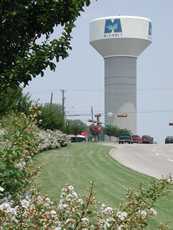
Crape Myrtle Trail of McKinney, with McKinney
water tower in background. |
Proceeds from
the conference went to the Crape Myrtle Trails. Owens says, “The goal
is to plant all of the city’s medians in crape myrtles, and there’s
probably more than 100 miles of medians. We’d really like to plant
along hike and bike trails too.”
Add to that all of the plantings by private citizens and businesses
and McKinney is shaping up to be the next hot spot for tourists seeking
mother nature’s beauty.
Book Your Hotel Here & Save
McKinney
Hotels
More Hotels |
|
|
 HOME
HOME