|
Ellis
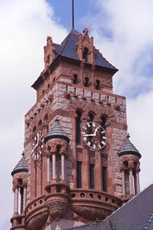
County Courthouse
Clock tower
October 2002
Copyright Sam Fenstermacher |
Ellis County
Courthouse
Constructed 1897
Architect J. Riely Gordon
Romanesque Revival Style
Designation National Register Listing - 1975
Texas Historic Landmark - 1969 |
Ellis County
History
The Texas State
Legislature created Ellis
County on December 20, 1849 with land drawn from Navarro County.
Waxahachie was established as the county
seat in August 1850 on land donated by Emory W. Rogers, a pioneer
settler. The town name comes from an Indian word meaning "cow", and
it's also the name of a local creek.
Construction on the Waxahachie Tap Railroad was completed in September
1879. The railroad carried Waxahachie's
vast cotton crop to market. In 1881 the Waxahachie Tap was absorbed
by the Houston and Texas Central Railway, which extended the rail
line all the way to Fort
Worth. In the following years more rail lines were built to match
the county's ever expanding agricultural output.
Like so many other rural counties in this part of the state of Texas,
Ellis County had
a period of great growth from about 1880 to 1930. By the 1920's Waxahachie
had a population of 7,958 and 200 businesses including three banks,
three cottonseed oil mills, five cotton gins, and two daily and two
weekly newspapers. Profits from the cultivation and processing of
cotton drove this economic boom.
Unfortunately, when cotton prices dropped in the 1930's so did the
local economy. |
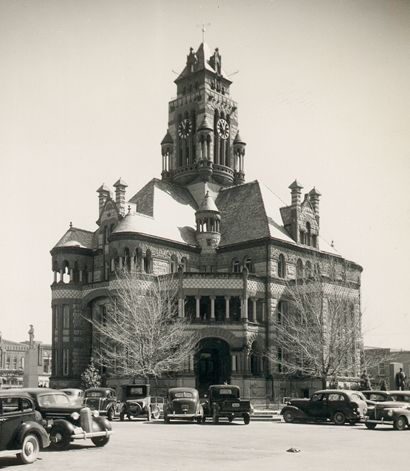 |
Ellis County
Courthouse as it apppeared in 1939
Photo
courtesy TXDoT |
The
Town of Waxahachie
Today, remnants of late 19th Century Waxahachie
prosperity are apparent all around town. The large number of late
Nineteenth Century Victorian-style homes and buildings remaining today
has given Waxahachie the title of "The
Gingerbread City". In fact, the town of Waxahachie
has about 20% of all the buildings listed in the National Register
of Historic Places in Texas.
The vintage Victorian-style homes combined with a picture perfect
courthouse square has made the perfect backdrop for several Hollywood
movies. Film footage for the 1967 classic "Bonnie and Clyde" and the
Academy Award winning "Tender Mercies" were both shot on location
here. |
|
|
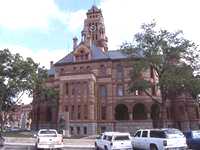
Ellis
County Courthouse
October 2002
Copyright Sam Fenstermacher |
The Ellis County
Courthouse
The Ellis County
Courthouse was built from architectural plans created by J. Riely
Gordon. The building incorporates the Richardsonian Romanesque architectural
style originally created by Boston architect Henry Hobson Richardson
and made popular in Texas by J. Riely Gordon.
For the Ellis County Courthouse Gordon used a floor-plan different
from many other county courthouses in Texas of the same vintage. Many
county courthouses built in this time period had intersecting halls
on the first floor that created the rigidity required to support the
weight of the district courtroom positioned near the middle of the
building on the second floor. For the Ellis County Courthouse Gordon
used a floor plan that provided an open space at the center of the
building first surrounded by a staircase then surrounded by a gallery
that provided access to offices and courtrooms. The large second-floor
courtroom was pushed off to one side of the building so the center
space was open all the way up to the clock tower. This open space
at the center of the courthouse created a chimney effect. Cool air
was drawn in through first floor windows toward the center of the
building then straight up to the tower where hot air was exhausted
out of the building.
Besides the advantage of superior ventilation, Gordon's design incorporated
a circular form which worked well with the Romanesque Revival architectural
style. Turrets containing spiral stairways and balconies incorporate
readily with the circular form. The building is further enhanced by
the use of stone of contrasting colors. From the building's base first
gray and then pink granite are used. Red Pecos sandstone is used for
accent, and cream colored sandstone is also used sparingly on a few
stringcourses. |
|
|
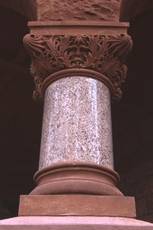
Column
made of polished pink granite with red sandstone capital and base.
Note face
carved in column capital.
October 2002
Copyright Sam Fenstermacher |
|
|
An
image illustrating the fine detail of the interior restoration of
the Ellis County Courthouse.
October 2002
Copyright Sam Fenstermacher |
| Ellis
County's courthouse is without a doubt one of the grandest old
county courthouses in the Southwest. To make it even more interesting
the county recently spent about eleven million dollars restoring the
building. After years of restoration work, the courthouse was reopened
in the fall of 2002. The restoration was so detailed that they matched
the colors of the interior to those used when the building was originally
built, and the county bought red sandstone for repairs from the same
query that produced the stone used for construction in 1895. This
is truly a good time to go see the Ellis County Courthouse! |
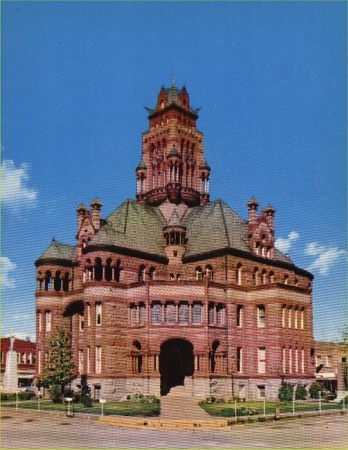
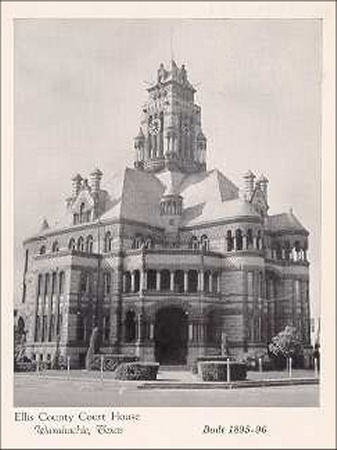
Ellis County
Courthouse
Postcard courtesy www.rootsweb.com/ %7Etxpstcrd/ |
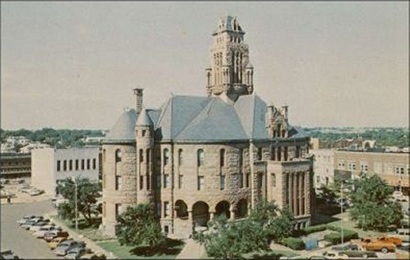
| Postcard
courtesy www.rootsweb.com/ %7Etxpstcrd/ |
| Postcard
courtesy www.rootsweb.com/ %7Etxpstcrd/ |
|
Bibliography:
Texas Historical Commission, Texas Historic Sites Atlas.
http://atlas.thc.state.tx.us/, 2003.
"WAXAHACHIE, TX." The Handbook of Texas Online. http://www.tsha.utexas.edu/handbook/online/articles/view/WW/hew2.html,
2003.
Copyright © 2003 by Sam
Fenstermacher All rights reserved
|
People
Richard Ellis
by Mike Cox ("Texas Tales" Column)
His imagined likeness stands frozen in bronze outside the courthouse
of the county bearing his name, but Richard Ellis is a long way from
being one of the more-recognized figures in Texas history.... |
|
|
 HOME
HOME