| |
| Precisionism
as an artistic movement spanned the years 1915 to 1941. Europe was growing weary
of Cubism and absolutely no one understood Dada (except maybe Mama). The term
first came into use in the early 20s when Paris was weary of hosting painters
with egos the size of the Hindenburg (or could that have been Diego Rivera?).
|
 |
|
Parisians
were hoping that the “Lost Generation” would live up to its name and either get
lost or go back where they came from. The European art community looked around
and saw a battered and imprecise world. They imagined that if there was to be
a new art movement, it would have to come from America.
They looked
across the Atlantic where (on a clear day) they could see skyscrapers sprouting
like mushrooms. Somedays they could even see cousins in the tall windows – cousins
who still owed them money. America was where plains were fruited and where people
drove on the right side of the road. America, being an artistic adolescent even
had art museums with uncountable acres of bare walls.
Despite the onset
of the Great Depression, the beauty (and potential salvation) of industrialization
and modernization gave people hope. Precisionism became all-American. Monoplane
manufacturing, streamlined trains, shipbuilding, and architecture kept people
looking up – and forward. America's artists saw the same things and got out their
palettes and canvases.
These new artists embraced the machine age with
its sharply defined, geometrical forms and painted them in bold colors with an
occasional shadow or two thrown in. It’s not easy to embrace anything so sharply-defined,
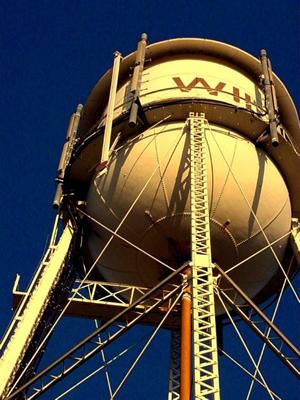
but times were hard and they did what they had to do. Water
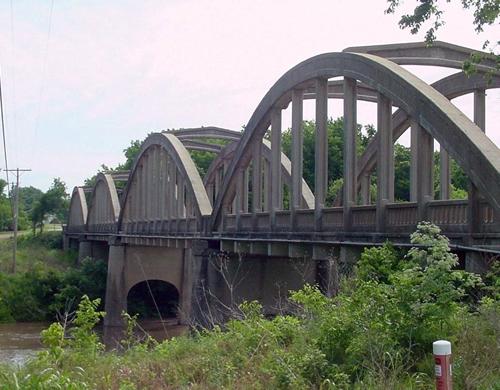
towers were celebrated, bridges
were lionized, and even the taken-for-granted grain
elevators had their day in the sun (as if they needed more days in the sun).
It got to the point where people’s dreams were hot-riveted.
The hard-edged
style was never fully-embraced by the general public who remained enamored with
the softer lines of Art Deco whose subjects included animals and humans. This
need was satisfied by the softer and more crowd-pleasing post
office murals.
Edward
Hopper painted the geometry of Mexican rooftops and New England lighthouses and
is widely considered to be a Precisionist. Even Andrew Wyeth (who was never considered
a Pecisionist) was a master at geometry with his weather-beaten barns and Cape
Cod saltbox houses.
Other artists paid homage to Precisionism, including
Texas’ own Jerry Bywaters. Bywaters often included oil rigs, sawmills and cotton
gins in his paintings, but never made them subjects.
In this series,
TE wishes to showcase photographs that might have once been considered Precisionism.
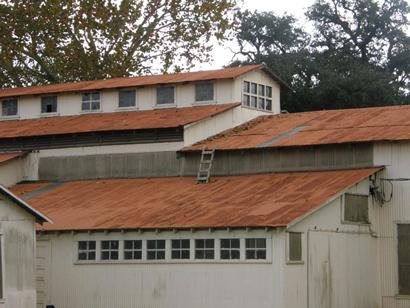
Some of the subjects are new and some of them are rusty and dull. Others are the
much more familiar houses and barns of the countryside. But one common trait they
share: they all still catch the sun and they all still cast a shadow. |
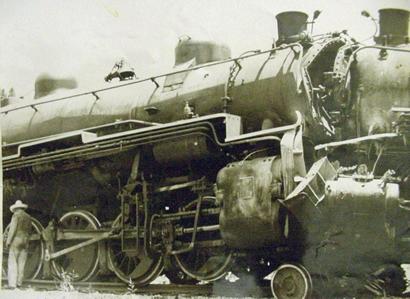 |
| Texas
Escapes (right) meets Precisionism (left).
Photo courtesy Smithville
Chamber of Commerce |
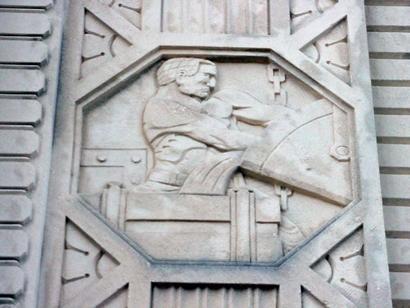
Precisionism
and Deco Meet
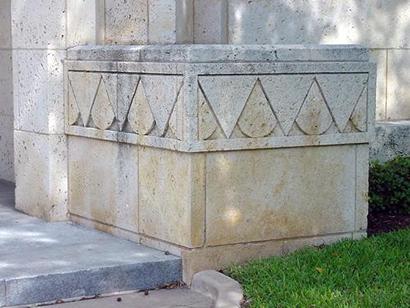
Beaumont
Bank Detail: Cement Worker
TE photo, 2003 |
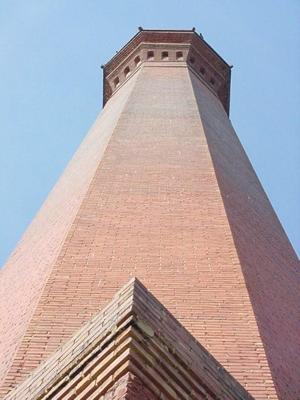
Rectangular
bricks form a tall octagonal cylinder tombstone for Texas' Industrial Ghost Town
of Thurber
TE photo, 2003 |
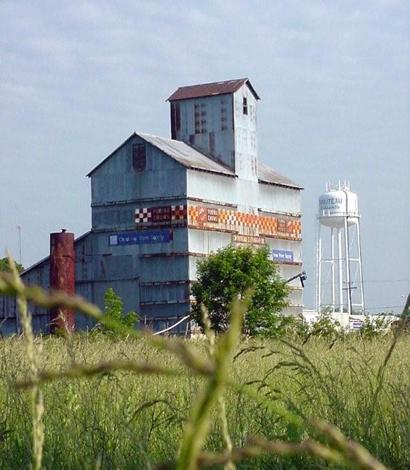
| Oklahoma
Geometry
Couteau Grain Elevator. TE photo, 2004
More Grain
Elevators | |
|