|
Title:
Tyler
Author:
Robert E. Reed Jr.
(Arcadia’s Postcard History series)
ISBN-10: 0738571784
ISBN-13: 9780738571782
# of Pages: 128
Publisher: Arcadia Publishing
Release Date: September 28, 2009
List Price: $21.99 |
|
| The book contains
226 vintage postcards covering
Tyler's history during the first seven decades of the twentieth
century. They are separated into nine chapters: Street Scenes and
Buildings; Courthouses and the Public Square; Public Buildings; Education;
Religion; Residences; Festivals, Fairs, and Parades; Businesses; and
Recreation and Organizations. |
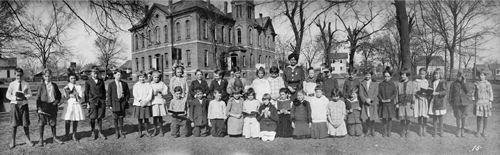 |
| Located on the
southwest corner of North Bois D’Arc Avenue and West Bow Street, North
Side School was built in 1889 as Tyler’s
first ward school. It was later renamed Marsh School to honor
Colonel Bryan Marsh, a local Confederate veteran who was a Texas Ranger
and Smith County sheriff for eighteen years. This school was demolished
in 1917 and rebuilt on the same site. None of the original four ward
schools of Marsh, Douglas, Bonner and Gary featured lighting of any
kind; hence, they all had a large number of windows for daytime illumination.
Also, all of these schools were limited to white students, for there
was the West End Colored School built in 1888 and the East End Colored
School established in a rented building in 1894. This panoramic real
photo postcard measures 11 inches by 3-1/2 inches. |
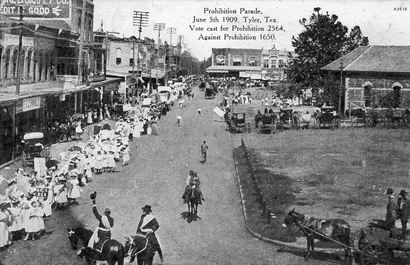 |
| Shown is the
Prohibition Parade held on June 5, 1909. The postcard is looking
east along Ferguson Street, from the intersection with North College
Avenue, and states that the votes cast for Prohibition were 2564,
with 1650 votes against. This must have been a revote, for prohibition
was achieved in Smith
County in 1901, long before the 18th Amendment imposed it nationwide
in 1919. |
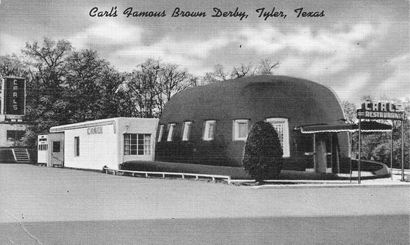
| The
Brown Derby Drive-In Café, located at 1905
South Broadway Avenue, was opened in December 1935. The entire restaurant
was originally enclosed in the hat-shaped structure, but in 1936 the
kitchen was moved into a new building in the rear, and the entire
“hat” was made a dining room. The restaurant closed in early 1953
and became a used car lot by 1956. The buildings were demolished in
1958. |
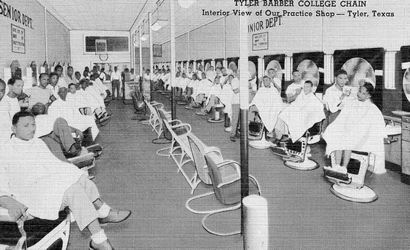
| No colleges existed
to train African-Americans the skills required to obtain a barber’s
license until Henry Morgan opened Tyler Barber College, located
at 212 East Erwin Street, in 1934. It became a successful chain with
locations in major cities throughout the United States and reportedly
featured in Ripley’s Believe It or Not column as a corporation headquartered
in a small town with a branch in New York City. |
 |
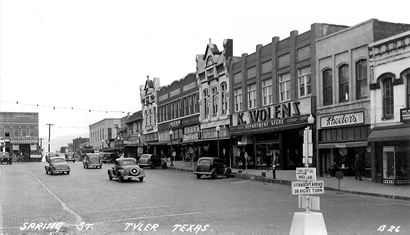 |
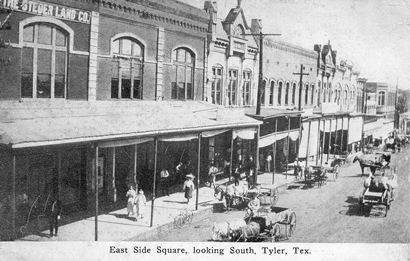
| These postcards
both show the same section of North Spring Avenue, but from
opposite directions and different times. The top view is early 1910s
looking south, from the intersection with East Ferguson Street. The
only readable sign is for The Steger Land Company to the far left,
but the Queen Theater is in the right adjoining building. Tyler’s
first Brookshire’s store opened in 1928 around mid-block. The bottom
view is late 1930s looking north, with East Erwin Street crossing
in the immediate foreground. Along Spring Avenue, a couple of blocks
further north, were boarding houses, two of which were closed in 1936
as “bawdy houses.” |
 |
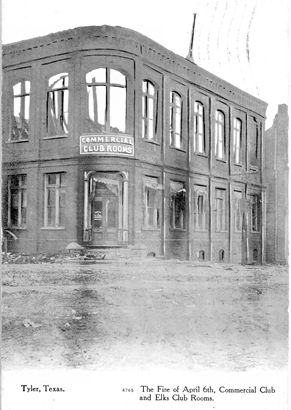 |
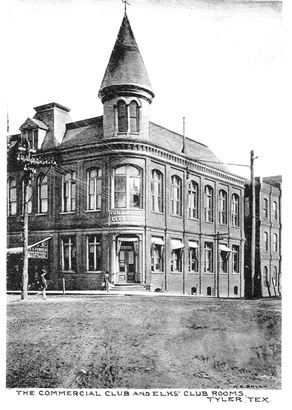
| Civic leaders
founded the Tyler Commercial Club on June 2, 1900. Located
on the southeast corner of South Spring Avenue and East Erwin Street
in the Durst and Bergfeld Building constructed in the early 1890s,
it was the forerunner of the Tyler Area Chamber of Commerce and the
Tyler Economic Development Council. This building also housed the
Elk’s Club on the second floor. On the far right of this postcard,
the Grand Opera House is partially visible. A devastating fire struck
this corner on April 6, 1907. The postcard below, with the exact same
view, shows the empty shell that remained of the building after the
fire. |
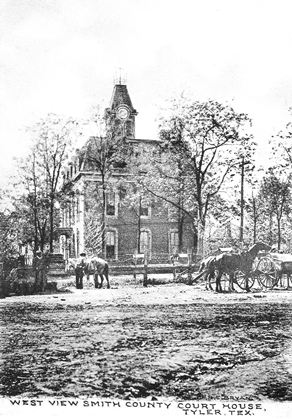
| After a series
of three log cabins over five years served as the county courthouse,
the cornerstone was laid in December 1851, for a new courthouse,
Tyler’s
first brick structure. The two-story building was 40 feet by 70 feet
and sat in the middle of the square. In 1876 a third story was added,
as well as a clock tower that never had a timepiece installed. |
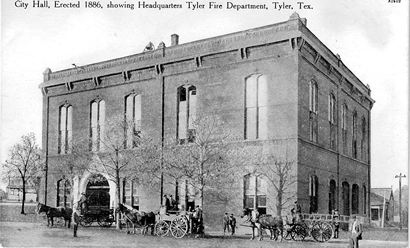 |
| The Locust
Street Fire Station was built on the northwest corner of North
College Avenue and West Locust Street in 1886. Over the years the
structure at times concurrently served other purposes, such as the
police department and city hall. This postcard includes a view of
the early horse-drawn fire department. Visible atop the building in
the above postcard is a bell used to summon the firefighters when
they were not at the station. The bell was originally used on the
first building that housed Marvin Methodist Church from 1852 to 1889.
After the church moved and no longer had a belfry, they loaned the
bell to the fire department. When this building was demolished in
1955, the bell was returned to the church, and it is currently displayed
on their east lawn along South Bois D’Arc Avenue. |
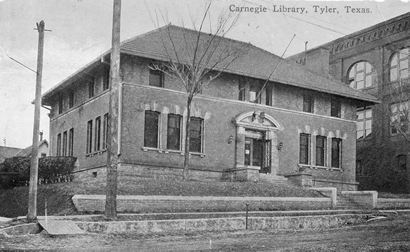 |
| Carnegie
Public Library, located at 125 South College
Avenue, opened October 3, 1904. It was constructed with a $15,000
donation from philanthropist Andrew
Carnegie, while private funds paid for the lot and furnishings.
With two large rooms on the first floor and an auditorium called Carnegie
Hall on the second, the library was designed to hold 12,000 books
and be operated by one librarian, paid $35 monthly. An expansion in
1936 doubled its size, courtesy of a Public Works Administration grant.
Library service for African Americans was segregated until the 1960s.
A new public library opened at 201 South College Avenue on May 5,
1980. The old library, one of a dwindling number of original Carnegie
Library buildings still standing in Texas,
now serves as the museum and archives of the Smith County Historical
Society. |
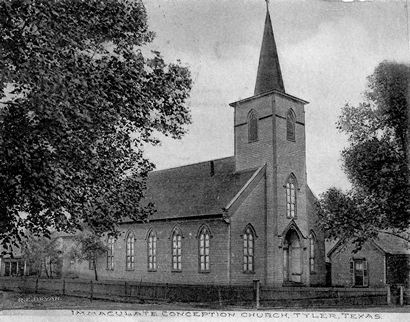 |
| While mass had
been celebrated for a number of years before, the first Catholic church
was dedicated in 1882 on the northeast corner of North College
Avenue and West Locust Street, shown above. It was called Church
of the Immaculate Conception, with French Reverend J.S. Chaland
preaching to a mainly Irish congregation employed by the railroad.
After a fund collection drive of fifteen years, construction started
in 1934 on a new church, on the southwest corner of South Broadway
Avenue and West Front Street. The parish, now known as Cathedral of
the Immaculate Conception, was so eager to move in that it actually
did by Christmas 1934, before construction was completed. The actual
dedication occurred on March 17, 1935. Soon afterward, the 1882 frame
church was moved to West Lollar Street for use as a mission parish. |
 |
| Mayer & Schmidt
moved their department store to the northwest corner of North College
Avenue and West Ferguson Street in 1893. The store, shown above, was
built on land made available when Alfred Ferguson’s hotel burned.
The new store was considered the area’s most spacious and luxurious.
In 1956 it became an early component of the Dillard’s chain, but operated
under its original name at this location until 1974. |
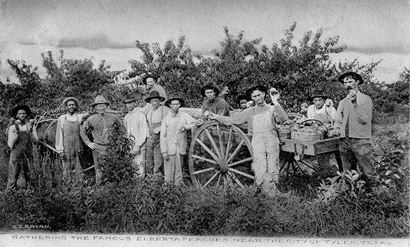 |
| Truck farming
is the cultivation of fruit or vegetable crops for transport to distant
markets where they cannot be grown due to climate. In Tyler’s case,
most of the crops were canned or iced down and shipped northward on
the Cotton Belt Railroad. One of the early important truck crops for
the area was peaches. Shown on this postcard is the gathering of
Elberta peaches. In 1889 alone Smith County harvested 104,283
bushels of peaches. However, disaster loomed on the horizon, arriving
just after the next century started. San Jose scale, a major peach
blight, soon struck, and by 1914 all peach orchards were killed. Most
peach growers switched to the growing rose industry. |
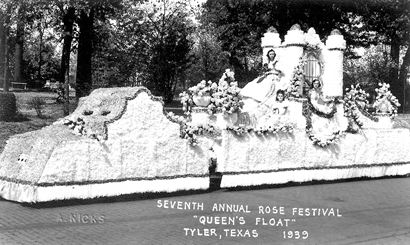 |
| In August 1933
Marion Wilcox and other Tyler Garden Club members approached Russell
Rhodes, the Chamber of Commerce manager, to insist he somehow publicize
local rose growing. With assistance from local attorney Thomas Ramey,
the effort evolved into the Rose Festival, with Thomas as the
first president. The festival dates were set for October 11-12, leaving
only six weeks to get it organized. Starting the first day at 2:30
pm, a 2-mile-long parade circled the downtown square. It is interesting
to note that the Rose Queen, Margaret Copeland, was not chosen until
that night, and her afternoon coronation occurred on the last day
in Bergfeld Park. This postcard shows Rose Queen Dorothy Bell’s float
for the 1939 Rose Parade. |
|
|
 HOME
HOME