|
|
THE
LOVE SONG OF J. RIELY GORDON
A series of photo essays of courthouses designed by J.R.G.
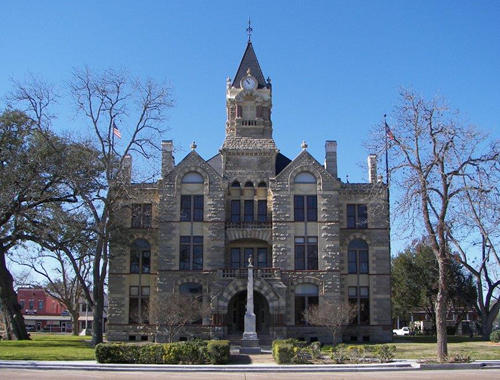
Fayette County
Courthouse
before Restoration in 2004
Text and Photos
by John Troesser
Book Hotel Here > La
Grange Hotels |
 |
| Fayette
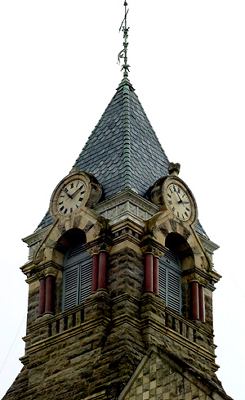
County Courthouse Tower |
|
County and Seat
La Grange is the
county seat of Fayette County.
The name comes from the Marquis de Lafayette's estate in France
which translates as "The Meadows". After the (American) Revolution,
it seemed that America couldn't name enough towns after the Marquis
- and many of them remain today. At last count there were something
like 16 towns across the United States named directly or indirectly
after the Frenchman. Since there was already a Fayetteville in Fayette
County - the citizens here settled for La Grange.
|
Fayette
is one of the most historic counties in the state of Texas. The Muster
Oak - or Dawson Oak - on the NE corner of the square attests to
that. The tree is looking much better than it has in years past -
despite the fact that a good deal of its trunk is now concrete. Special
attention has been given to the tree - and it's paid off.
A fire has recently (2000) destroyed a historic corner in downtown
La Grange - but this will be made right - count on it. The square
itself dates back to a time before a standard driving pattern existed
for small towns across Texas. Please pay attention to the flow of
traffic around the square when you visit - and watch the cars that
are parked in between two traffic lanes. Corner intersections are
NOT all four way stops. |
The
Building:
The understated Fayette County courthouse is not one of Gordon's "wedding
cake" efforts like Waxahachie or Waco. It's a relatively utilitarian
building - as it was designed to be. The detail is there - it just
doesn't hit you at first glance.
Gordon often employed a cruciform floor plan (on his courthouses with
a square floor plan) that drew air up through the entrances and staircases
through a central shaft. It must have been a blessing to civil servants
before air-conditioning.
For an informative no-nonsense description of the courthouse - we
turn to Richard Zelade's Hill Country:
"The most visually arresting building on the square is, of course,
the Fayette County Courthouse, built in 1891 to the tune of $96,000.
The finished product was well worth the cost, don't you agree?
The exterior walls are Belton white limestone, complemented with blue
sandstone quarried at nearby Muldoon. Red Pecos sandstone stringcourses
(decorative horizontal mouldings) and pink Burnet granite columns
and steps form rich accents. At the base of the clock tower is a large
stone slab on which is carved a large American eagle. Above this,
at the tower's four corners, are carved griffins. The roof is covered
with slate and Spanish tile." |
| Part
II - The Clock / Bell Tower |
|
The bell tower can be reached from a small staircase off the third
floor. The door leading to the stairs is locked with a hasp and padlock.
The steps are small and the place is definitely not for claustrophobics.
Tiny windows look down at the sidewalk - nearly 100 feet below.
|
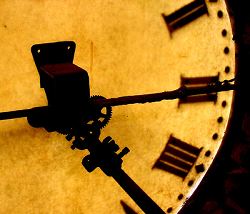 |
The
back of the West facing clockface
|
| |
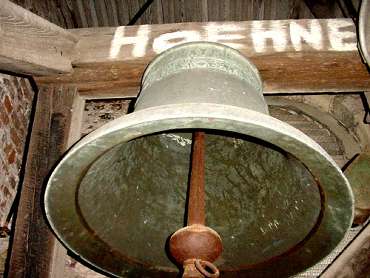 |
Looking
up at the bell
|
| On
the way up one sees that someone named Albert was once in the tower
with white paint and time on his hands. It can't immediately be proven
that Albert was a county employee - but when he painted his name here
- he was certainly "on the clock". |
The Bell
Above the bell (which could use a little Brasso, by the way) one sees
what is presumably Albert's surname.
We found three Hoeners in the La Grange phone directory - but we didn't
want to squeal on Albert. |
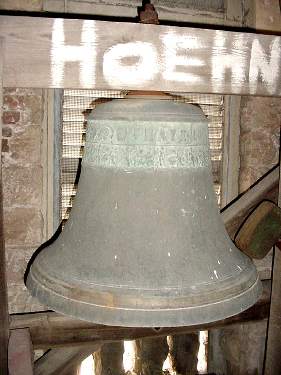 |
The
cherub-encrusted bell
- cast in Louisville, Kentucky
|
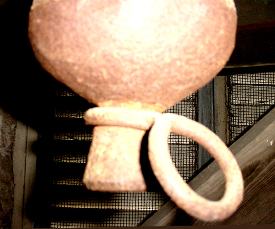 |
The clapper and the iron rope ring
|
| Looking
up - is the bell and the huge clapper collared with an iron rope ring.
The bell is now struck by an electric hammer - visible in another
photo |
The
Clockworks
Tiny 8-inch square steps with no railing or handhold brings one to
the clockworks. |
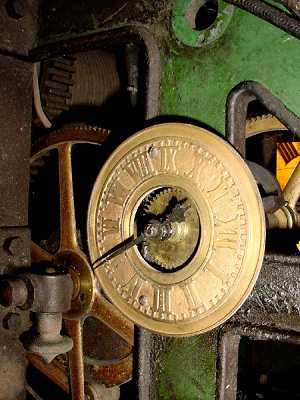 |
The courhouse clock mechanism
|
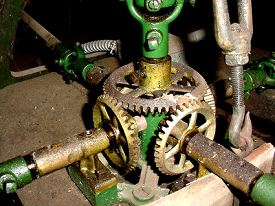 |
The
four-way drive mechanism
|
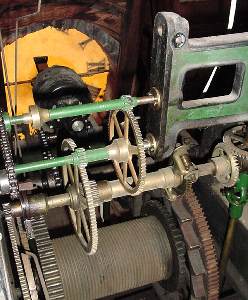 |
Another
view of the clock mechanism
|
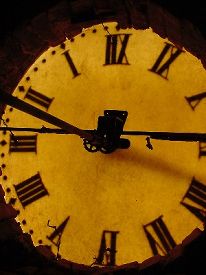 |
The
reversed numerals -
Does anybody really know what time it is?
|
| The
four clock faces - with reversed numerals give off a rich amber glow
even during the day (if you happen to be inside). At night it appears
faint and ghostly - perfect for Halloween. |
The
Weathervane
The height and shape of the tower guarantee a breeze - even when the
tree branches outside (and far below) are stock-still. |
 |
|
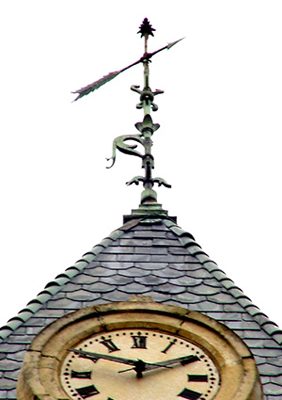
The clock tower weathervane |
| The
100-foot-tall clock tower has a slate shingle roof and is capped by
a weathervane with an intricate but hard to determine design. |
|
The courthouse at one time had a spacious atrium that had been replaced
by a large vault. Only one photograph exists of the atrium - an impromptu
snapshot showing banana trees, a fountain and a resident squirrel
perched on the judge's shoulder. We were told the atrium will be included
in the restoration. |
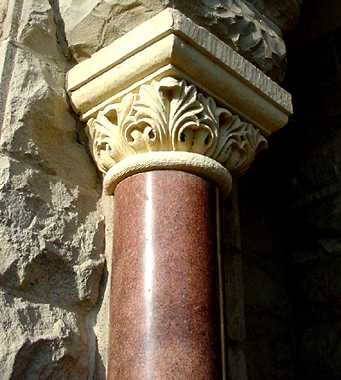 |
Several
of Gordon's trademark features
are immediately recognizable -
Corinthian column close-up view
|
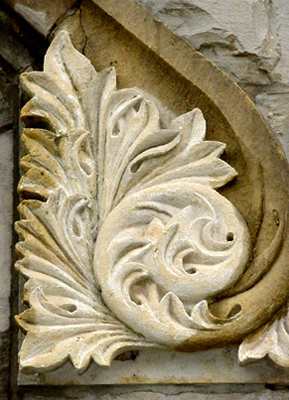 |
One
of the more intricate details
|
The
Obelisk
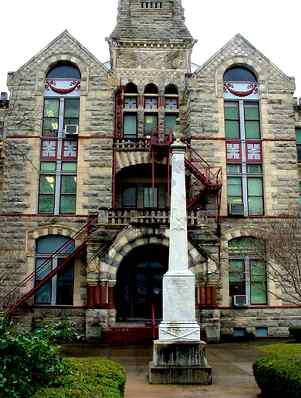
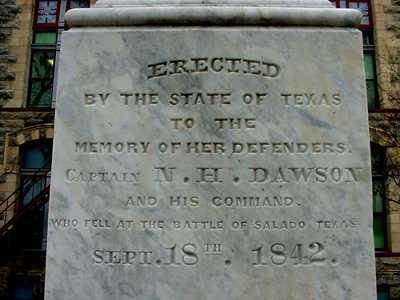
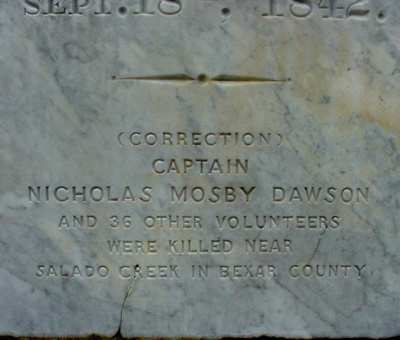
Approaching the main entrance to the building - is an obelisk in memory
of the Fayette County men who were killed with Captain Nicholas Mosby
Dawson at Salado Creek - just outside of San Antonio in 1842.
The middle initial of Dawson was misspelled - and so a correction
was made - with the word (correction) cut into the stone.
|
 |
The
Main Entrance
|
 |
The
inscription on the obelisk
|
 |
The
Correction - a stonecutter's worst nightmare
|
Architectural
Details
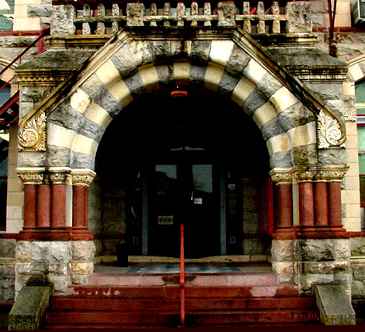
Entering the door - you're greeted by 8 short Corinthian columns -
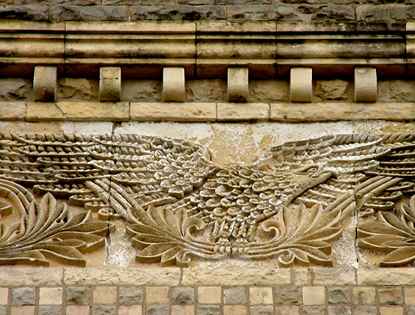
similar to Gonzales, Lee, and Comal County courthouses. Looking up
is an American eagle composed of three large sandstone slabs - an
unusual detail. |
 |
The
main entrance
|
 |
Sandstone
American Eagles
|
|
Stonework
You will also see a checkerboard effect worked into the outside
wall with alternating light and dark stone. This theme is repeated
in the pattern of the marble floor.
The darker stone
is "Muldoon Blue" sandstone - quarried in Muldoon,
Texas.
|
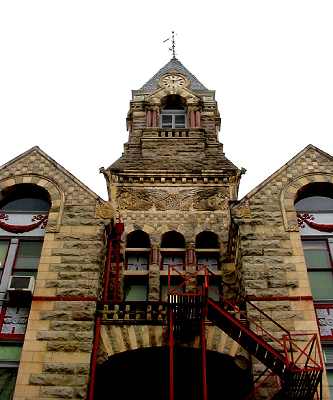 |
The
alternating light and dark stonework
|
Cornerstone
Although the description of the courthouse mentions Pecos red sandstone
- you'll have to look hard to find it. Here it can be seen near the
cornerstone. Gordon employed it as sparingly here as he used it generously
in the Bexar County courthouse. |
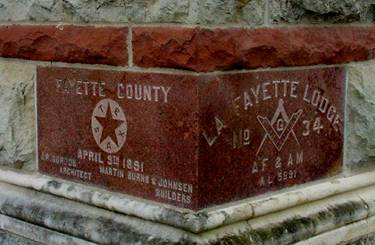 |
The
cornerstone of Fayette County Courthouse
|
Gargoyles
The courthouse has two gargoyles that don't look as frightening as
they look frightened. Judging by the look on their faces - they have
a fear of heights. We asked if they had names - but were told that
they were as yet unnamed. Perhaps La Grange will have a Name-the-Gargoyle
contest during the restoration. |
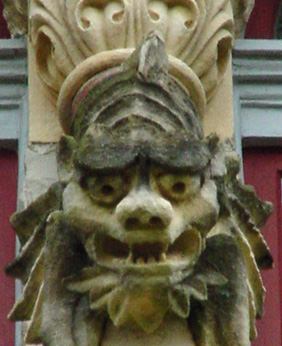 |
"Quasi"
- The Acrophobic Gargoyle
(north side)
|
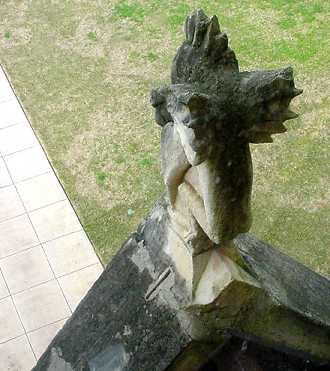 |
The
gargoyle's view of the courthouse lawn
|
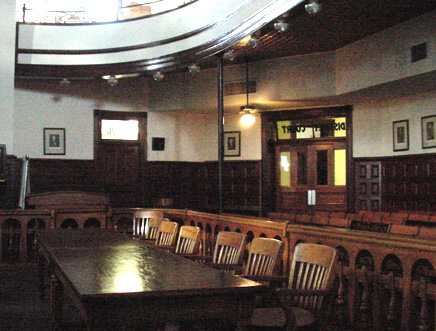 |
The
courtroom
|
Entering the building from the main entrance - you'll immediately
see a vault in front of you when you enter.
This was where an atrium once held semi-tropical plants year-round
and provided sanctuary for at least one squirrel. |
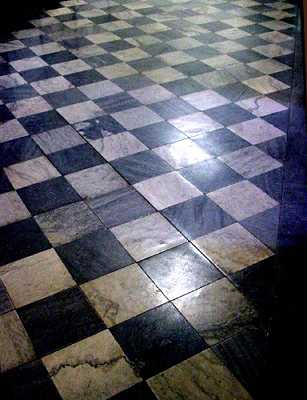 |
| A
portion of the checker-board marble floor. |
|
The floor is marble in the same light and dark checkerboard pattern
as the exterior walls. The marble thresholds bear the imprint of none
other than "The Father of the Texas Granite Industry" himself - Frank
Teich. |
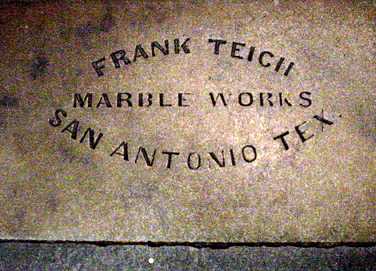 |
Sculptor
and Granite expert - Frank Teich's company imprint.
|
|
When the light strikes the transom window of the former County Sheriff's
office - one can see where T. L. Flortnoy's painted name has been
razor-bladed off the glass. |
 |
A
transom window
|
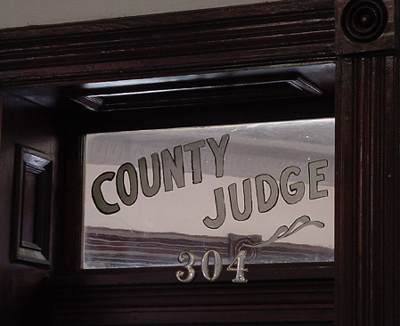 |
| County
judge's door |
| The
courtroom was used (very) briefly for the 1996 movie Michael. The
movie company furnished the courtroom with a set of engraved or engraved-looking
prints of the Presidents of United States to add to the room's already
stately dignity. |
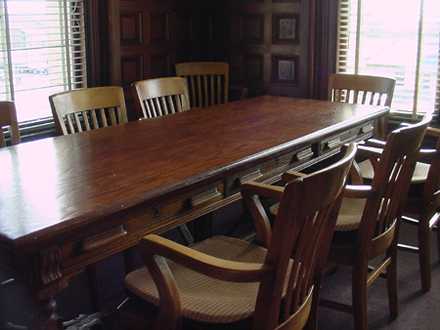 |
| The
Jury table |
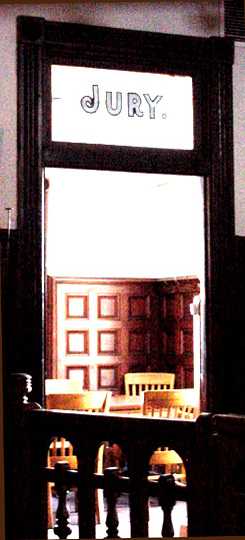
Off from
the main courtroom - a few feet behind the jury box is the deliberation
room.
At least one early photograph shows the courtroom with the judge's
bench inexplicably under the balcony. It gave the judge something
to look at beside lawyers - but made it hard on the audience to
watch the proceedings.
|
 |
| |
The
Jury room |
| |
|
|