|
History in
a Pecan Shell
A committee of
six men, including William T. Millican, (Millican, Texas) Joseph Ferguson
(whose cabin was the first county courthouse) and Mordecai Boon, Sr.
(the namesake of Boonville) was appointed by The Republic of Texas
Congress to select 150 acres from the John Austin league to be the
county seat.
The committee purchased the land for $1.00 per acre from William and
Elizabeth Pierpont and deeded it to the County (then Navasota County)
on July 30, 1841. The county name was changed in 1842 to Brazos County.
The town was built around a square, with space intended for a courthouse
and was named after Mordecai Boon, who was a nephew of the Kentucky
hero Daniel Boone.
Boonville residents felt the need for a jail over a courthouse and
built one in 1843 while renting a building for use as a courthouse.
The new courthouse was completed by 1846, and although it was a modest
one-story wood frame building, it was the site of political speeches,
religious sermons, and dances. It also served as a school and church.
By 1850 Boonville was an overnight stop for the stage from Houston.
The town enjoyed prosperity from 1842 to 1861. After the Civil War
when railroad expansion picked up where it left off – The Houston
and Texas Central Railway extended from Millican to Bryan.
Rather than fight to keep the county seat, an election was held in
the fall of 1866 and Bryan
won – supported by Boonville citizens who started moving near the
railroad. Later that year mail was routed through Bryan
which punctuated the end of Boonville.
Boonville also contributed the Bryan
Courthouse Cedar. This tree – now down to one lone branch (2002)
has stood near 6 different courthouses. It was transplanted to it’s
present location by Harvey Mitchell – the “Father of Brazos County.”
See The
Courthouse Cedar |
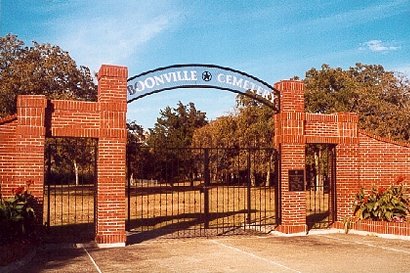
Boonville Cemetery
TE Photo, 11-02 |
Boonville,
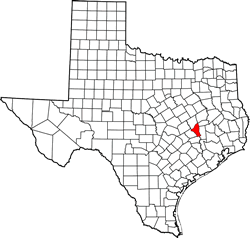
was the first county seat of Brazos
County. The former town site is now inside a well-maintained cemetery
next to a subdivison called Austin’s Colony just East of Bryan
on highway 6.
A Texas Centennial granite monument.sits on a grassy lawn behind a
tall iron fence. Although the large gate for vehicles is locked, the
pedestrian gate is to the right. A sliding-bolt latch on the cemetery
side opens it. Parking is adequate for six cars. |
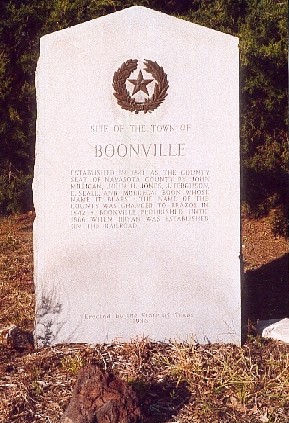
Centennial
marker acknowledging Boonville’s existence.
TE Photo, 11-02 |
|
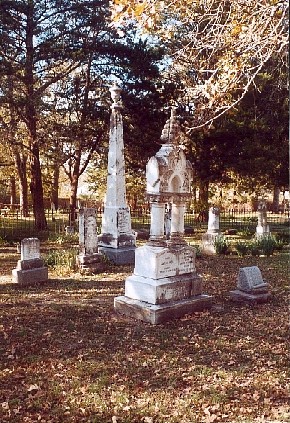
Inside the cemetery
are about 150 graves – most of them well-defined family plots and
shaded by old cedar trees. One of the largest of these family plots
is for the family of Harvey Mitchell – the namesake of Harvey,
Texas and the man known as “The Father of Brazos
County.” Harvey,
Texas, - another former town between Boonville and Bryan
has been absorbed by Bryan.
|
The grave of
Harvey Mitchell in the Mitchell Family plot
TE Photo,
11-02 |
Boonville
Texas Forum
Subject: Boonville,
Texas
During the early 1980's we were residents of Houston,
TX. We were amateur treasure hunters and belonged to a club know
as "The Gulf Coast Historical Preservation Society"
In order to enter and hunt an area someone from our club would contact
the owners of said property and arrangements were made for the members
to hunt this site.
Sometime in either 1982-1984 we traveled one Sunday to a fenced in
area which was told to us was the former town of "Boonville". All
that was in this area were several head of cattle and a few horses.
There were about two dozen of us and we found many artifacts including
lead shot (ammo), gate or perhaps house or barn door hinges, and numerous
other metal artifacts.
We were told that the town of Boonville was a thriving community in
the 1800's and that when the railroads started criss-crossing the
U.S. agents preceded the laying of the tracks and solicited funds
from the townfolk to help pay the cost. The citizenry of Boonville
felt no need for a railroad and voted against any such outlay of funds.
The tracks were coming nevertheless, and the R.R. VIP's decided to
lay their tracks some distance west of Boonville and bypass the town.
How far this was is anybodie's guess but it was about a mile or so.
After the trains started running, some of the local businessmen built
warehouses near the tracks and made arrangements for pickups and deliveries.
Soon afterward other businesses did the same. This induced the entire
town, after a period of time, to move near the rail line. Thus the
birth of what is known today as Bryan,
TX.
Whether the preceding is true or not, it makes a lot of sense and
we enjoyed our day in a ghost town called Boonville. - Charles & Marion
Van Tornhout, Killeen, Tx, September 18, 2005 |
| Texas
Escapes, in its purpose to preserve historic, endangered and vanishing
Texas, asks that anyone wishing to share their local history, stories,
landmarks and recent or vintage photos, please contact
us. |
|
|
 HOME
HOME