|
|
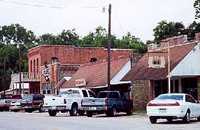
Glen Flora business district on FM 960 |
History in
a Pecan Shell
In 1890 a Pennsylvanian named C.H. Waterhouse bought
land on the west bank of the Colorado River. He used the river to
irrigate his land for the growing of cane and was said to have had
the largest pumping plant in Texas at the time. Waterhouse brought
German farmers from his native Pennsylvania to work the land on shares.
The people were given five acres for a church and cemetery and they
called their community Vesperville.
In 1895 they built St. John's Lutheran Church in Vesperville and it
went through an extremely rough period. The building was hit by a
hurricane in 1909 and the next year it was ripped apart by a tornado.
Eight years later it was destroyed by fire and the congregation felt
it might fare better in Glen Flora. They moved it there in 1919, but
it was destroyed by another tornado in 1929. Finally they moved it
to its present location in Wharton
in 1941 and renamed it St. Paul's.
Note: Another source (A History of Wharton County 1846-1961 by
Annie Lee Williams) gives the dates of the St. John's Church disasters
as:
Destroyed by storm: 1900
Destroyed by storm: 1910
Struck by lightning: 1918
Destroyed by cyclone: 1929
Glen Flora proper was established across from the sugar plant
in 1898. The plant had undergone several name changes by this time
as business partners came and went. Waterhouse himself served as president
of the newly formed Glen Flora Town Company in 1902.
|
|
|
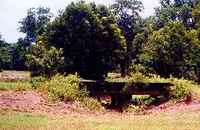
A
small trestle forgotten by the Santa Fe when they pulled up tracks
TE photo 2001 |
The plant got
permission from the county to build a rail line across the Colorado
River Bridge to the Cane Belt Railroad tracks. This spur helped
move cotton and sugar to the main line with cars drawn by mules. As
sugarcane production diminished, the line was no longer needed and
was removed.
In 1991 the Santa Fe railroad (which had acquired the Cane Belt in
1902) pulled up the tracks of the main line and the right of way returned
to private ownership. |
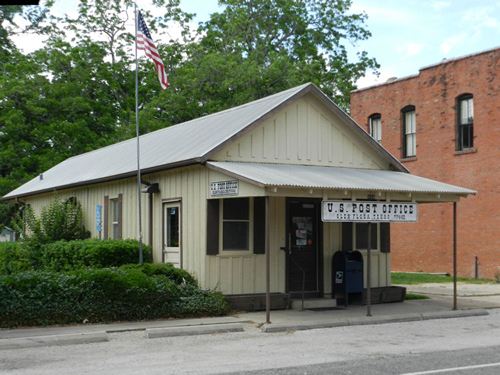 |
The Glen Flora
Post Office which was first opened in 1900 - been spared the fate
of so many small town post offices. It was to be turned into one of
the modular monstrosities that are polluting the Texas landscape -
but through the valiant efforts of certain townspeople, they were
able to retain the dignified little building that has served them
for these many years.
Although the modular units are tight, insulated, weatherproof and
they may also float and contain life support systems - one fact remains
- they are still ugly. Congratulations to the citizens of Glen Flora
who just said no to ugliness. |
L
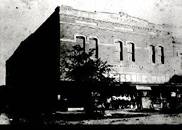
- The Martin and Hood Building
Vintage photo courtesy Antique Emporium
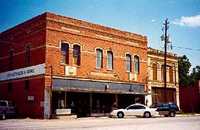
R - The Martin and Hood Building today
TE photo 2001 |
William Hood
came to Glen Flora and went into the Mercantile Business with R.M.
Martin. Martin had been Secretary of the Glen Flora Town Company.
They were doing a brisk business when the Geo. Northington Store opened
up across the street in 1903 (or 1905). The name of Northington is
woven tightly into the fabric of nearby Egypt,
Texas.
Hood and Martin had a fire in March of 1912 that did $ 9,000
damage to the building and destroyed $ 35,000 worth of merchandise.
They rebuilt in the form of a grander three-story building. The building
contains a rare buggy elevator. The buggy showroom was on the second
floor while domestic and yard goods were on the ground floor. Today
the Antique Emporium (beside their interesting antiques) is also a
spot for indoor birding. |
L
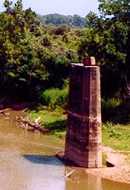
- Colorado River Bridge ruins
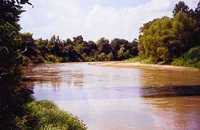
R - The Colorado River near Glen Flora
TE photo 2001 |
The 1913 Flood
was so bad even the traditionally dry San Bernard River flooded. It
has been called "The flood that washed away East Waco" but its devastation
extended all the way to the coast. At Glen Flora the town was covered
with 3 feet of water and the $17,000 county-owned bridge over the
Colorado River washed out. It had to be replaced with the help of
the railroad. The standing water might've been a relief if it arrived
in July, but the flood occurred on December 6th.
The force of the water was such that it washed away the collected
silt in the cotton fields to where the old six-foot rows (dating back
to 1869) were exposed.
The River crested at 44.65 feet and the railroad tracks were upended
so that they "looked like a picket fence."
Reference:
A History of Wharton County 1846-1961 by Annie Lee Williams
© John
Troesser |
Glen Flora,
Texas Forum
If you're looking
for a unique, quaint town, you need to visit Glen Flora in Wharton
County.
The post office was earmarked to be replaced by a generic modular
building, & the community campaigned to save the old post office building.
Hence the building was preserved, but remodeled & enlarged to address
several security & safety concerns. The end result is really something
to see. - Jerilyn Black, Postmaster Glen Flora TX 77443 April 22,
2001 |
| Texas
Escapes, in its purpose to preserve historic, endangered and vanishing
Texas, asks that anyone wishing to share their local history and vintage/historic
photos, please contact
us. |
|
|
 HOME
HOME
 Texas
Gulf Coast
Texas
Gulf Coast East
Texas
East
Texas Central
Texas North
Central
Texas North Central
Texas South
Central
Texas South Texas
Panhandle
Texas
Panhandle South
Texas
South
Texas Texas
Hill Country
Texas
Hill Country West
Texas
West
Texas Texas
Ghost Towns
Texas
Ghost Towns Texas
Counties
Texas
Counties