|
|
| Born
in Kentucky in 1788 and dying in California in 1851, makes it easy
to understand how Mr. Smith may have come close to being forgotten.
Scant mention is made of Henry Smith in Texas
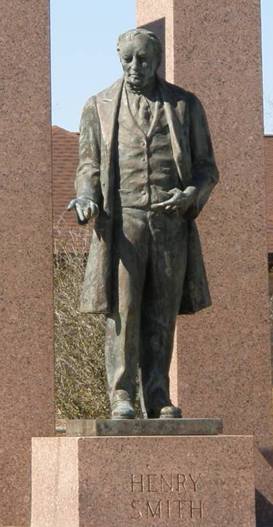
history texts, but the Centennial Statue in Brazoria
holds his place in early Texas
history. |
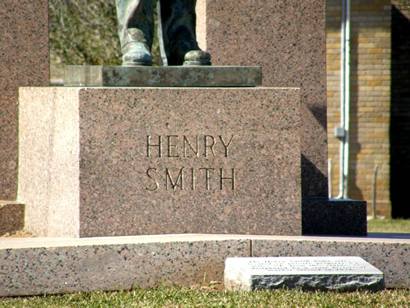
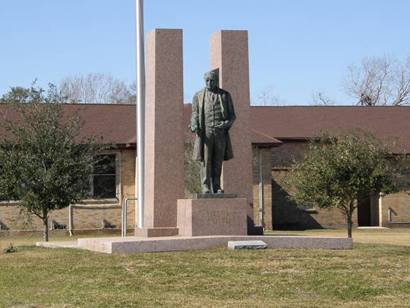
| The statue of
Henry Smith, designed by sculptor Hugo Villa, was a Texas
Centennial statue. It sits in the 200 Block of North Brooks Street,
(AKA Highway 36) in Brazoria.
|
Ten Things
to Know about Henry Smith:
1. Smith entered
Texas in 1827, settling in along the coast at present-day Brazoria
County. He was wounded at the 1832 Battle of Velasco
and was an early convert to the idea of Texas Independence.
2. His election as Alcalde in 1833 and then appointment as the head
of the newly established Mexican “Department of the Brazos” the following
year forced him to keep quiet about his thoughts of Texas Independence.
By all indications, the Mexican government had faith in Mr. Smith’s
loyalty.
3. In the summer of 1835, the Mexican Constitution of 1824 was upheld,
but by November of that year, a majority of the General Council favored
Independence and named Smith (as leader of the Independence party)
governor – giving claim to his most remembered title of “First American
Governor of Texas.”
4. Smith is said to have assumed that Texas became a free state by
simple declaration. As governor, he was known to be both “undiplomatic
and uncompromising.” As governor, he attempted to dissolve the council
while the council attempted to impeach him.
5. Things came to a head in January of 1836 when he was charged with
failure to support the Declaration of November 7, "official perjury,"
and slandering members of the General Council. But Independence (and
Santa Anna’s advancing army) demanded the full attention of the Convention
and Smith’s transgressions were laid aside and ultimately forgotten.
6. After Independence, Smith had enough friends left to nominate him
for President of the new Republic, even though Smith, himself, openly
supported Sam Houston.
7. He became Secretary of the Treasury under Houston, but failed in
balancing the budget of the emerging Republic – a feat that would’ve
proven impossible for anyone since the Republic was essentially bankrupt.
8. In the late 1830s, Smith built his home on Live Oak peninsula in
present-day Aransas County. In 1840 Smith was elected to Congress
and later served a single term in the House of Representatives before
retiring to his coastal home.
9. In 1849 he joined the hordes of gold-seekers in California, dying
two years later in an unnamed Los Angeles County mining camp.
10. Mr. Smith was married three times and his three wives were sisters.
(Harriet, Elizabeth and Sarah Gillett). |
 |
|
|
 HOME
HOME