Book by
MIKE COX
Order Here |
|
| The
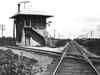
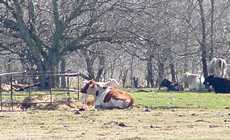
field that once was Crush, Texas is now occupied by cows, but a recently
replaced historical marker south of West,
Texas tells the story of one of the most bizarre publicity stunts
of all time. |
The
site as it appeared in February of 2004
TE Photo |
It
was a slow day at the office and George Crush, a passenger agent for
the Katy railroad was thinking about train wrecks and how they never
failed to draw a crowd. George knew that even the slightest collision
would have people coming from far and near to see derailments, explosions
and steam-scalded victims.
If accidents drew crowds of hundreds, how many would come to a deliberate,
heavily publicized crash? Agent Crush bet the numbers would be in
the thousands, but no one in Texas in the 1890s was stupid enough
to take the bet. They knew better.
George ran the idea up the MKT flagpole and his superiors saluted
it. The railroad laid a spur off their main tracks north of Waco
in September of 1896. A four mile spur with a grandstand, press offices,
a bandstand and a "depot" marked Crush, Texas.
The "Monster Crash" was advertised for months in advance and newspapers
kept readers updated on preparations. Two obsolete engines were given
a reprieve from the scrap furnaces and reconditioned to the point
where they could build up a good head of steam. Painted in contrasting
red and green, and pulling boxcars covered in advertising, the locomotives
were like aged gladiators painted with cosmetics for one final battle
where both would lose. They were displayed in various towns before
the event and people all across Texas were hoping they would live
long enough to witness the event.
The
half-town, half-carnival that became Crush, Texas was set up with
restaurants, game booths and "lemonade" stands. Some of the latter
even sold real lemonade!
The railroad had offered two dollar round-trip tickets from anywhere
in the state and the first of thirty-three excursion trains began
arriving at dawn on September 15, 1896. Some of the trains arrived
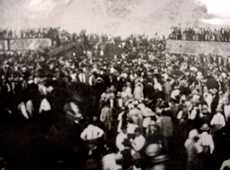
with passengers riding al fresco - on top of the cars. Approximately
40,000 men, women and children were given until late afternoon to
spend their money and be subjected to the speeches of politicians,
the warnings of prophets and the light fingers of pickpockets.
The few trees on the site had boys hanging in them like noisy fruit.
Children sat on their father's shoulders and ladies were politely
asked to remove their hats. At 5:00 p.m. the engines nosed toward
each other and "shook hands" like prizefighters before backing into
position.
Agent Crush, riding a borrowed white horse, threw down a white hat
as a signal and got out of the way. The engines headed toward one
another while the crowd roared their approval over the locomotive's
death-whistles. |
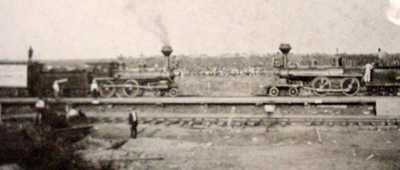 |
The
Event Unfolding
Photo Courtesy The Texas Collection, Baylor University |
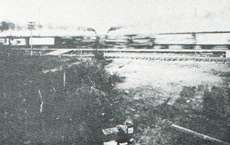
The
Crash
Photo Courtesy The Texas Collection, Baylor University |
The
Aftermath
Photo Courtesy The Texas Collection, Baylor University |
Railroad
officials had taken the precaution of asking their best mechanics
about the chances of the two boilers exploding. The officials were
reassured that it would never happen. But, the mechanics were wrong
and the boilers exploded on impact, sending shrapnel into the crowd
and killing several spectators. A hot bolt was sent through the eye
of a Waco
photographer (who miraculously survived).
Those not carried away by ambulance or hearse went home to brag to
their friends and relatives that couldn't scrape together the two-dollar
fare. Railroad cranes removed the big iron and souvenir hunters took
away the smaller pieces. By nightfall, all that was left was mud,
red and green chunks of iron and pools of used lemonade.
The Katy did have some claims by irate relatives of the victims, but
refunds, cash payments and lifetime passes took care of them. A lifetime
railroad pass in the 1890s was like winning the lottery. George Crush
was fired (with a wink) and was rehired as soon as the press moved
on to other disasters. Some accounts say that he was given a bonus.
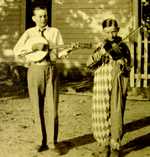
Although
the "town" only existed for a day, the event was certainly remembered
by the local residents. This photo shows two boys in 1935 - with the
photo identified as being "near Crush, Texas." |
Two Boys playing instruments in their yard identified as "near
Crush, Texas"
Photo Courtesy West, Texas Library and Museum
|
|
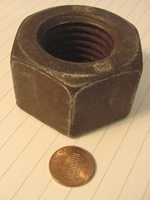
An
iron nut that may or may not have been present on Sept. 16th
1896.
TE Photo, March, 2004 |
|
Ragtime
composer Scott Joplin commemorated the event a few years later
with "The Great Crush Collision." It wasn't one of his most memorable
tunes and it was left out of the soundtrack for The Sting. Fortunately,
though, contemporary composer, singer and Last Texas Troubadour
Brian Burns, was inspired enough by the event to record his song
about the collision in 2001.
Mr. Burns unique specialty is blending Texas history and music. Playing
to schools (where he says the students inspire him as much as he inspires
them), events and venues, he leaves behind enthusiastic audiences
and a rapidly growing following.
© John Troesser
March 28, 2004 Column
Reprinted in the Bricolage Truth - December 2014 THE
ACCIDENT ISSUE (http://www.bricolagetruth.com) |
|
|
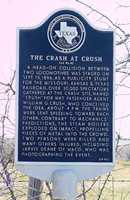
The
recently replaced Historical Marker
Location
A few miles South of West,
Texas (North of Waco,
South of Hillsboro)
on the I-35 service road (East side of the highway)
TE Photo,
February 2004 |
Historical Marker:
The Crash
at Crush
A head-on collision
between two locomotives was staged on Sept. 15, 1896, as a publicity
stunt for the Missouri, Kansas & Texas railroad. Over 30,000 spectators
gathered at the crash site, named "crush" for MKT passenger agent
William G. Crush, who conceived the idea. About 4 p.m. the trains
were sent speeding toward each other. Contrary to mechanics' predictions,
the steam boilers exploded on impact, propelling pieces of metal into
the crowd. Two persons were killed and many others injured, including
Jarvis Deane of Waco,
who was photographing the event.
(1976) |
Crash at Crush
Forum
Subject:
Crash at Crush
General Passenger
Agent William 'Bill' Crush, of the Missouri-Kansas-Texas Railroad
-- the Katy -- was the first to stage a collision between locomotives,
but far from the last. For several years prior to the Crash at Crush,
Broadway shows had been simulating railroad crashes on stage, together
with sparks, fire, and steam. A man known as 'Head-on Joe' staged
collisions at fairs from a few weeks after the Crush show until
the 1920s. The last deliberately-staged collision of steam locomotives
was filmed for the movie Denver & Rio Grande, when two former
D&RGW narrow-gauge locomotives were crashed on former D&RGW (by
then Durango & Silverton) narrow-gauge tracks in Colorado. One boiler
exploded, so it's fortunate the crash was filmed with telephoto
lenses. - C.
F. Eckhardt, May 10, 2006
|
| Texas
Escapes, in its purpose to preserve historic, endangered and vanishing
Texas, asks that anyone wishing to share their local history, stories,
landmarks and recent or vintage photos, please contact
us. |
|
|
 HOME
HOME