|
|
Periodically,
there are documentaries aired relating to events of U.S. involvement
preceding, during, and following the Cuban Blockade. Much has been
said on “taking down the wall” and the subsequent opening of borders
in Berlin. One rarely hears of the Berlin Wall Crisis, a critical
time in history in which I was personally involved.
One afternoon in September, 1961, I was en route to my home from work,
listening and enjoying programming on the car radio, when an announcer
broke in with these words: “The 49th Armored Division, Texas National
Guard, has been activated; members report to your Armory for further
instructions”. That was a shock to hear!
I was a Radio-Teletype Team Chief with Headquarters Company, Combat
Command C, 49th Armored Division, Texas Army Reserve National Guard,
4th Army, based in Houston.
(That was a mouthful…) Our Armory was located at the Ellington Air
Force Base off I-45 towards Galveston.
Upon arrival, we were told that we had fifteen days to “clear our
calendars” and be prepared to convoy to Ft. Polk, LA. |
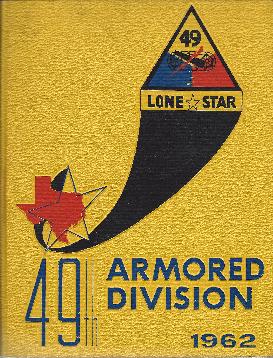 |
| Lone Star 49th
Armored Division 1962 |
|
A side-note
of irony is that when we were at summer camp in Ft. Hood only two
months earlier, the rumors were that we would be activated due to
the Cuban Missile Crisis. We “escaped” that rumor and chuckled to
ourselves that the 36th Infantry Unit, following us at Summer Camp,
would be the ones activated.
The
Ft. Polk base had been closed and inactive for five years, with
only a small portion still open for summer camp use by the Louisiana
National Guard. When we arrived, a lot was in disrepair; barracks
windows were broken, heating boilers were not fully functional –
and here we are approaching the winter months. The first couple
of weeks were hectic, to say the least. Supplies had not yet arrived.
We went to the local hardware and building supply stores to buy
tools, equipment, and materials in order to perform repairs to buildings
and the grounds.
Once “settled in”, training began to improve readiness in our respective
Military Occupational Specialties. Much time was also spent “in
the field” on bivouac maneuvers, putting into practice lessons of
training.
As
I am sure occurs with many in numerous military experiences, over
time there were humorous moments. In the field, everyone ate from
mess kits; and, going down the chow line, meat was the first served,
with vegetables ladled second, and the dessert was last and wound
on top of the stack. It was not unusual to eat peaches, potatoes,
and meat – in that order. On one occasion, the cooks forgot to pack
flour among the provisions and fried chicken was on the menu to
be served. The only thing from which a batter could be made was
cake mix, Hey, that contains flour; improvise! The pieces of chicken
cooked to a golden brown, a great looking crust. But, the meat itself
was still raw, because of the crust browning sooner than a normal
cooking cycle.
During another field exercise, units loaded their equipment on the
trucks and proceeded to their designated locations. Upon arrival,
our company unloaded everything, set up the command center, hooked
up all the equipment and was operational around 11:00 PM. By that
time, it was really too late to set up their pup tents, so everyone
simply blew up their air mattresses, crawled into their sleeping
bags, and hoped for a good nights’ sleep. Apparently, someone didn’t
check the weather forecast! It began to rain, and it rained, and
it rained. Everyone seemingly planned to weather the storm, cocooned
up in their sleeping bags. By daybreak, it had rained to the point
that air mattresses had floated quite a ways from their original
placements on the rolling terrain.
One
serious moment occurred in the spring of 1962. After the evening
meal, an alert was sounded that all Units of the Division were to
pack up the base and make-ready for point of debarkation at the
Port of New Orleans. By 11:00 PM, all Units had loaded their gear
and were in convoy formation, ready to drive out the gates. At that
time, the command was given to stand-down and return to quarters.
We have no certainty to this day whether it was a “Readiness Alert”;
or, whether something ominous was eminent.
The 1st Armored Division was already stationed in Germany; the 2nd
Armored stationed at Ft. Hood would have been deployed as a second
line of defense; and, the 49th would have been the third source
of personnel and equipment for replacements during conflict.
The
various Units were comprised of Guardsmen from across the State
and maintained as homogenous hometown personnel. The Unit adjacent
to ours was from the Rio Grande region with a large number of members
being Mexican-American. Mexican food was not on the Army menu schedule;
so, our cooks and theirs schemed to trade foodstuffs in order for
them to prepare ethnic meals on occasion. Mexican-Americans in our
Unit were often invited as guests to join; and, the “gringos” in
their Unit would be our guests. In this black-market exchange, we
often got extra servings of steaks! In civilian life, one of our
cooks worked in a bakery. He would often spend extra hours at night
cooking pastries, cakes, and pies above and beyond the menu schedule.
A cloudy issue during the beginning of service was the recall of
“regular” Army personnel, with recent discharges, to fill voids
in our ranks. The “Why Me” personnel were understandably bitter.
Their backgrounds, though, were helpful toward our transition of
duties. Over time, these “regulars” and our “weekend warriors” blended;
and, some meaningful friendships emerged.
Much of the remainder of our tour of duty was rather routine. One
of my assignments was to monitor radio and wire service transmissions.
In evenings and over weekends, we in the Communications Section
could become “hams” over the MARS network.
|
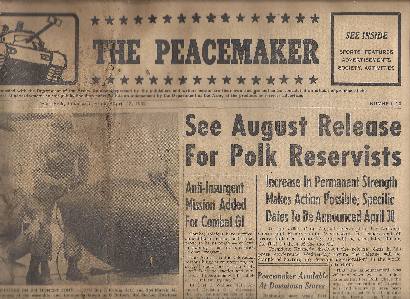 |
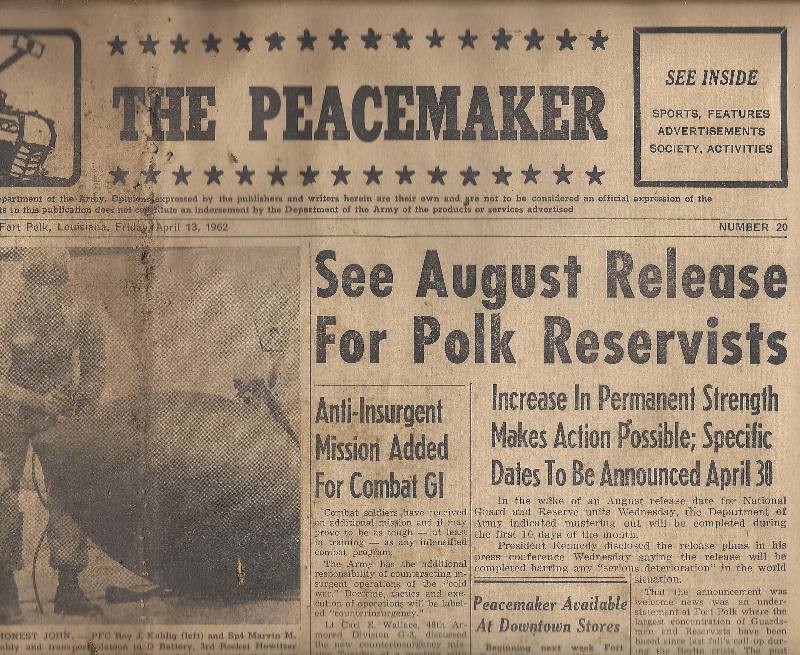
"The Peacemaker"
Vol. 1, No 20
Friday, April 13, 1962
Published by Beauregard News, Inc
"Published in the interest of the Personnel and their Dependents,
Ft. Polk, LA"
Click on picture for large image |
|
In
early July, President Kennedy issued orders that our Division, as
well as the one called up in Washington State, be returned to inactive
status. By mid-August, we were homeward bound. No parades, but it
was good to be back home, return to jobs, and restore family and
community relationships.
Upon our departure, Ft. Polk was converted into a training base
and personnel from Ft. Carson in Colorado Springs, Colorado were
transferred as its initial troops who were eventually deployed to
Viet Nam duty.
|
|
|
Click
on picture for large image
|
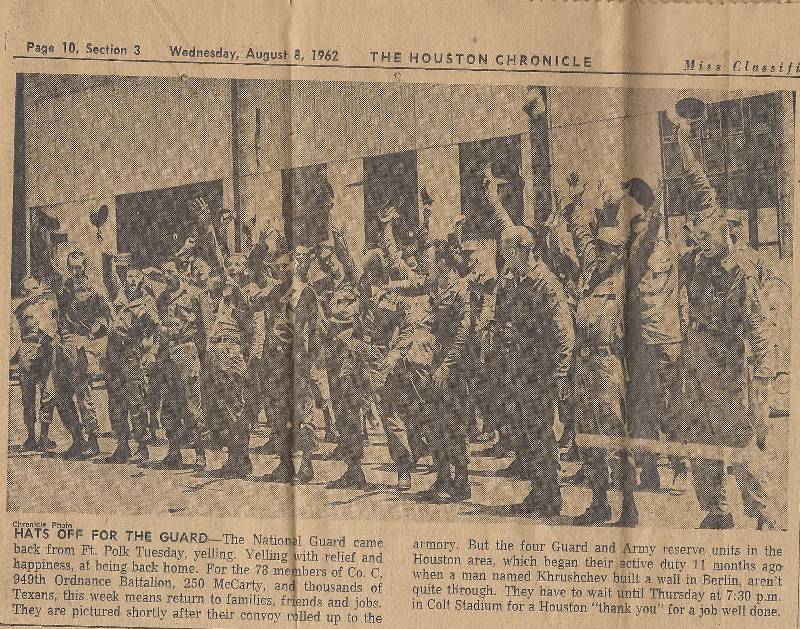
HATS OFF FOR
THE GUARD — The National Guard came back from Ft. Polk Tuesday,
yelling. Yelling with relief and happiness, at being back home. For
the 78 members of Co. C, 949th Ordinance Battalion, 250 McCarty, and
thousands of Texans, this week means return to families, friends,
and jobs. They are pictured shortly after their convoy rolled up to
the armory. But the four Guard and army reserve units in the Houston
area, which began their active duty 11 months ago when a man named
Khrushchev built a wall in Berlin, aren't quite through. They have
to wait until Thursday at 7:30 p.m. in Colt Stadium for a Houston
"thank you" for a job well done.
Houston
Chronicle - Wednesday, August 08, 1962 |
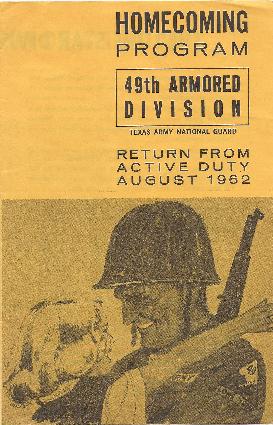
HOMECOMING
Return from Active Duty August 1962 |
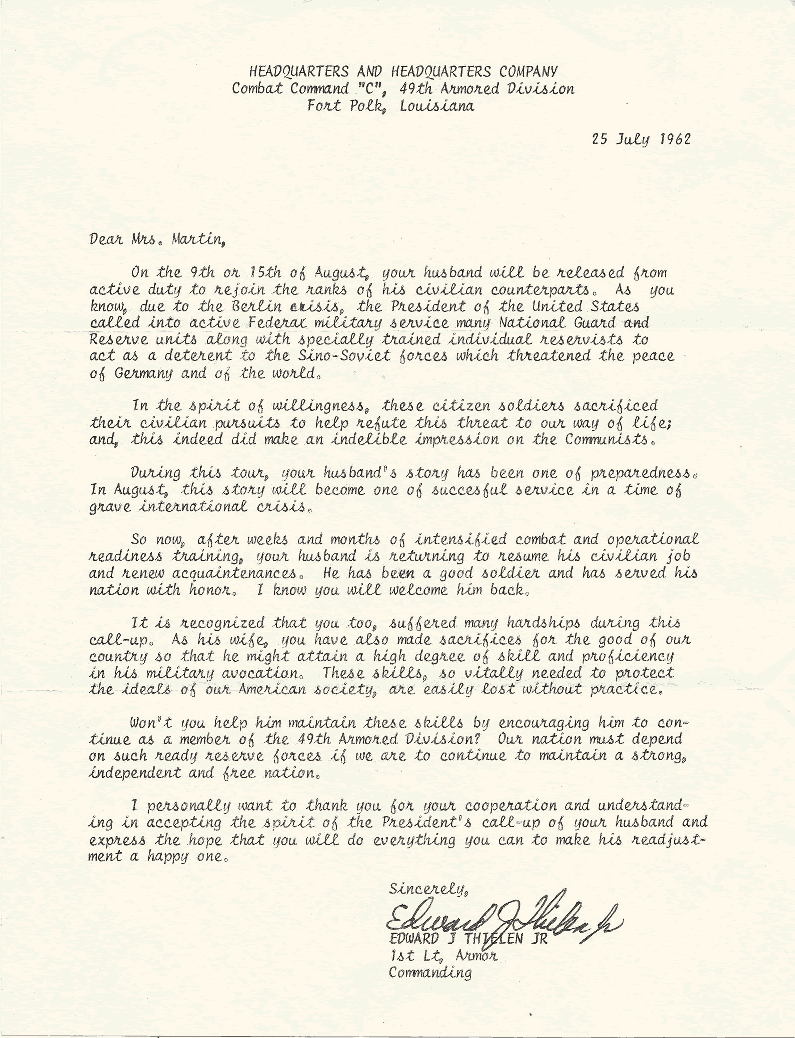
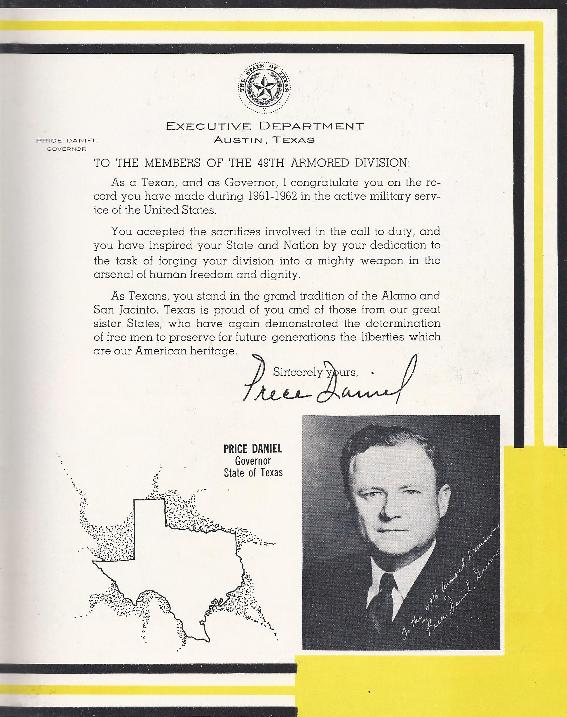
L - Letter from
Fort Polk, LA Commander, 1962
R - Letter from Texas Governor Price Daniel
Click on letter to for large images |
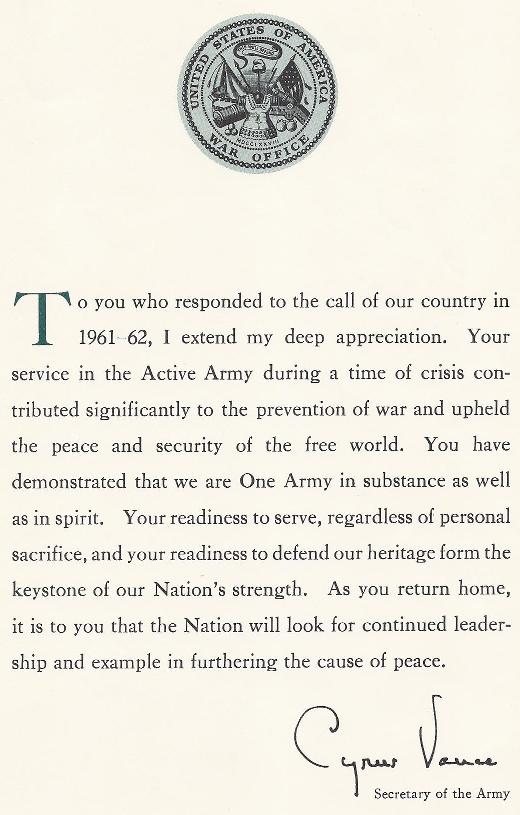
Letter
from US War Office
Cyrus Vance, Secretary of the Army
Click on letter for large image |
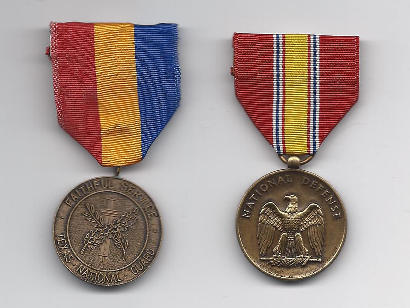
L - "Faithful
Service, Texas National Guard"
R - "National Defense"
S/Sgt Bruce A. Martin, TexARNG (1958-1963) |
Forum:
Subject: "Berlin Wall Crisis 1961"
Mr. Martin, It was with great interest that I read your article on
TexasEscapes.com on the activation of the 49 AD (Texas) Guardsmen
during the Berlin Wall Crises. My dad was one of the Guardsmen who
served at Ft. Polk during that time... Thank you for your service
to our country! - Tracy P. Teems, USAF & TxANG Vet - 1983-95, June
08, 2013 |
|
|
 HOME
HOME