|
| Our most recent
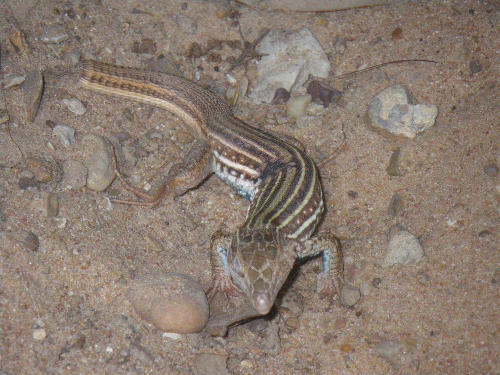
admit: a female six-lined racerunner. She was discovered slow to move
and freshly de-tailed in a local barn. With a little bit of TLC and
lots of heat, she seems to be on the road to recovery, energetically
chomping down her daily fare of crickets. The black blotch that extends
across her right side is a scar remaining from a fully healed over
wound of the past, which leaves us with great hope that this tough
female will fully recuperate and be back chasing down lunch in the
wild in no time. |
Six-lined Racerunners
in Texas
Photo courtesy Dove Key Ranch Wildlife Rehabilitation |
Six-lined Racerunners
in Texas:
Identifiable
by their fast and jerky dashes and the six light-colored lines that
streak from head to tail base, six-lined racerunners enliven well-drained,
sun-filled environs across all but extreme west
Texas. These 6 – 10 1/2 inch long lizards advertise their age
and sex through subtle coloration schemes: females wear inconspicuous
white throat scales, while males don flashy green to bluish hues along
their gular regions. Juvenile racerunners boast their youth in the
form of blue tails, while more mature individuals can be identified
by discreet tan to brownish tails.
Once the proper social displays have been traded, pairs mate in the
beginning of April through late June. Egg-laden females deposit one
to six fertilized eggs in a specially dug brooder burrow that can
be up to a foot below ground. Under favorable conditions, the act
may be repeated once more over the summer, at least three weeks following
the initial deposit. Approximately two months later, blue-tailed youngsters
hatch and dig upwards to the dry grasslands, woodlands, or coastal
dunes that will become their hunting grounds.
Darting out from vegetated cover to snatch the hapless invertebrates
that comprise its diet, a six-lined racerunner can reach speeds of
up to 18 mph! Strong hind legs and elongated toes help to propel these
reptiles swiftly towards dinner or away from numerous aerial and terrestrial
predators (hawks, snakes, and the neighbor’s cat to name a few). In
addition to sheer rapidity, this lizard species’ namesake striping
contributes to successful getaways: the horizontal lines blur in motion,
making the desired prey difficult to detect and impeding the judgment
of just how fast that racerunner is racing. At the end of a chase
is usually a safe burrow, which these reptiles excavate to hide not
only from predators, but also from overnight lows and winter cold
snaps. In some cases, the erratically-fleeing racerunner is captured
by its attacker and is forced to use its last chance resort: it drops
part or all of its tail. Hopefully, as in the case of our patient,
the pursuer will be distracted and/or satiated by the still writhing
appendage, permitting the main course to escape and sprint another
day. Although caudal autotomy may appear like a win-win situation,
the energy needed to regenerate a new tail may cost a female racerunner
the next reproductive season and tailless lizards risk losing dominance,
choice mates, and their original level of speed and maneuverability.
Plus, it’s a one-shot deal: once your tail’s gone, there’s no using
this trick to evade future predators until a new tail has grown back.
So, as you wilt in the shade sipping an ice cold beverage of your
choice on the next blistering mid-summer’s day, enjoy these hyper,
striped sun-worshippers, zipping around after insect meals and divulging
the stories of near catastrophes by foreshortened tails.
© Bonnie
Wroblewski
http://www.dovekeywildlife.org
May 13, 2010
More Dove Key Ranch Wildlife Rehabilitation
- "Animal of the Week" Series |
|
|
 HOME
HOME