|
A
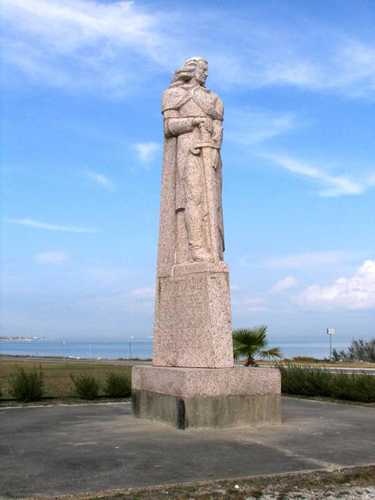
remarkable Frenchman whose name I love to rattle off when lecturing
about early Texas history, Rene Robert, Cavalier, Sieur de la
Salle, made an impact on East
Texas with his life and with his death.
First, "the life." La Salle led an expedition down the Mississippi
River to its mouth in the lower delta in 1682. There La Salle stuck
up the Bourbon fleur de lis and claimed and named all the land drained
by the river in the name of his sovereign, Louis. Then he returned
home to request permission to plant a colony near that site to anchor
French claims throughout the Mississippi Valley.
In 1685, La Salle returned to plant his colony, but either through
bad luck, poor navigation, or deceptive policy, he overshot his
target about 400 miles and landed instead in Matagorda Bay, primarily
to expand Spanish claims westward. I like the latter explanation
push French claims as far westward as possible at Spanish expense.
Certainly the Spanish took that attitude, as we shall see.
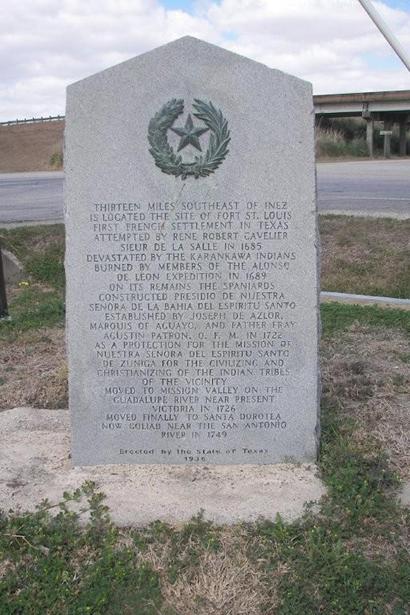
Anyway, once there, La Salle stayed. After pushing up a small stream,
he selected the site for Fort St. Louis and ordered the others,
who had remained on the coast, to hasten thither and to build a
fort. Eventually, after much grumbling and arguing, which is what
La Salle's colonists did best, they completed six buildings and
the one nearest a creek served as a fort.
And they could argue. The problem stemmed from La Salle's recruiting
method, which was to bring too many "gentlemen" who refused to work,
and from La Salle's own abrasive personality. After their three
boats either returned to France or sank in the bay, La Salle agreed
to lead part of the men to seek relief from French settlements on
the Mississippi.
Unfortunately, on the way, La Salle's men murdered him. Meanwhile,
the Spanish searched for the fort to destroy it, but when they found
it they learned that Indians had beaten them to the task.
|
 HOME
HOME