|
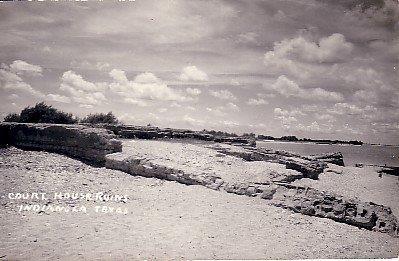
"Destroyed
in the 1886 hurricane, part of the second Calhoun County courthouse's
foundation can still be seen at low tide in Indianola." - Terry
Jeanson.
See Calhoun
County Courthouses
Photo circa 1945 courtsy THC |
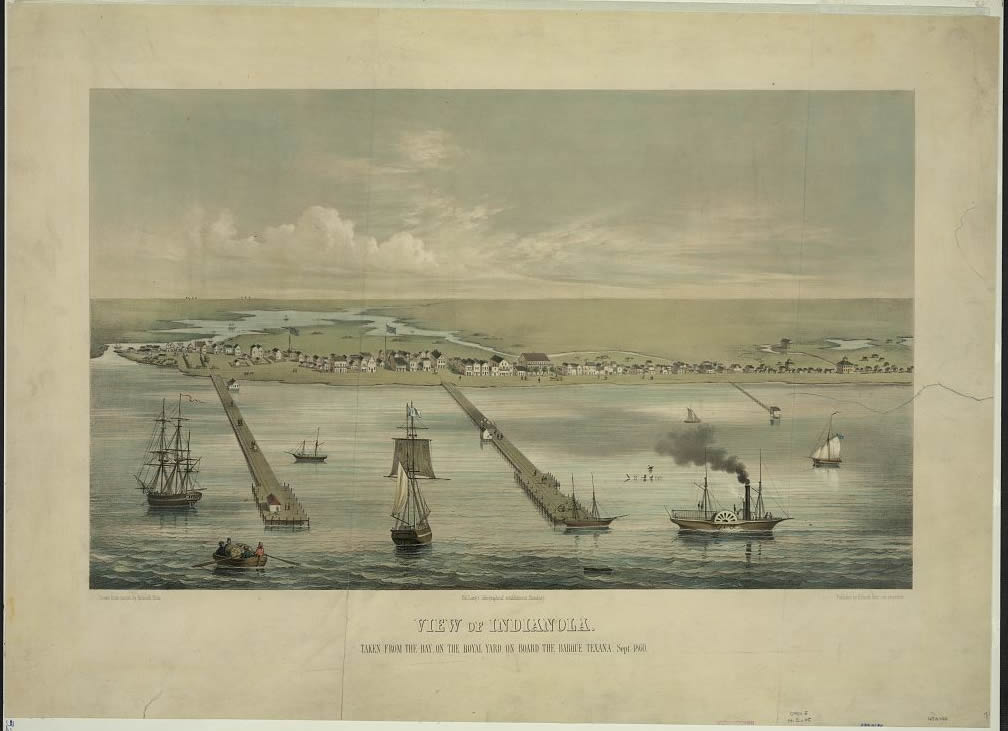
Indianola Texas
1860 lithograph by Helmuth Holtz
Click on image to enlarge
Library of Congress |
History
in a Watersoaked Pecan Shell
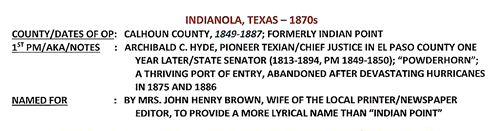
Started in 1846 as Indian Point, the town almost immediately
entered into a rivalry with Port
Lavaca. Lavaca had taken the role of leading port south of Galveston
after Linnville
was burned by Comanches in 1840.
Indianola is Texas' Queen of ghost
towns. While Thurber
(west of Ft. Worth)
was nearly as colorful, Thurber's
history had to do with labor relations, immigrant miners, infrastructure,
manufacturing and railroading - while Indianola was a port of debarkation
for the thousands of European immigrants (plus a few boatloads of
camels).
Today, they have only one thing in common - hardly any trace of either
town exists.
In 1845, thousands of Germans were stranded at Indianola because
their agents had gone broke. Disease claimed many lives on the shore,
and when others attempted to walk to their destinations of New
Braunfels and Fredericksburg,
they infected the established populace, causing hundreds of more deaths.
Many who couldn't finish their journey settled in the towns of Victoria,
Cuero
and Gonzales.
(See The
Story of our Texas' German Pilgrims: or Death March to Comal County
by W. T. Block Jr.)
A storm hit the Texas
coast in 1851. It was referred to as "The Great Storm" until
the bigger ones arrived.
During the Civil War, Indianola was occupied by the Union Army
and there were enough skirmishes to keep both sides occupied. After
the war "occupation" was peaceful and relations cordial. Discord would
stand in the way of business and in Indianola business was everyone's
interest.
As a port to rival New Orleans, Indianolia was well on its way. Ships
had started sailing directly from New York and New England. The New
England ships brought cargoes of ice - cut in the winter months. A
newspaper called the Indianola Bulletin had correspondents
as far inland as Wilson County (30 miles east of San
Antonio).
Besides storms, a fire did damage in 1867 and the same year
brought a yellow fever epidemic.
The first major hurricane to hit a fairly populated Indianola was
in 1875. Nearly all of the debris was used in rebuilding a
stronger and more secure city. The second storm of 1886 totally
demoralized Indianolans and forced them to move inland. In some cases
the few houses that were left standing were moved inland to places
as distant as Victoria,
Cuero
and even Gonzales.
The huge ice warehouse, second in size only to the courthouse, was
floated across the bay and converted into a residence. As one of the
few remaining buildings - it had proven its strength.
(See Indianola
Remnants by Mike Cox) |
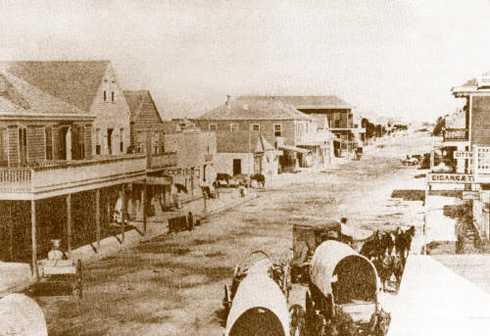 |
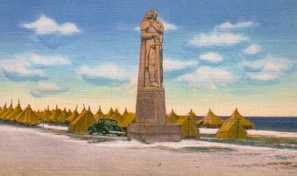
| Indianola
vintage photo courtesy texasoldphotos.com |
The Beaumont-Steele
house
at 501 N. De Leon in Victoria |
Indianolia could've rebuilt again, but the amount of silt and sand
blown in by the storm made the bay too shallow for the ships that
mattered.
Three railroads had Indianola
in their name and had varying degrees of success. "Warehouse Row"
- was Indianolia's cash cow. Although the warehouses had different
owners, they were a select group of businessmen, which made for a
near-monopoly. |
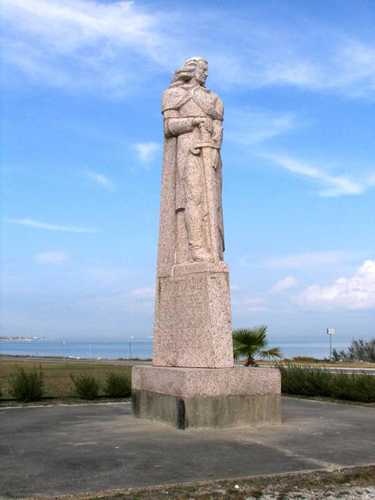
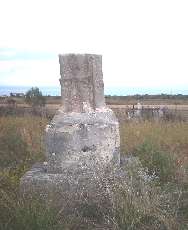
Remains
of the first La Salle monument near the Indianola
Cemetery
Photo Courtesy Ralph Ware, May, 2004 |
Beef:
It's what's for dinner - next year
Even prior to the Civil War, as early as 1848, companies in
Indianola were canning beef. Or shall we say they were experimenting
with the process. The initial test market was the shipping industry
since they needed food that wouldn't spoil on long voyages.
After the war, the glut of cattle made beef valueless. Cattle were
slaughtered for their hides and tallow and the meat was left to rot.
Experiments were conducted, equipment built and Indianola was the
first port to ship refrigerated beef to Eastern markets in 1869.
The reading of Indianola's history is rewarding both for its influence
on early Texas and for the drama and tragedy of its brief life.
© John
Troesser |
Indianola Stories
-
Eyewitness Accounts & Aftermath
Indianola
Remnants by Mike Cox
Indianola, once the “Queen City of the West,” recovered from a killer
hurricane in 1875 but it did not survive a second devastating storm
in 1886.
Modern day visitors find few remnants of the once prosperous Calhoun
County seaport, but they’re looking in the wrong place. If you want
to see some of Indianola’s stately Victorian houses, just go to
Victoria or Cuero... more
The
Story of Indianola by Maggie Van Ostrand
On my bookshelf sat a slim volume of poems by one Jeff McLemore....
The name of the book, published in 1904, is "Indianola
and Other Poems,"...
Indianola
A poem by Jeff McLemore published in 1904.
Indianola
A poem by David Knape
Sept.
17, 1875 - Indianola History Cartoon by Roger T. Moore
Aug.19,
1886: Indianola History Cartoon by Roger T. Moore
|
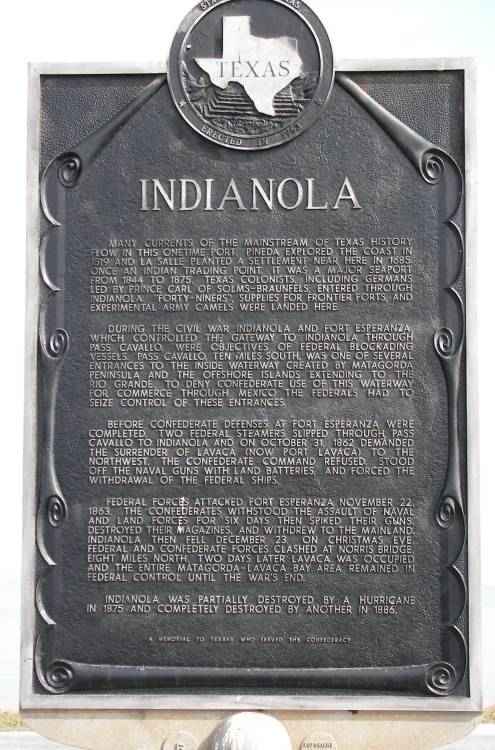
Indianola Historical
Marker
Photo courtesy Barclay
Gibson, December 2006 |
Indianola Historical
Marker:
INDIANOLA
Many currents of
the mainstream of Texas history flow in this onetime port. Pineda
explored the coast in 1519 and La
Salle planted a settlement near here in 1685. Once an Indian trading
point, it was a major seaport from 1844 to 1875. Texas colonists,
including Germans led by Prince Carl of Solms-Braunfels, entered through
Indianola. "Forty-niners", supplies for frontier forts, and experimental
Army camels were landed here landed here.
During the Civil War Indianola and Fort Esperanza, which controlled
the gateway to Indianola through Pass Cavallo, were objectives of
Federal blockading vessels. Pass Cavallo, ten miles south, was one
of several entrances to the inside waterway created by Matagorda Peninsula
and the offshore islands extending to the Rio Grande. To deny Confederate
use of this waterway for commerce through Mexico the Federals had
to seize control of these entrances.
Before Confederate defenses at Fort Esperanza were completed, two
Federal steamers slipped through Pass Cavallo to Indianola and on
October 31, 1862 demanded the surrender of Lavaca
(now Port
Lavaca) to the northwest. The Confederate command refused, stood
off the naval guns with land batteries, and forced the withdrawal
of the Federal ships.
Federal forces attacked Fort Esperanza November 22, 1863. The Confederates
withstood the assault of naval and land forces for six days then spiked
their guns, destroyed their magazines, and withdrew to the mainland.
Indianola then fell December 23. On Christmas Eve, Federal and Confederate
forces clashed at Norris Bridge, eight miles north. Two days later
Lavaca
was occupied and the entire Matagorda-Lavaca Bay area remained in
Federal control until the war's end.
Indianola was partially destroyed by a hurricane in 1875 and completely
destroyed by another in 1886.
A memorial to Texans who served the Confederacy. |
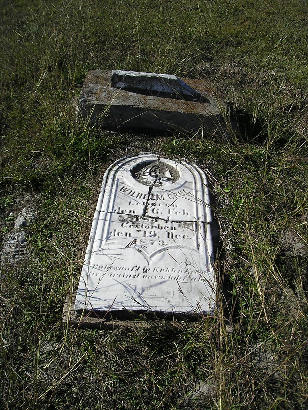
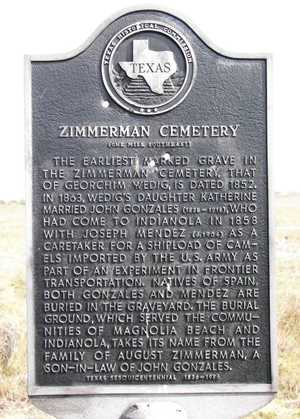 |
Zimmerman Cemetery
Marker
on FM 316 near Indianola
Photo courtesy Barclay
Gibson, December 2006 |
Historical Marker:
Zimmerman Cemetery
The earliest marked
grave in the Zimmerman Cemetery, that of Georchim Wedig, is dated
1852. In 1863, Wedig's daughter Katherine married John Gonzales (1838-1918),
who had come to Indianola in 1858 with Joseph Mendez (d. 1904) as
a caretaker for a shipload of camels imported by the U.S. Army as
part of an experiment in frontier transportation. Native of Spain,
both Gonzales and Mendez are buried in the graveyard. The burial ground,
which served the communities of Magnolia Beach and Indianola, takes
its name from the family of August Zimmerman, a son-in-law of John
Gonzalez.
Texas Sesquicentennial 1836-1986 Supplemental plate (1989) Correction:
The last line of the Zimmerman Cemetery historical marker should read
"son-in-law of Joseph Mendez." |
Indianola Related
History:
|
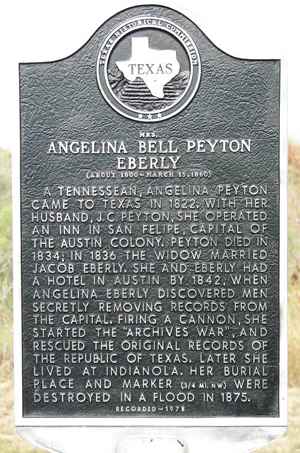
Mrs. Angelina
Bell Peyton Eberly Marker near Indianola
Photo courtesy Barclay
Gibson, December 2006 |
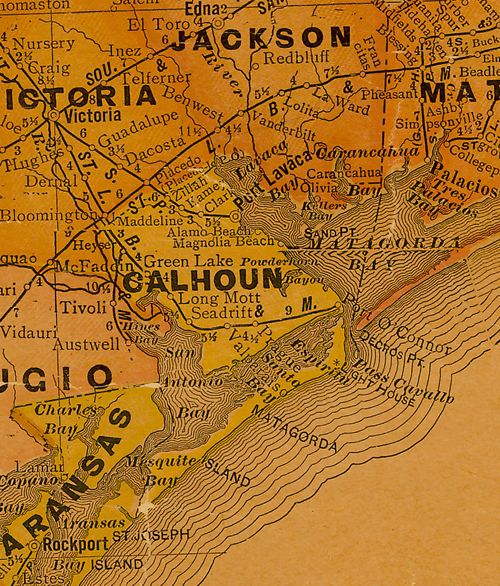
Calhoun
County 1920s map showing Matagorda Bay
From Texas state map #10749
Courtesy
Texas General Land Office |
| Texas
Escapes, in its purpose to preserve historic, endangered and vanishing
Texas, asks that anyone wishing to share their local history, stories,
landmarks and recent or vintage photos, please contact
us. |
*The
Indianola Railroad Company | Indianola and GuadalupeValley Railway
|
The Indianola, San Antonio and El Paso Railroad |
|
|
 HOME
HOME