|
| Samuel
Doak McMahan moved his family from Tennessee and settled in the municipality
of San Augustine
about eleven miles south of the nascent town in 1831. Other family
members, including William Friend McMahan, established homesteads
in Newton County.
All the McMahan's made contributions to the Anglicization of East
Texas, but Samuel's experience was exemplary: he affixed the family
name to the first organized Protestant and Methodist congregation
in Texas. |
 |
Here is how it
happened. The Rev. James P. Stevenson, a representative of the Mississippi
Conference of the Methodist Church, was posted to the Louisiana Circuit
in 1832. Stevenson headquartered near the Sabine
River just a few miles from McMahan's farm. In 1833, Stevenson
accepted an invitation to cross the river into Texas to preach to
settlers who wanted to hear the "old time religion." These services
were proscribed by Mexican law, which established Roman Catholicism
as the official religion of Mexico. Assured of protection from authorities,
Stevenson held a two-day meeting in a home in Milam,
a small community near the Sabine
River. McMahan attended the services, liked what he heard, and
asked Stevenson to hold additional services in his home. Stevenson
did so and returned several times during the year to a religious field
anxious for his ministry.
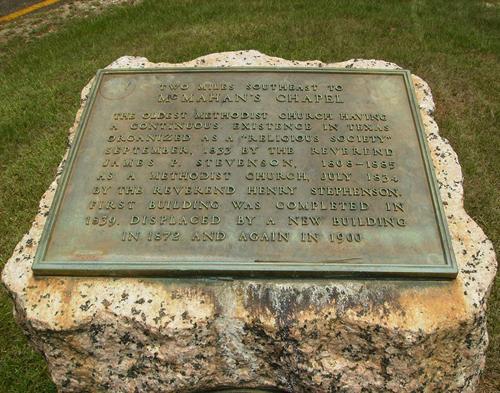
In September, the group organized a "religious society," euphony for
a church, to skirt Mexican legal prohibition of formal Protestant
worship. Actually, this was a good-will gesture. There is little evidence
of government attempts to interfere with Texas settler's worship practices
or to supply them with Catholic churches or priests east of San
Antonio. The "society" had 48 members when it was organized, and
McMahan served as "class leader." The Rev. Henry Stephenson, Stevenson's
successor in the Louisiana Circuit, reorganized the society in McMahan's
home, which became known as McMahan's Chapel.
Protestant
religious activity increased in Texas after the successful Texas Revolution.
In 1838, the Mississippi Conference created the Texas Mission District
and assigned the Rev. Littleton
Fowler to lead it. Fowler lived near McMahan's Chapel and took
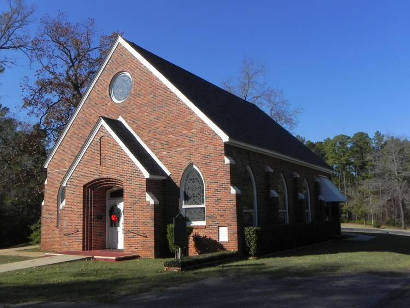
special interest in its development. In 1839 he helped build a log
structure for the church, which was the first of three wooden predecessors
of the small brick chapel erected in 1956. Fowler, McMahan, and other
pioneers of Methodism are buried in the church cemetery.
In 1970, the general conference of the Methodist Church named McMahan's
Chapel as one of three official United Methodist landmarks. It serves
yet as a house of worship, and may be visited for that purpose by
driving east from San
Augustine on Highway 21 and turning onto Spur 35. |
 |
McMahan
Chapel by Bob Bowman
The news that San Augustine businessman Jack Maund has contributed
$100,000 for a museum and events center at McMahan Chapel Methodist
Church has focused new attention on one of East Texas’ most historic
churches... |
All
Things Historical
July 21-27, 2002 column
A syndicated column in over 70 East Texas newspapers
Forum:
My husband and I are caretakers for McMahan Chapel near San Augustine
and as a writer myself, I was delighted to find Mr. McDonald's article
on the chapel included in your website. There are a couple of inaccuracies,
though, that I feel need to be corrected.
The first is that Rev. Littleton Fowler is not buried in the cemetery
at McMahan Chapel as the article states. Instead, he was buried at
own request under the pulpit inside the chapel and has remained there
since his death despite the construction of several buildings that
replaced the original. The second error is on the brick building which
was actually dedicated in 1949, not 1959 as the article states.
I enjoyed Mr. McDonald's stories very much and just wanted to take
a moment to correct these errors. Sincerely, Patti Murr, August 28,
2004
Related Article:
Man
with a Method by Archie P. McDonald
"Long before winning fame and martyrdom at the Alamo, William
Barret Travis wrote to tell Methodist leaders in the United States
how badly Texas needed their attention. Samuel Doak McMahon held
the first meeting of Methodists in Texas in his home, located ten
or so miles east of San Augustine, in 1832, but the arrival of Littleton
Fowler in 1837 was the first authorized Methodist activity there..."
|
|
|
 HOME
HOME