|
|
Long
before Anglos settled East
Texas, the region’s first settlement was going about its business
on a prairie slope near the Neches
River in what is now Cherokee
County.
Caddoan Mounds, a settlement of dwellings and temples, was the home
of a prehistoric group of Caddo Indians, who settled in the Neches
Valley sometime in the late eighth century, A.D.
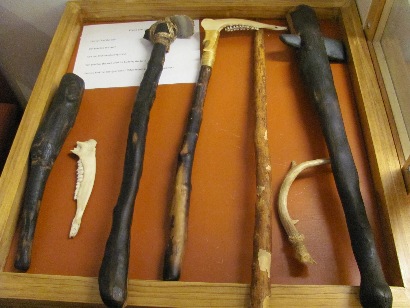
What is left of the mound-building Caddos is found in stone artifacts
and small tools at the Caddoan
Mounds State Historic Site east of Alto
on Texas Highway 21, often known as El
Camino Real. Founded in the l960s, it is a wonderful place for
a weekend family trip and to learn about the Caddos. |
| Photo
courtesy Dana Goolsby, October 2010 |
The Texas Forest
Service’s tree nursery, standing across the road from Caddoan Mounds,
was also a part of the Indians’ village. Nearby are two natural flowing
springs likely used by the Indians.
While the Caddo were among the first to establish villages in East
Texas, they were not the first Indians to come here.
During
some 11,000 years preceding the Caddo occupation at the prairie, small
groups of nomadic hunters and gatherers wandered through East
Texas, following game animals and collecting nuts and fruits.
Over several centuries, the introduction of corn,
pottery and the bow and arrow transformed the nomad hunters and gatherers
into village dwellers. The result was villages such as the one found
at Caddoan Mounds.
As their populations grew and their influence spread, the Mound Builders
established trade networks extending from the Rocky Mountains to the
Atlantic Ocean and from the Great Lakes to the Gulf of Mexico.
Trade goods included foods, raw stone materials, pottery, and finished
luxury and ceremonial objects, such as copper, ear spools, and stone
effigy pipes.
The Caddos lived in round beehive-shaped houses, which ranged from
25 to 45 feet in diameter and of similar heights. Temples and other
public buildings ranged in shape from round to squarish thatched structures,
often built on platforms.
Periodically for more than sixty years, archaeologists have been investigating
the mounds, attempting to learn more of their origin. Conclusions
from the excavations indicate that the site was an important Caddoan
community for centuries.
The volume of information gathered at Caddoan Mounds has provided
more knowledge about East
Texas’ oldest known “town,” but many questions remain unresolved.
Among them: What happened to the Caddos? Did they travel to another
land? Were they vanquished by rival tribes? Did they die of starvation
or an epidemic illness? Or did they simply leave when French and Spanish
explorers brought new and different people to East
Texas?
The answers are still to be resolved.
All
Things Historical August 4, 2008 Column
See Bob Bowman's
East Texas
A weekly column syndicated in 70 East Texas newspapers
(Distributed as a public service by the East Texas Historical Association.
Bob Bowman of Lufkin is a former president of the Association and
the author of more than 35 books.) |
| Texas
Escapes, in its purpose to preserve historic, endangered and vanishing
Texas, asks that anyone wishing to share their local history, stories,
landmarks and recent or vintage photos, please contact
us. |
|
|
 HOME
HOME