|
His
ship had run aground on a mud flat, his water and food supplies were
exhausted, and he curled up on a pile of rope to die.
That was more than 300 years ago. No one is certain of his name, but
today his bones rest among the titans of Texas history on a hillside
in the Texas
State Cemetery in Austin.
Texas Historical Commission archeologists discovered the sailor's
skeletal remains during the 1996 excavation of French explorer Robert
Cavelier, Sieur de La Salle's ship, the Belle, which sank in Matagorda
Bay in 1686.
Near the bones in the bow of the ship was a pewter cup with the inscription,
"C. Barange," and a small water cask. Archeologists know
from historical documents that the crew of the Belle ran out of fresh
water awaiting the return of La
Salle from his search for the mouth of the Mississippi River.
"This individual made a great contribution to Texas history,"
said THC Chairman John Nau III. "He was one of the first European
settlers in America and he has taught us much about his lifestyle
through the things he and his shipmates left behind."
THC archeologists recovered more than a million artifacts from the
sunken Belle, including bronze cannons, beads, pottery, coins, cutlery
and the ship's hull.
La
Salle and his crew had hoped to maintain French control over the Gulf
of Mexico and lay claim to Louisiana, but problems plagued the colonists.
One of La
Salle's four ships was lost, another ran aground, and a third
sailed home to France.
La
Salle and the remaining crew members established Fort St. Louis
near what is now Victoria.
The Belle and its supplies sank off the Texas coast during a violent
storm with at least one crew member still aboard.
La Salle left the coastal area and headed east with several men to
find the Mississippi River. Somewhere in what is now East
Texas, he
was killed by his men and buried. The site is unknown.
Forensic
tests revealed that the sailor was between 35 and 45 years old, stood
five feet and four inches tall, was arthritic and had suffered a broken
nose. Researchers completed a full facial reconstruction of the man,
which included three-dimensional imaging of the skull performed by
technicians at the Scottish Rite Hospital for Children in Dallas.
The information was used to generate an exact model of the skull.
Experts at the University of Michigan School of Art and Design produced
a facial reconstruction of what the man would have looked like. |
|
|
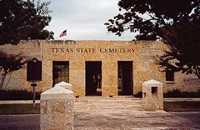
Texas
State Cemetery
TE Photo |
Hundreds of historians,
state officials and news people gathered in the Texas
State Cemetery for the funeral service the sailor never had.
As I sat watching the rites by a Catholic priest, it suddenly struck
me that the lonely French sailor had achieved a distinction no one
else in Texas can claim.
His remains are now the oldest ever buried in the State Cemetery. |
|
|
 HOME
HOME