|
Some
time in the distant future, if Dallas
has its way, a new reservoir could be built on the Neches
River in Cherokee
and Anderson County.
If the proposal ever becomes reality, the lake would inundate a landmark
in the history of the forest products history--an old logging camp
known as Fastrill.
There were hundreds of logging camps in early East
Texas, but few achieved the homely nobility of Fastrill, which
was established in 1922 as a logging base for Diboll’s Southern Pine
Lumber Company. |
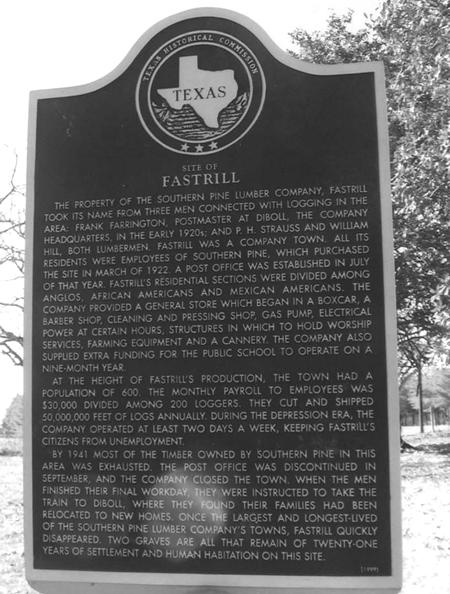
A Texas State
Historical Marker at Fastrill
Photo courtesy Bob Bowman |
The
town got its name from a combination of three names: FA from F.F.
Farrington, a former Diboll postmaster; STR from P.H. Strauss, who
was in charge of Southern Pine’s logging camps; and ILL from Will
Hill, the company’s woods foreman.
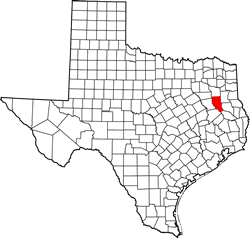
The town stood near a bend in the Neches
River about 15 miles west of Alto.
Of all the Southern Pine logging camps, Fastrill is best-remembered
by the company’s old timers. At its peak the community had a four-teacher
school, two churches, a post office, commissary store, boarding house,
a voting precinct and a population approaching 600.
“Fastrill was as pretty a logging camp as a person went into,” said
Wesley Ashworth, a carpenter and repairman for Southern Pine. “It
had wide, long streets, sycamore trees up and down the streets, and
stood on a sandy hill, a beautiful place.”
Southern Pine operated dozens of logging camps--sometimes called “front
camps,”--in places like Alceda, White City, Buff City, Lindsey
Springs, Walkerton, Neff, Hull,
Gilbert, Buggerville, Gipson, and Apple Springs.
“I suppose Fastrill is remembered so well because it was a big camp,
the most permanent camp, and was in existence longer than any other
camp the company had,” said Vina Wells, whose family moved there from
White City in 1922.
Today, little is left of Fastrill, but some of the town’s former residents
return regularly to its site to wander through the forest, dig up
old railroad spikes, and read a Texas State Historical Marker placed
there years ago.
Bob Bowman's East Texas
April 4, 2009 Column.
A weekly column syndicated in 70 East Texas newspapers |
| Texas
Escapes, in its purpose to preserve historic, endangered and vanishing
Texas, asks that anyone wishing to share their local history, stories,
landmarks and vintage or recent photos, please contact
us. |
|
|
 HOME
HOME