|
| Al
Jennings of Oklahoma, largely through masterful self-promotion, became
for a time the best-known of the outlaws of the American West. He
was a genuine bandit, he did go to a Federal penitentiary for attempted
murder on a life sentence which was commuted to five years in 1900.
He was pardoned by President Theodore Roosevelt in 1902. |
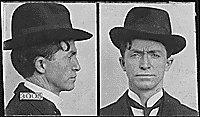
Al Jennings
Photo courtesy National Archives and Records Administration |
He went to Hollywood
in the early years of the movies and became a free-lance technical
adviser on Western movies and later on television Westerns. Five movies,
including the 1927 silent epic Beating Back, were based on
the life and career of Al Jennings—as recalled and told by Al. In
the days before heavy income taxes his percentages amounted to a tidy
fortune.
The lobby cards for Beating Back featured a copy of Al’s Teddy
Roosevelt pardon, which, they implied, came because Teddy recalled
the exploits of his ‘old Rough Rider buddy,’ Al, at San Juan Hill.
Teddy refused to allow such a brave soldier to rot away in prison.
The catch slogan for the movie was “He Robbed More Trains Than Jesse
James—He Killed More Men Than Billy the Kid.”
If pressed—you didn’t have to press hard—Al would admit to ‘twenty
or twenty-five’ face-to-face shootouts. He was, though vague about
who-what-when-where “in case somebody might start digging that old
trouble up and making something out of it again.”
While in prison Al made the acquaintance of a bookish young man who
had been sentenced from Austin,
Texas—a one-time newspaper man and bank teller who was doing time
for using the depositors’ assets to back slow horses. The young man’s
name was William Sidney Porter, and he would become, as O.
Henry, the undisputed master of the only purely American literary
form, the short story.
Porter was apparently as good a listener as Al was a talker. Al filled
the future short-story master’s ears with tales of a second career
‘on the border,’ which he insisted he pursued “while every lawman
in Texas, Oklahoma, Kansas, Arkansas, and Missouri was out shaking
the hills looking for me.”
If you have a good story don’t tell it to a writer. We have no principles
at all. We’ll steal it, file the serial numbers off, change it just
enough that you can’t prove it’s yours, and sell it for money. Whether
or not Porter believed Al’s yarns is moot, but he used them to create
a character called The Cisco Kid (O. Henry’s original Cisco
Kid was an Anglo, by the way) who still lives in Saturday-morning
syndication all over the civilized world. If you consider Al the original
Cisco Kid, he is without question the best-known outlaw who ever lived.
Al
Jennings’ entire outlaw career lasted a total of 108 days, from August
14, 1897, until December 6 of that year. In that time he successfully
robbed one train, robbed a post office with semi-success, burgled
one general store, and stole a wagon and mule from a couple of Cherokee
teenagers. He got in one gunfight in which no one was killed and only
one person was wounded. He surrendered without a fight.
He was chased by only one lawman, a Territorial Deputy Sheriff named
Bud Ledbetter. The largest reward ever offered for him was $100, and
it wasn’t ‘dead or alive.’ The only reason he got a life sentence
was his insistence, on the witness stand at his trial, that he was,
too, shooting to kill in his only gunfight—to the utter dismay of
his attorney, who had a five-year sentence in the bag until the client
shot off his mouth.
Al
and Frank Jennings were the sons of ‘the town Republican’ of Edmond,
Oklahoma. Republicans controlled the White House—and all political
patronage—from 1860 until 1912, with only two four-year breaks for
Grover Cleveland’s non-consecutive terms. Every town in the South—and
Oklahoma was full of ex-Confederates—had to have a nominal ‘town Republican’
to serve as post master, judge, or whatever. The Jennings boys’ father
was Edmond’s.
The Jennings brothers’ bosom pals were the O’Malley boys, Patrick
and Morris. Their father was the town grocer. All four were in their
late teens, too old for school and too young for adults to take them
seriously. They also had a problem. In a day when men rode tall in
the saddle Frank, the tallest, stood five feet four. Al, the acknowledged
leader, stood five-one. The O’Malleys stood five-three. According
to those who knew them all four—Al in particular—were addicted to
Ned Buntline’s Wild West stories.
Sometime in the spring of 1897—the exact date isn’t clear, nor are
the circumstances—Al met a real, genuine outlaw. His name was Richard
West, the same ‘Little Dick’ West who rode with Bill Doolin. He was
a typical ‘cowboy gone bad.’ Harry Halsell, in his 1937 classic COWBOYS
AND CATTLEMEN, had nothing but good to say about West when he worked
with him on the Waggoner and Halsell ranches near Wichita
Falls in the 1880s.
West came by his nickname honestly. He stood five-six in his socks,
which was little when standing next to Bill Doolin but must have been
bordering on giantism to Al Jennings. Nobody knows for sure who talked
who into a train robbery, but on the evening of August 14, 1897, Al
Jennings’ outlaw career began. The beginning would have made a good
sequence for the Three Stooges in “Train Robbers.”
To
begin with, they tried it in Edmond, where everybody in town knew
the Jennings and O’Malley brothers. When a Santa Fe passenger train
pulled up for water, Morris O’Malley mounted the tender and in true
Ned Buntline style threw down on the engineer and fireman from atop
the coal. The rest of the gang—All, Frank, Pat, and Dick West—began
pounding on the express-car door with their sixshooters. The noise
attracted the conductor, who had been with the road for years and
had known the Jennings and O’Malley brothers since they were in diapers.
He ambled up, appropriately clad in brass-buttoned black frock coat
and pillbox cap, and carrying a bullseye lantern. He recognized Al
and demanded “What do you think you’re doing, Al Jennings?”
“It’s the Pinkertons!” Al screamed. The four would-be train robbers
bolted for the woods. Morris, who was still on the tender holding
a gun on the engine crew, saw his support legging it for the tall
timber. He leaped off the tender screaming “Wait for me!” and hit
the ground at a high lope, heading for the trees.
The attempted robbery was duly reported and—holding sixshooters on
a train crew being downright illegal, not to mention annoying—the
local law issued warrants for Al, Frank, Pat, Morris, and a John Doe.
The Santa Fe issued a reward notice listing $100 apiece for the would-be
robbers.
On
August 30 the gang tried again. This time they got completely out
of their home territory, way over in Indian Territory near Muskogee.
Al decided to rob the Katy between Muskogee and Oktaha and to stop
the train by piling ties on the track, one of the sure-fire trainstopping
tricks he learned from Ned Buntline.
You can, of course, stop a train that way—but you have to know how
to do it. It works when the train is already moving slowly and can’t
increase speed, like on a very tight curve or a long, steep hill.
Al stacked his ties dead in the middle of about the longest and smoothest
stretch of track in the entire eastern half of Oklahoma. He also picked
a moonlit night. The engineer could see the pile of ties and the waiting
horsemen a good two miles away.
The Katy engineer opened the big Baldwin wide, hauled back on the
whistle cord, and told the fireman to sit on the popoff. He rammed
the cowcatcher into the stack of ties at a solid sixty miles an hour.
Pieces of broken tie rained all over Muskogee County—and Al went back
to Ned Buntline to figure out what went wrong.
Trainrobbing
was proving downright unprofitable, not to mention embarrassing. The
boys decided to take on an express office. The American Railway Express
Company’s office in Purcell, about 45 miles south of Edmond on the
South Canadian, was the target. The boys surrounded the office and
began to peek into the windows to see if the express agent was alone.
The express agent, seeing faces with bandannas over them pop up at
his windows and then disappear, got a little perturbed. He went to
the telephone—this was 1897, and every town of any size had a telephone
system by then—and called the law. The town marshal, accompanied by
about a half-dozen shotgun-armed citizens showed up—sometimes having
a party line can work to your advantage—and the boys departed without
firing a shot or taking fire. The Purcell fiasco was on the September
8.
Discouraged
by a certain lack of success with trains and express offices, the
gang decided to try a bank. Minco, about 30 miles southwest of Edmond,
was chosen. When the boys showed up to rob the Minco bank early on
the morning of September 20, it was pretty obvious something had gone
wrong. The bank was surrounded by shotgun-armed locals. There had
obviously been a leak somewhere. The most likely suspect was Al, who
had a bad habit of shooting his mouth off. The Al Jennings Gang rode
into Minco and out the other side without stopping.
On
October 1, 1897, after having been a bandit for 46 days without a
single success, Al Jennings, The Notorious Oklahoma Bank and Train
Robber, the man who Robbed More Trains Than Jesse James and Killed
More Men Than Billy The Kid, finally managed to steal something. The
gang pulled what the press described as a ‘daring daylight robbery’
of the Rock Island passenger train 8 miles north of Chickasha, at
the water stop now known as Pocasset.
Well, it was. It was straight out of Ned Buntline—up to a point, anyway.
They piled the passengers out, lined them up alongside the cars, and
went through their pockets in the best Beadle’s Dime Library approved
fashion. The take from the passengers was some $300 in currency and
assorted loose change, a silver pocketwatch worth about $15, a bunch
of bananas, and a jug of busthead whiskey.
The train had an express car, the express car had a safe—two of them,
in fact—and the safes had money in them. The boys wanted the money.
They demanded the combinations from the messenger. He denied knowing
them. That, of course, was a lie, but one the company insisted all
messengers tell. All express-company messengers had the combinations
to both the through and way safes, but they could be fired for admitting
it to bandits. A good many messengers died rather than give up the
combinations to the company safes.
Al, however, had read his Ned Buntline well. He came prepared. He
had two one-pound sticks of dynamite, which was more than enough to
open both safes if he’d known how to open a safe with dynamite. Unfortunately,
Ned Buntline had always been sort of vague about exactly how one went
about opening a safe with dynamite. Al found himself in the express
car faced with two safes, two sticks of dynamite in his hands, and
he didn’t know chocolate pie from cowflop about how to blow a safe.
Of course, he didn’t know any more than that about how to be an outlaw,
either, but it hadn’t slowed him down so far.
He decided to improvise. The through safe was the big one and Al couldn’t
lift it. He put the two sticks of dynamite atop the through safe,
set the way safe atop it, precariously balanced on the dynamite, lit
the fuzes, and ran.
It would make a much better story, not to mention a great scene in
a movie, had the dynamite blown the way safe out the top of the express
car. Unfortunately, that’s not what happened. The way safe tilted.
The force of the explosion went sideways. It blew the side out of
the express car, tore up the mail, did the interior no good at all,
and simply flipped the way safe back onto its wheels on the floor.
The boys fired a few shots into the air because that’s what Ned Buntline
said you were supposed to do. Then they galloped away into the postoaks.
They holed up not far from Chickasha, where they split the money and—according
to the records—ate the bananas and drank all the whiskey. How they
survived the combination is not part of the record. Dick West took
his $60 and drifted. Nobody said who wound up with the watch.
What Al, Frank, Morris, and Pat did between October 1, the Rock Island
stickup, and November 14, the next time they were heard from, nobody
but Al ever said. His story about wine-women-song in St. Louis isn’t
supported by the $60 he had in his pocket.
The
stickup did have one major effect. Before, the law had been only mildly
annoyed with the Al Jennings gang. Now it was downright put out with
them. The Rock Island was also more than a little perturbed. It posted
a $100 apiece reward for the boys. Of course, everybody knew exactly
who they were. Al made sure of that. He told everybody he robbed who
he was.
Territorial Deputy Sheriff Bud Ledbetter of Muskogee County was an
old-time lawdog. He’d served as town and county law in Missouri,
Arkansas,
and Texas before becoming a Deputy US
Marshal out of Judge Isaac C. Parker’s court at Ft. Smith. With the
closing of Parker’s jurisdiction and the opening of Oklahoma
and Indian Territories to Anglo settlement, Bud moved to Muskogee.
Now this seasoned professional got the job of running down the four
most inept amateur bandits the 19th Century ever produced.
It gets cold in Oklahoma
come November. The boys hadn’t been home since mid-August. On the
night of November 14 they broke into Nutter’s Store at Cushing about
25 miles southeast of Stillwater, just over the line in Indian Territory.
At the time what is now the State of Oklahoma was divided, the eastern
half being known as Indian Territory, the western half as Oklahoma
Territory. Al lived in OT and, with the exception of the abortive
attempt to stop the Katy near Muskogee, all his ‘career’ had been
in OT. The burglary was not to Al’s liking. He pictured himself as
a dashing bank and train robber, not a burglar. Still, he didn’t intend
to lose credit for the crime. The boys stole warm clothes, blankets,
canned food, cartridges, tobacco, and about $40 from the till. Al
left a note claiming credit.
A little less than a week later, on November 20, the gang burst into
the US Post Office at Foyil, 11 miles northeast of present Claremore.
In a classic stickup straight out of Ned Buntline’s best, they lined
up the customers and employees, rifled the till, sacked up some $300,
carcoled their horses, fired a few shots in the air for effect, and
galloped away in a cloud of dust.
There was just one minor hitch. There were two sacks in the place.
One was the one they’d put the money in. The other sack—identical
to that one—contained the postmaster’s collection of cancelled stamps.
The boys picked up the wrong sack.
The burglary at Cushing and the stickup at Foyil told Bud Ledbetter
the gang was headed for the Spike S ranch, which had been a notorious
bandit haven in the early years of the territory and might still take
in a man on the dodge. The lawman decided Al would try to talk the
folks at the Spike S into letting him and the boys hole up until spring.
Bud rode ahead and waited for them.
He was right. On October 29 Al and the boys rode into the Spike S.
At that point the prototype for every long-term gunfight Republic
Pictures ever put into a 13-chapter serial began. The Gunfight At
The Spike S lasted nearly 15 minutes, one of the longest shootouts
on record. It was also one of the least lethal. Only Morris O’Malley
was wounded, hit in the leg with a slug from Ledbetter’s Winchester.
The wound wasn’t especially dangerous, but Morris thought he was dying.
Bud did nothing to disabuse him of the notion.
The rest of the gang escaped, but Bud made sure the first thing he
did was spook their horses. They lost their blankets, spare clothes,
food, smokes, and extra ammo. Al covered the retreat, sixgun blazing
in true Ned Buntline style—marred by the unfortunate fact that the
gang was now afoot.
Morris, who apparently thought he was making a deathbed statement,
spilled everything. He detailed both successful stickups, the burglary,
and the four fiascos, and identified the John Doe at Edmond, Purcess,
Minco, and Chickasha as Dick West. He also told Bud that Al told him
to break jail as quickly as he could and head for ‘the corners,’ where
Texas, Oklahoma,
and Arkansas
meet. The gang, Al said, would meet him there.
Ledbetter was a Territorial officer. He had no jurisdiction in Arkansas
or Texas. Though the gang had committed a Federal offense—sticking
up a post office—the crime had been less than an unqualified success.
Federal Deputy Marshals, who received only those expenses they could
produce receipts for and any rewards offered for bandits in lieu of
salary, could hardly be expected to go chasing off after a bunch of
teenaged kids for a paltry $200 apiece. If Al actually reached ‘the
corners’ there was a better than even chance the gang would get away
free.
There was, however, only one good trail going from the Spike S to
where Al wanted to go. It crossed the Deep Fork of the Canadian at
a place called Rock Creek Crossing. Bud Ledbetter went to the crossing
and waited.
Al, Frank, and Pat, meanwhile, were making their slow, painful way
afoot through the icy brush. On the cold, wet evening of December
2 Al pulled his final stickup. Along a farm trail not far north of
Okmulgee he stepped in front of a rickety farm wagon driven by two
Cherokee teenagers and pulled by a ragged mule. He leveled his sixshooter
on them and croaked, through his laryngitis “Do you know who I am?”
“No, sir,” they admitted.
“I’m Al Jennings, the great train robber and bandit,” he announced.
The boys looked blank. Jesse James they’d heard of, the Youngers,
and the Daltons. They knew about Bill Doolin and Turkey Creek and
Red Buck and Dick West, and of course Ned Christie and Cherokee Bill,
but who was this Al Jennings?
Al’s next remark was “Gimme that mule an’ wagon or I’ll blow your
heads off.”
Maybe the boys had never heard of Al Jennings, but he did have a gun.
They gave him the mule and wagon. The ragged, dirty, shivering man
climbed onto the seat. Two more equally ragged, dirty men stumbled
out of the brush and flopped down in the wagon bed. The wagon rattled
away into the gathering night, leaving two very bewildered Cherokee
boys alongside the trail.
Four days later, on the afternoon of December 6, 1897, Al drove the
wagon into Rock Creek Crossing—and found himself looking into the
muzzle of Bud Ledbetter’s Winchester. “Please, Mr. Ledbetter,” the
disconsolate bandits begged, “take us someplace where it’s warm.”
In April, 1898, the Al Jennings gang went on trial. Frank and the
O’Malleys drew five years each for train robbery. Al was convicted
of assault with intent to kill an officer of the law—for reasons previously
mentioned—and drew a life sentence. All were sent to the supposedly
escape-proof Ohio State Pen, which took Federal prisoners at the time.
Al’s sentence was commuted to five years on June 23, 1900. Frank and
the O’Malleys were pardoned in 1901. Al got his Teddy Roosevelt pardon
in 1902, but it had nothing to do with Rough Rider service. Al spent
the Spanish-American
War in prison.
After
he got out of prison Al returned to Edmond, where he read law and
was ultimately admitted to the Oklahoma bar. He practiced law for
a while, but Al always had a serious case of the itch-foot—and he
could never let go of his ‘outlaw career.’ He might have tried it
again, but something else intervened. Shortly after he got out of
prison he saw ‘the wonder of the age’—a motion picture filmed in the
wilds of New Jersey and along New York City’s Central Park bridle
paths. It was called The Great Train Robbery, and it starred
Gilbert N. Anderson, who became known to an entire generation of American
kids as ‘Broncho Billy.”
Al thought about it for a while, and the longer he thought about it
the better the idea looked. He’d show ‘em how it was really done.
He’d go to wherever they made these movin’ pictures and he’d see to
it they made ‘em right—told how to do it by the Great Oklahoma Bandit
and Train Robber, the Oklahoma Robin Hood, Al Jennings himself. And
that’s just what he did.
From the early days of the silents until the mid-1950s, Al Jennings,
the self-styled Oklahoma Robin Hood, the Man Who Robbed More Trains
Than Jesse James and Killed More Men Than Billy The Kid—only he didn’t—was
the final arbiter of what went and what didn’t in the B Westerns turned
out by Hollywood’s poverty row. Now you know why those movies—and
early TV shows—were so phony. The guy who ‘told ‘em how we really
done it, ‘cause I was there an’ did it for real’ was a total fake.
© C. F.
Eckhardt
"Charley Eckhardt's Texas"
July 21,
2008 column |
|
|
 HOME
HOME