|
|
THE SPANISH
AMERICAN WAR CHRONICLES
"A splendid
little war"
Article and photos
by John Troesser
|

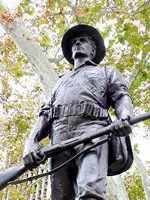
"The Hiker"
|
The
war came about at a time when America was flexing its muscles and
looking with envy at Europe with it's colonies. The Civil War, while
not forgotten, had receded into the past and former foes were once
again united.Two former Confederate generals served as generals in
the Spanish American War.
The flashpoint came when the dreadnought battleship U.S.S. Maine
was sunk in Havana harbor in early 1898. Recent findings
say that the explosion was probably the result of an accidental coal
dust explosion igniting the ship's powder magazine - but at the time
- it was thought that it was an intentional act of war by the Spanish.
|
|
|
"The
Hiker"
The mold for this statue was bought many years
after its first casting. 50 of the statues were cast - with 2 of them
standing in Texas
(Capitol Grounds and Wichita Falls) |
|
|
The
plaque at the base of the statue |
Up
until recent years, the Spanish American war was the conflict that
claimed the fewest American lives. While figures vary somewhat, it
is generally accepted that there were fewer than 500 combat deaths.
Fever claimed more lives than combat.
Texas' involvement in the war was primarily providing men and a place
to train "The Rough Riders". Technically known as the First
U. S. Volunteer Cavalry Regiment - the group was composed of cowboys,
adventurers and polo playing aristocrats from New York. Volunteers
swelled the ranks from the regulation 700 to closer to 1,000. |
|
|
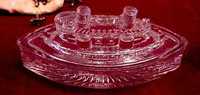
A
butter mold inscribed with "Remember the Maine!"
Courtesy
Flatonia Historical Museum |
Roosevelt
was second in command under Col. Leonard Wood. The two men used the
patio adjoining the bar of the Menger
Hotel to sign up cowboys, adventurers and (according to
some sources) even a few outlaws. Several members of the Hole in-the-Wall
gang reportedly served. The polo players arrived by train.
Their training lasted about one month and had it gone on - the unit
may have missed the war. Roosevelt arrived on May 16th and the unit
left on a train May 28th.
Roosevelt Park in San
Antonio was named in honor of Theodore Roosevelt - and
the Menger bar is sometimes called the Roosevelt Room. Ironically,
the Rough Riders made their assault on San Juan Hill as dismounted
Cavalry - their horses having been delayed in Tampa.
The troop trains leaving San
Antonio for Galveston
stopped at towns along the way - where well-wishers would meet the
train. In Gonzales,
the Inquirer reported that young women brought cakes to feed
the soldiers. While the soldiers reportedly gave the women a taste
of their rations, unfortunately no mention was made of their reactions.
|
|
|
The
sudden war caught the Army with no khaki. Troops wore blue flannel
uniforms.
Postcard
courtesy of the Flatonia Historical Museum |
Troops
embarked from Tampa and sailed to Cuba. Dewey's fleet sailed to Manila
Bay to win victory there.
The War was declared in April and fighting was over by October. An
official end was declared in December.
Compared
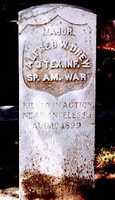
to the Civil War, the Spanish American War was a footnote in Texas
history. Little remains from that brief period and even the tombstones
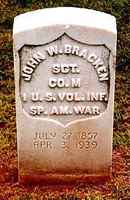
of the participants are not all that common. Fort
Sam Houston contains many Spanish American War graves - perhaps
because of the city's use as a training facility. The lengthy spelling
of the conflict is usually abbreviated on the stones as SP AM War.
A letter sent home to Luling,
Texas and now in the Caldwell
County historical society shows that one local volunteer never
made it to Cuba. His service, he complained was spent "draining
the swampland of the (Henry) Flagler estate."
© John
Troesser
February 2002 Feature |
Left
- One of the survivors - later buried in the State
Cemetery
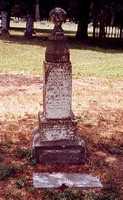
Center - Another SP AM War casualty with the inscription: Died January
27, 1899 "erected by his comrades-in-arms"
Independence
Cemetery, Washington
County
Right - A Spanish American War participant in Houston's
Glenwood
Cemetery is marked "killed in action near Angeles P.I."
with the date of death inscribed as 1899. |
|
|
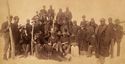
Buffalo
Soldiers by Jeffery Robenalt
In nearly thirty years of dedicated and arduous service, Buffalo
Soldiers won the grudging respect of even the most prejudiced of
their white officers. The black cavalrymen and infantrymen were
awarded nine Medals of Honor for meritorious valor in combat and
countless other awards and commendations for distinguished service.
More importantly, Buffalo Soldiers were a credit to the African-American
race.
|
|
|
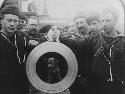
"Old
Hoodoo" The Battleship Texas, America's First Battleship (1895-1911)
In this book about a little known era of Naval History, authors Al
Sumrall and Mark D. Cowan research the first Battleship Texas. This
is the illustrated story of the design, construction, and operational
history of the USS Texas of 1895, America's first battleship and hero
of the Spanish-American War. |
|
|
 HOME
HOME