|
|
This
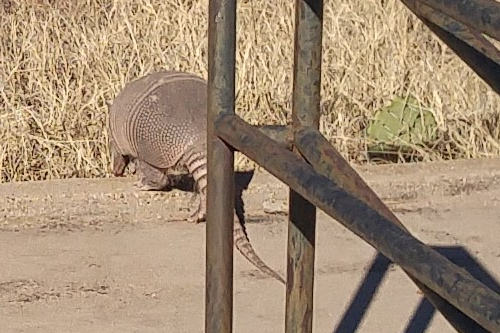
is gonna come as a surprise to a lot of folks, but armadillos are
not native to Texas. In fact, the very
first armadillo ever identified in the Lone Star State apparently
crossed the Rio Grande near Brownsville
in 1859. It was captured by a local man, who’d never seen such an
animal. Neither had his neighbors. It was so unique that the man put
it in a cage inside a tent, fed it lettuce, and charged 5¢ to look
at the ‘unique beast.’ It was, in fact, so unique that the advance
man for a traveling circus paid the fellow $5,000 in gold to buy it
for his show’s menagerie.
The nine-banded armadillo, scientific name dasypus novemcinctus,
is native to Central and South America. It apparently meandered its
way northward during the 18th and 19th Centuries. The first one we
know about showed up near Brownsville
in 1859. From there it began to spread. By the 1880s it was common
in South, South
Central, and Southeast
Texas. It appears to have crossed the Sabine
sometime in the 1890s, to become common in Louisiana, Arkansas, and
eastern Oklahoma by the early 1900s. Today, it’s common all across
the American South. However, west of the Nueces and north of about
Laredo,
you simply don’t find armadillos. True to their jungle heritage from
Central America, they simply don’t go into arid or semi-arid areas.
|
 |
|
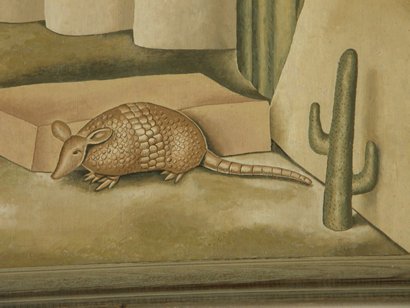
Armadillos
live on insects and vegetation, but are not averse to stealing ground-nesting
birds’ eggs. They have small, peg-like teeth unsuited for much else.
They have a keep sense of hearing, but very poor eyesight. They
are also very fast on their feet. The average person can’t catch
one by running after it. They also have powerful claws. It takes
an armadillo only a few moments to dig a hole deep enough to conceal
its vulnerable head and belly. Its shell-armored body makes it invulnerable
to smaller predators like bobcats, foxes, and coyotes—so long as
the predator can’t get to the animal’s unarmored belly. It will
also take refuge in pre-dug holes it finds. By digging the claws
of all four feet into the walls of the hole, it makes itself almost
impossible to pull out by the tail.
Reaching into a hole to pull an armadillo out by the tail is risky.
The animal’s shell makes it virtually invulnerable to snakebite,
but the hand that grabs the tail isn’t. When an armadillo takes
refuge in a hole already inhabited by a rattler or a copperhead,
the snake is annoyed by the intrusion. Unable to attack the intruder
through the shell, it will take out its annoyance by striking the
hand attempting to remove the intruder.
When caught in the open by a predator, an armadillo has a second
line of defense. It relies on its hearing to identify the direction
and proximity of the predator. As soon as the predator is almost
atop the armadillo, the intended prey leaps straight up, sometimes
as much as six feet. It lands on its feet and scoots off in a direction
either opposite the approach of the predator or at right angles
to it. This requires the predator to stop its rush, change direction,
identify the new location of the prey, and start the chase over
again.
This instinctive behavior, however, has a drawback. An armadillo
can’t tell the difference between an approaching coyote and a semi-rig
roaring down the highway. Millions of years of evolutionary conditioning
cause it to react to the truck just as it would react to a coyote.
This explains the armadillo-shaped dents in the radiator shutters
of a lot of diesel rigs that frequent roads in armadillo country.
The armadillo has a third defense against predators if there is
a fast-flowing stream close by. The shell’s watertight. The armadillo
simply jumps into the water, rolls itself on its back, and floats
away on the current.
Armadillo
meat, when properly prepared, can be very tasty. To say “it tastes
a lot like chicken” is perhaps too trite, but during the Great Depression
in the 1930s armadillo and dumplings, prepared like chicken and
dumplings, was a common dish in much of the rural South. The animals
got a nickname at that time—Hoover hogs.
In the 1940s, during WWII,
Afrika Korps soldiers captured in the Sahara were kept, by Geneva
Conventions, at the same latitude at which they were captured. A
lot of them were sent to Camp Maxey, deep in the hardwood and pine
forests of East Texas,
where almost-daily rain can be common in every month except August.
In addition to the shock of transfer—being taken from one of the
driest places on earth and placed in what is only about two steps
from being a temperate rain forest—they encountered animals they’d
never seen before. One of those animals was the armadillo.
The German
POWs asked the prison-camp guards what the strange, shelled
animals were. The guards, who had been selected from troops from
New York and New Jersey—a precaution against the guards, even unintentionally,
being able to give the prisoners information that might aid in an
escape—had no idea what an armadillo was. They’d never seen the
critters, either. The Germans gave them a name that was uniquely
German and uniquely descriptive—panzerschwein. Tank pigs.
|
 |
| Photo
courtesy Dove Key Ranch Wildlife Rehabilitation |
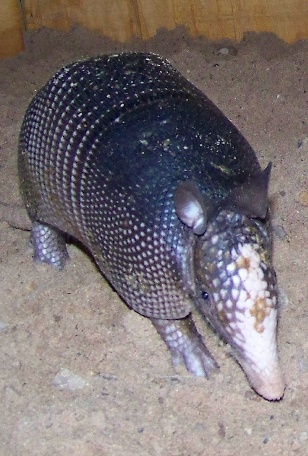
Today
the armadillo is common all across Central
and East Texas and in
most of the Deep South. They thrive wherever there is sufficient humidity
and forage and the temperature doesn’t stay cold for too long.
Contrary to some ‘authorities,’ armadillos do not make good pets.
Frankly, they aren’t smart enough to be pets. However, baby armadillos—there
are always six in a litter, all the same sex, and they’re pink until
their shells harden—are incredibly cute.
They are so common that the sight of a dead armadillo alongside the
road is one of the most common sights in armadillo country. That’s
why they have their last—and most appropriate—nickname. We call ‘em
‘organic speed bumps.’ “Why does a Texas chicken cross the road? To
show armadillos it can be done.”
© C. F.
Eckhardt
"Charley Eckhardt's Texas"March
12, 2010 column |
|
|
 HOME
HOME