|
|
Up
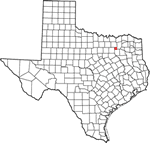
where the Red River meets the north-south line that forms the eastern
edge of the Panhandle,
there's a little place called Turkey.
In Turkey is
the largest public school building on earth. It covers some 40 acres,
maybe more, with a single building, and it's at least 30 stories high.
Now, please understand. I've never seen this school. Neither, to my
knowledge, has anyone else. Yet it has to be there. It absolutely
has to. Over the years I've met so many people who 'went to school
with Bob Wills in Turkey' it'd take a school that big to hold 'em
all.
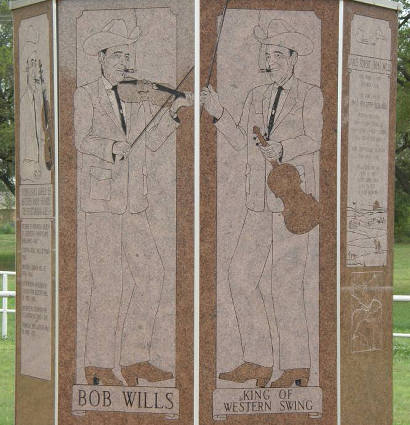
His name was Jim Rob Wills, and whether that was James Robert
or simply Jim Rob means nothing to anyone, because it's not important.
He was a shirt-tail kid from Turkey,
where they put both city limits signs on the same post. He had a fiddle
and a Model T, and he pushed that Tin Lizzie to anywhere anybody would
pay $3 or $4 to hear him fiddle all night and sometimes well into
the dawn while they danced to old songs. |
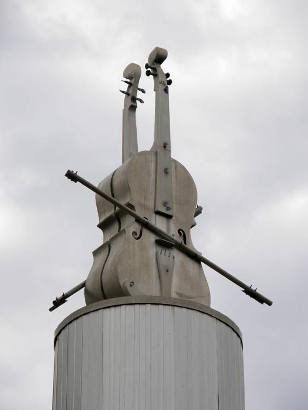 |
Sixty years after
that beginning he was a legend-Bob Wills, the fiddle king, the man
who started the sound called Western Swing. He led the most famous
dance band in the Southwest - Bob Wills and the Texas Playboys. He
wrote God only knows how many songs and saw more of them become standards
than perhaps any other American songwriter. He wrote and played San
Antonio Rose (which was simply called 'Spanish Dance' until Tommy
Duncan wrote lyrics for it) Across The Alley From The Alamo, Faded
Love, Big Ball's In Cowtown, Stay All Night, Stay a Little Longer,
Ida Red Loves The Boogie, and dozens if not hundreds more. During
WW II, wherever
American servicemen went, Bob Wills' music went with them.
Bob took the most maligned and scoffed-at musical form in the United
States-'hillbilly,' they called it, not yet realizing it was the natural
outgrowth of 'folk' music (and it had not yet become, through its
own askance-viewed offspring, Rockabilly, the direct ancestor of Rock
'n' Roll) - and married it to the Glen Miller type big-band sound
of the 1930s. In doing so, he created an entirely new, purely Southern/Western
form of music-Western Swing-that has influenced nearly every type
of American dance music since. Yet in Bob's own words, "Nobody loved
us but the people." |
 |
Bob
began as a solo fiddler, but soon organized his first band - The
Bob Wills Fiddle & Jug Band. It consisted of Bob on fiddle, Herman
Arnspiger on guitar, and an as-yet-unidentified jug blower. A talent
scout who saw the band at an amateur tryout for WBAP radio in Ft.
Worth in the very early '30s called it "about the worst thing
hillbilly music comes to."
Bob's second band existed until just a few years ago, but he didn't
form it. Burrus Mills of Texarkana,
home of Lightcrust Flour, hired a go-getting promoter named Wilmer
Lee O'Daniel. W. Lee 'Pappy' O'Daniel later made himself governor
of Texas, US Senator from Texas, and a complete ass, not necessarily
in that order. This, however, isn't Pappy's story but Bob's, so we'll
let Pappy's political career die an unlamented death at this point,
mentioning only that when he was elected governor a Washington wag
suggested that the Stars and Stripes be changed to have 47 stars and
a circle in the union-representing a biscuit, in recognition of the
fact that Pappy used the same tactics to sell Texans a governor that
he used to sell 'em biscuits.
The Lightcrust
Doughboys, the Burrus Mills promotional hillbilly band, was
the brainchild of Pappy O'Daniel. Pappy, a hillbilly music fan, reasoned
that a band organized to play hillbilly music and promote Lightcrust
Flour would be a great success. He was absolutely right.
The original Lightcrust Doughboys consisted of Bob and Herman. The
Doughboy's musical theme, still played today, was written by Bob.
The catchy refrain: |
Listen, everybody
from near and far
While we tell you who we are-
We're the Lightcrust Doughboys
From Burrus Mills- |
accompanied by
Bob's breakdown fiddling and Herman's thumping guitar made Lightcrust
Flour the most widely sold and used in the four states of Texas, Louisiana,
Oklahoma, and Arkansas, outselling any other flour including Pillsbury
and General Mills by two to one or better. Pappy was on his way-and
so was Bob Wills.
Those ways were soon to part. Bob used his time off to play country
dances, picking up the extra money that often meant the difference
between solvency and bankruptcy during the Depression. Pappy, a hardshell
Southern Baptist, frowned on dancing, drinking - and just about everything
else that looked like it might be fun.
The Doughboys played five live shows a week. Monday, Wednesday, and
Friday they were live from the studio at WBAP in Ft.
Worth at prime rural radio time-noon. Tuesday and Thursday they
were live from the studio at WHOO in Oklahoma City, again at noon.
This meant the band did a lot of traveling. The band would leave Ft.
Worth right after the Monday show, play a dance in Lawton on Monday
night, do the Okie City show on Tuesday, pick up a dance in Cherokee
Tuesday night, make the show in Ft. Worth Wednesday, and so on. Sometimes
the dances degenerated into drinking bouts with home-brew and 'shine,
and Bob didn't make the show the next day. This, of course, infuriated
Pappy, who read to Bob from the Good Book about missing shows. This
in turn infuriated Bob, who responded by going out and tying one on.
|
In
1933 Pappy and Bob came to an entirely un-amicable parting. Pappy
did his best to prevent that young upstart from ever getting another
job as a musician. Bob formed the nucleus of the band that became
the Texas Playboys and went to WHOO. He was joined by Smokey
Dacus on drums and a boyish-looking hellraiser of a singer who claimed
he could play the piano but couldn't - Tommy Duncan. The new Bob Wills
band, called simply 'The Playboys' at the time, got the Monday/Wednesday/Friday
noon slot on WHOO.
Here came Pappy! His new Lightcrust Doughboys, minus Bob, were the
station's Tuesday/ Thursday noon mainstays. Burrus Mills was the biggest
local advertiser on WHOO. O'Daniel threatened to pull the Doughboys
- and all Burrus Mills advertising except that for network shows -
if the Playboys weren't kicked out immediately. WHOO couldn't afford
to lose either the Doughboys or the Burrus Mills advertising, so Bob
got the boot.
The next stop was KTOK in Tulsa, which didn't get the Doughboys and
needed a noon attraction. Bob and the Playboys landed the Monday/Wednesday/Friday
noon slot, with plenty of time to play dancehalls and nightclubs during
the week and on weekends. The schedule, though, was rough. The Playboys
would do the noon show live on Monday, roar off in a rickety bus to
Little Rock, Shreveport, Tyler, or maybe Mission, Kansas-anywhere
KTOK's signal reached - and then hotfoot it back to Tulsa in time
for the Wednesday show.
By 1936 Bob Wills and the Texas Playboys, as they'd begun to
be called, could draw more people to a crossroads barn dance on three
hours' notice than Ted Weems or Glen Miller could draw in Dallas with
three weeks' notice. Outside the KTOK listening area - Oklahoma, northeast
Texas, northwest Louisiana, western Arkansas, and southeastern Kansas-nobody
ever heard of 'em. "Bob Who and the Whatboys?" was the A&R man's reaction
when they turned up in Chicago to record.
That soon changed. Ted Weems or Glen Miller might sell well in New
York, Chicago, or LA, but across the south and southwest people wanted
a different kind of swing-Western Swing - and the Texas Playboys were
the only band playing it. Across the south and southwest the Texas
Playboys outdrew the 'name' bands two to one.
Part of the secret of the band's success was Bob's philosophy of popularity.
People, he figured, wouldn't take to folks they couldn't get to know.
At Bob's instructions the boys mingled with the house between sets,
made friends, shook hands, maybe danced with a few ladies to the fill-in
band's music, and generally got acquainted with their fans. It worked.
Bing Crosby, Ted Weems' star vocalist, was somebody you saw on stage.
Between sets he disappeared backstage. Tommy Duncan sat down at your
table with you, had a beer with you, and got to know you and your
girl. Bob talked to the crowd between numbers, called out old friends'
names over the mike and brought them up on stage to shake hands. During
the sets the band cut up on stage, hollered, and occasionally raised
a little hell. There was never any way to figure what might happen
when The Texas Playboys took the stage.
One notorious night Bob opened the show with a breakdown that ran
a full three minutes. Just after he started playing his second fiddler-Johnnie
Lee, his brother - approached him and whispered something to him.
Immediately Bob began acting very strange. He kept fiddling, but his
knees came together, his feet went pigeontoed, and he stooped over.
As soon as he finished the piece he turned his back on the house,
then began to chase Johnnie Lee around the stage, whacking him with
his fiddle bow. Tommy Duncan, who - as usual - instigated the gag,
took the mike and told the audience what was going on. Johnnie Lee
told Bob his fly was undone and his drawers were hanging out. It wasn't
and they weren't. The crowd roared-and loved the Playboys even more.
By 1940 the Texas Playboys were a Southwestern legend. Another young
Texan, who'd made his way to Hollywood via radio, records, and the
New York musical stage-Woodward Maurice Ritter, better known as Tex-was
doing himself right proud making singing-cowboy movies. His two major
rivals, Roy Rogers and Gene Autry, had backup bands and singing groups
- The Sons of the Pioneers and The Riders of the Purple Sage. Tex
figured he needed a backup band, too, and he knew a good one-Bob Wills
and the Texas Playboys. He contacted Bob and the Playboys went to
Hollywood to back up Tex Ritter in a series of pictures-for which
Bob wrote most of the songs.
It was in Hollywood that Bob wrote Bluebonnet Lane, and he
and Tommy took the 'Spanish Dance' tune the band had been playing
as an instrumental, changed the phrasing slightly, added lyrics, and
called it San Antonio Rose. Tex recorded it and it remained,
until 1952 when he recorded Dimitri Tiompkin's title song for the
Gary Cooper Western "High Noon," his biggest hit.
All during '40 and '41 Bob and the Playboys remained in Hollywood,
riding horses for the cameras and doing the background music for Tex
Ritter Westerns, playing club dates in and around LA, and building
a national following. Then, just about 8 AM Honolulu time on Sunday,
December 7, 1941, the world fell apart. The Texas Playboys fell apart
with it. Tommy Duncan started it. "I don't know what the rest of you
are gonna do," he said, "but I'm joinin' the Army." On Monday morning,
December 8, that's just what he did. By noon on Tuesday, December
9, the Texas Playboys, for all practical purposes, had ceased to exist.
Bob and a few others held off joining until they got back to Texas.
They went by the recruiting depot to say goodbye to Tommy and the
rest before they were shipped off. In the middle of the floor in the
back room there was a circle of kneeling men. It might have been a
prayer meeting, and Bob was on the verge of leaving quietly when he
heard the unmistakable clicking of dice and Tommy sang out "eighter
from Decatur, county seat of Wise." Bob wrote the line down and, after
the war, wrote a song called Eighter from Decatur, which became
a minor hit. Tommy sang it, of course-after Bob explained where the
song came from.
Eighter from Decatur, for the record, is one of two songs based
on crapshooters' calls. The other, Tenaha,
Timpson, Bobo, and Blair was written by Tex Ritter. Tenaha
- pronounced "Tenney-haw" - Timpson,
Bobo, and Blair are
towns once on the H&TC railroad in deep East Texas. So the story goes,
the towns were so close together that if the conductor tried to call
them individually, the train would be in Blair before he got through
all the cars calling Timpson. The phrase is the call for the ten in
craps. Both phrases, since WWII,
have gone worldwide.
After the War Bob gathered up the survivors including Tommy and reformed
The Texas Playboys. During the late '40s and '50s, The Texas Playboys
were the hottest dance band between the Mississippi and California.
Nationally-known bands like Tommy Dorsey and Benny Goodman avoided
playing any town within three weeks of a Texas Playboys date. They
had too many walkouts. Folks in the West wanted Western Swing, and
only The Texas Playboys were playing it. It was during this period
that some of the finest of Bob's music was written, including Take
Me Back To Tulsa, Big Ball's in Cowtown, and the immortal Faded
Love, considered the finest Country/Western fiddle tune ever written.
The Playboys, of course, inspired imitators-some successful, some
less so. Peewee King and The Golden West Cowboys, whose style, for
years, was a direct imitation of The Texas Playboys, were perhaps
the most successful. Peewee King had a stroke of luck like Bob's with
San Antonio Rose. The band had just cut a side with Rootie
Tootie, which had been a hit, and needed a B side for the record.
He and his vocalist took an untitled waltz tune the band had been
playing for some time, wrote words for it in about twenty minutes,
and recorded it for the B side of Rootie Tootie. They called
it The Tennessee Waltz. Yet another imitator, Jimmy Heap and
the Melody Masters, never rose to great heights, but worked most of
Texas as a Western Swing band before changing styles in the '60s.
The
Playboys' star rose - to featured appearance on the Grand Ole Opry,
the Carnegie Hall and Madison Square Garden of Country and Western
music-and then went into a dramatic decline. With the rise of Rock
'n' Roll, progressive jazz, and the pseudo-sophistication of the late
'50s, followed by the English invasion of the '60s, Western music-and
Western Swing-went down suddenly.
Tommy Duncan left the band to pursue a solo career. Other vocalists
followed him, but only one, Leon Rausch, ever came close. In 1965
Bob and Tommy reunited for an album called "Together Again,"
but the great Duncan voice was gone. Two years later Tommy was dead
of throat cancer.
When country music began its great rise in the late '60s, the Playboys
rose with it-but only for a time. Long hours, late nights, and too
much whiskey had taken their toll. In 1971 Bob suffered the first
in a series of massive strokes that silenced that wonderful fiddle
forever. Early in 1974, after attending a recording session for an
album released as 'Bob Wills and the Texas Playboys - For The Last
Time' Bob died in Ft.
Worth. The Texas Playboys went on for a while with replacement
members, but eventually faded away.
They do say that in 10,000 drafty old dancehalls across Texas,
Oklahoma, and the rest of the West, when the moon and stars are right
and the night is still and quiet, you'll see an apparition in a white
Stetson, a cigar tucked in the side of his mouth, step out on the
deserted stage, tuck a well-worn fiddle under his chin, and if you
listen hard you'll hear the sweet notes of Faded Love, followed
by that well-known holler-"Ahh-Hahh! San Antone!" Maybe Waylon Jennings
said it best-"Once you're down in Texas, Bob Wills is still the King."
Amen, brother.
© C. F.
Eckhardt
"Charley Eckhardt's Texas"
July 19, 2006 column |
|
|
 HOME
HOME