|
Temple
Lea Houston, the last child born to Sam
Houston and his final wife, Margaret Lea, was also the first child
born in the Texas governor's mansion-on 12 August 1860. He never really
knew his dad, though, because Sam died when the boy was only 3. His
mother died 4 years later, and from age 7 on Temple lived with his
Lea kin.
Temple Houston was probably the closest of all the sons to the old
man in temperament and abilities, but he resented being compared to
Sam. He determined at an early age that he would not be remembered
as 'Sam's boy,' but as 'Temple Houston.'
For six years, until he turned 13, Temple lived with his Lea relatives
and attended various schools, getting kicked out of most of them for
what was termed his 'rebellious temperament.' This, of course, was
much like his father, who had trouble with schoolmasters, too. When
Sam got a bellyful of school, he ran off to live with the Cherokees.
Temple didn't have any Cherokees to live with. Well, he did, too-he
had a whole slew of half-brothers and half-sisters with the Cherokees
in 'the Nations,' but that's not something his Lea relatives would
have mentioned. In 1873, at the ripe old age of 13, he signed on as
a cowboy with a drive going all the way to Dakota Territory. To get
home he hired on as a clerk on a steamboat and came down the Missouri
and Mississippi to New Orleans.
In New Orleans he met an old friend of his father's, who happened
to be serving as a congressman from Louisiana. Temple got an appointment
as a page in the US Senate in Washington. He remained in Washington
for the next 4 years. There he studied law under various senators
and sharpened his oratorical talent, which had begun to flower while
he was in school. In spite of his many, many scrapes with schoolmasters,
all who knew him praised his logical mind and gift for oratory. He
excelled in debate and extemporaneous speaking-'rhetoric,' it was
called in those days, and schools of the day emphasized it.
On
his return to Texas in 1878 Temple spent
about a year at Baylor Military Academy in Waco,
a forerunner of Baylor University. He left and a year later, at the
age of 19, he was admitted to the Texas Bar. He opened his first law
office in Brazoria
County.
Temple Houston was so effective as a defense attorney the people of
Brazoria County
decided it was better to have him on the people's side of the courtroom.
He was elected County Prosecutor. Before he turned 21 he was appointed
as the first district attorney for the new district court established
to cover some 1,400 square miles in the Panhandle.
|
|
|
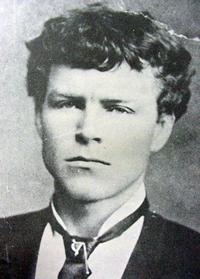
Temple
Lea Houston
Photo courtesy Texas State Library |
The young man
who went to the Panhandle
in 1880 was impressive to look at. He stood 6'2"-the same height as
old Sam-was extraordinarily handsome, had piercing gray eyes, and
wore his coal-black, wavy hair to his shoulders. The fact that he
had long, wavy hair had any number of young women wanting to run their
fingers through it. According to tradition, Temple Houston wasn't
at all averse to having that happen. One of the young women who liked
to run her fingers through his ample locks was Laura Cross of Columbia.
She eventually became Mrs. Temple Houston.
Temple went to Mobeetie,
which at the time was an open door to Hell. As he described it in
a letter to Laura, it was "a baldheaded whiskey town with few virtuous
women." He prosecuted horse thieves, gamblers, and killers, though
usually a killing resulted in a charge of assault. In the Panhandle
of the day it wasn't murder unless the victim was unarmed or shot
in the back.
There were a lot of people who resented Houston's success as a prosecutor.
Some of them tried to do away with him. They discovered something.
Sam's youngest boy had a skill his daddy never developed. Under the
long black frock coat he habitually wore, Temple Houston packed a
pair of ivory-gripped, nickel-plated Colt sixshooters-and he was greased
lightning when he reached for 'em. One contemporary wrote "Temple
Houston stays alive because he is very fast on the draw. He has winged
several bad men and killed two or three, and now he is a man to be
feared."
He was also a crack shot. After he outshot two notorious gunmen-legend
holds that one was Billy the Kid-in a shooting match for money, his
reputation spread. Not only was he fast, he could pick the eye out
of a rooster at 40 yards with a sixshooter.
Mobeetie, when Houston
first came there, had no jail. The new DA was convicting malefactors
on an hourly basis and there was no place to put them. One was chained
to a rock pillar supporting the roof of one of the town's main saloons.
The chain wasn't long, so he had limited movement. He was given a
blanket and left in the saloon overnight.
He was a thirsty man. He was also a cowboy. The next morning he was
found dead drunk, surrounded by bottles from the saloon's bar. He'd
torn the blanket into strips, made a lariat of it, and roped the bottles
off the backbar.
Houston insisted on a jail and construction was started. However,
there wasn't any place to hold a female prisoner. Two of the prisoners
the town had to contend with were a couple of prostitutes who got
in a fistfight over a cowboy-who hadn't time to take off his boots
before the fight started. The poor cowboy, who just wanted to get
out of the vicinity of the catfight, accidentally hung a spur in a
featherbed, covering himself, the room, and the two fighting women
with feathers. The women were eventually separated. Unfortunately,
they had to be confined in the same room. As soon as they were put
together, the fight started all over. They were finally chained by
their ankles to opposite walls of the room, the chains too short to
allow them to get to one another. They spent the next several days
glaring at each other and turning the air blue with their language.
By 1883 Temple judged the new district tame enough. He went back to
Brazoria County,
and when he returned to Mobeetie
he was a married man. The next year he was elected to represent his
district in the legislature, though he was only 24. He won a second
term in 1886 and the badmen of the Panhandle
sighed in relief. Houston was in Austin,
not throwing them in jail.
Temple's powers of oratory were legendary. At the dedication of the
new capitol building in 1888 he was chosen, over all the orators in
the state, to deliver the dedicatory address. He was being groomed
by the legislature to succeed his father in the US Senate, though
it would be another 7 years before he was eligible for that office.
At the time, senators were chosen by state legislatures, not by direct
election.
In
1893 Temple Houston took his young wife to Woodward, in what, 14 years
later, would become the state of Oklahoma,
in the newly-opened Cherokee Strip. He's remembered there partly for
his skill as a gunfighter. He witnessed a teenage boy get fleeced
at a gambling table in the territorial capitol of Guthrie. This so
thoroughly incensed him that he shot the place up and chased off not
merely the gamblers, but the owner of the saloon who'd allowed the
fleecing to happen. He's also remembered for his flamboyant appearance.
His first foray into the streets of Woodward saw him under the biggest,
whitest Stetson the town had ever seen, wearing not merely his trademark
long black frock coat, but a snow-white vest decorated with a pattern
done in bright yellow beads.
In Oklahoma Temple moved from the prosecution table to the other side
of the courtroom. Shortly after he arrived he took the case of a Texas
cowboy called Red Tom. Red Tom shot an Indian. He apparently
shot the Indian simply because he wanted to shoot an Indian. In fact,
he said-in front of witnesses-"If you find a dead Indian out there
with a bullet in his head that's my Indian." It was an open-and-shut
case of cold-blooded murder. The Indian was unarmed. The trial should
have taken all of half an hour-and probably would have if Temple Houston
hadn't been Red Tom's defense attorney.
The facts were clear. Red Tom shot an unarmed man. Temple, however,
knew it hadn't been all that long since most of the jurors lived in
deathly fear of Indian attacks. Instead of offering evidence of Red
Tom's innocence-there wasn't any-Houston launched into a long speech
that brought back memories of the Indian wars. When the defense rested
it took the jury 5 minutes to acquit the defendant.
In an alleged murder in which a young cowboy, a stranger, was accused
of stealing a horse and then killing the animal's owner, Houston came
to the defense. The dead man was a well- known gunman, reputed to
be fast on the draw. The cowboy pleaded self-defense, but there were
no witnesses to back up his plea. Houston leaned on the deceased's
reputation as a gunman and his client's inexperience. The prosecution
claimed that the fact that the cowboy drew and fired first constituted
murder. In answer, Houston said "He could no more have stood up to
his malefactor than the spark from the lowly firefly could outshine
the noonday sun-than the stubborn jackass could outrun the swiftest
racehorse. Gentlemen, such things are impossibilities." He moved closer
to the jury's box. "Gentlemen, that malefactor had a gunman's reputation,
while my client here is an ordinary, hardworking citizen like yourselves.
He had no chance unless he fired first. The malefactor was so adept
with a sixshooter that he could draw and fire his own weapon before
his victim could begin to draw-like this!" Houston's hand went under
his coat, came out with a shiny sixshooter, and emptied it directly
at the jury.
The result was panic. The jurors dived out of the box, spectators
dived out of windows and through the door, the defendant crawled under
the table, and the judge ducked down behind the bench. Houston's pistol
was loaded with blanks. A mistrial was declared, and the cowboy was
later acquitted in the same court.
The
Jennings brothers, local lawyers, were decidedly unsavory characters.
Ed Jennings in particular resented Houston, who was a far better lawyer.
One evening as Temple and a friend were having a friendly drink in
a local saloon, Ed and John Jennings came in looking for a fight.
They found one. When the smoke cleared Ed was dead and John's left
arm would be useless for the rest of his life. Houston and his friend,
ex-sheriff Jack Love, were charged with first-degree manslaughter.
On the testimony of 20 witnesses who stated the shooting was in self-defense,
Houston and Love were acquitted.
There were two more Jennings brothers-Frank and Al. Al, a loudmouth,
swore he'd kill Temple Houston at the first opportunity. Apparently
the opportunity never arose. A year later Al and Frank were convicted
of train robbery and Al was convicted of attempted murder of a federal
officer as a result of the longest-and most bloodless-gunfight in
the history of the American West. By the time Al got out of prison
Temple Houston was dead-of natural causes.
In
1899 Temple Houston assured his own immortality in the annals of the
legal profession. If all else he'd done were to be forgotten, he would
still be remembered for his defense of a notorious Woodward prostitute
named Minnie Stacey.
Temple wasn't even on the case. He was in the courthouse waiting for
a case he was defending to be called. Minnie Stacey was charged with
"plying her vocation and operating a brothel." She had no counsel.
Houston said "Your honor, I'll defend the lady if she'll allow me."
For about 10 minutes he talked with his new client, then pronounced
himself ready for the trial to begin. The prosecution presented the
state's case, which was pretty much open and shut. The woman was a
known prostitute. The evidence was clear. Then Temple Houston stood
up.
Temple Houston spoke in Minnie Stacey's defense for about 30 minutes.
He presented no evidence-there wasn't any. By the time he finished
what a newspaper called "the most remarkable, the most spellbinding,
heart-rending tearjerker ever to come from the mouth of man" there
wasn't a dry eye in the courtroom, including those of the judge, the
prosecutor, and the 'hardened prostitute' who was the defendant.
Houston's speech to that jury is still studied by law students today.
It's considered one of the finest, if not the finest, masterpieces
of extemporaneous speaking in the English language.
Houston began "Gentlemen, you have heard with what cold cruelty the
prosecution referred to the sins of this woman, as if they were of
her own choosing. Do you think that she willingly embraced a life
so revolting and horrible? Gentlemen, one of our sex was the author
of her ruin, more to blame than she." The speech went on for a long
time, but nobody dozed off. As he continued men began to turn red
and look away. Even those most adamantly opposed to immorality began
to cry openly.
When Houston concluded with "The Master, while on Earth, though he
spoke in wrath and rebuke to kings and rulers, never reproached any
of such women as Minnie Stacey; one he forgave, another he acquitted.
Do as your Master did. Tell her to go in peace," there was no doubt
in the courtroom that Minnie Stacey would be acquitted-nor that Temple
Houston was probably the finest defense attorney who ever lived. Minnie
was, in fact, acquitted-almost instantly.
The court's stenographer, who had taken down the speech word for word,
was bombarded with requests for copies of it. A copy was framed and
hangs, today, in the Library of Congress. It is labeled "One of the
finest examples of American oratory ever uttered."
And Minnie Stacey? Well, what happened to her after she left Woodward
is open to debate. There are those who say she merely moved on, continuing
as she had before. There are others who insist, and claim they have
good reason for insisting, that she went to Canadian,
Texas, abandoned her life as a prostitute, took in washing for a living,
was baptized in the Methodist Church, and remained a church-going
Christian until she died, late in the 1930s. Whether that's true or
not we don't know, but if it isn't it certainly should be.
Temple Houston prospered in Oklahoma.
His reputation as a defense attorney made him a fortune. He built
a fine home in Woodward, which is still a showplace. He gained the
nickname "The silver-tongued orator of Oklahoma,"
but he never again entered politics.
In 1904 he apparently suffered a stroke, aggravated by his somewhat
choleric temperament and his fondness for whiskey, both of which he
inherited from old Sam. He was confined to his bed or a wheelchair
for the remainder of his life. On 15 August 1905 he suffered a second
stroke and died. Flags flew at half-staff all over Indian Territory,
Oklahoma Territory, and Texas.
Today Temple Houston is little remembered, overshadowed by the reputation
of his father-a reputation he sought all his life to outshine. He
deserves better, for like his father, Temple Lea Houston was an original.
We do not see his like today.
© C. F.
Eckhardt
"Charley Eckhardt's Texas"
January 22, 2007 column |
Texas Books
by C. F. Eckhardt
|
|
|
 HOME
HOME