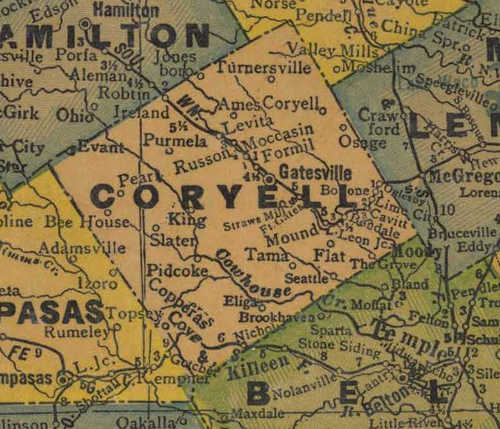
|
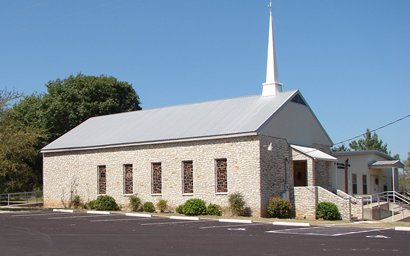
The
Methodist Church in Pidcoke
Photos courtesy Richard Miller, October 2007 |
History
in a Pecan Shell
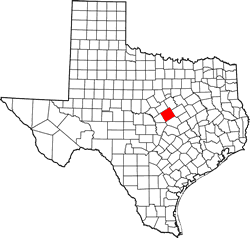
The name is from
the Revered Richard Pidcocke family, English immigrants who arrived
in the 1850s to form a colony.
Pidcocke sons Hartley and Reginald, bought land in 1857 and began
the Pidcock Ranch. A post office was granted under that name in 1875.
The post office changed its name in 1882 to Pidcoe, and in 1883 to
Pidcoke. The first school and church were built on land donated by
W. H. Belcher.
In 1884 Pidcoke had a population of 150, the school, three churches,
two gristmills, and two cotton gins.
In 1914 it had a population of sixty-five, and it peaked in 1940 with
a population of 200.
The construction of Fort Hood in 1942 caused many far-reaching changes.
The post office closed in 1944 and the last store closed in 1983.
|
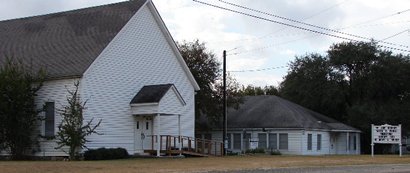
Pidcoke Baptist
Church on FM 116
Photos courtesy Richard Miller, October 2007 |
Historical Marker
- FM 116
Pidcoke Baptist
Church
Organized in 1884
as Harmony Baptist Church, this congregation began with four charter
members. Early worship services were held in the local schoolhouse.
A sanctuary, erected in 1907 was destroyed by fire two years later.
A new church was built by 1911, and in 1916 the name was changed to
Pidcoke Baptist Church. In 1934, a new sanctuary replaced the 1911
structure. Among the church's traditions are camp meetings and baptisms
in Cow House Creek. Active in community projects, the congregation
led in the restoration of Pidcoke Cemetery. |
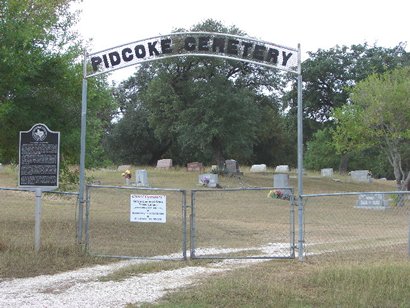
Pidcoke Cemetery
CR 142, 0.7 miles west of FM 116
Photos courtesy Richard Miller, October 2007 |
Historical Marker
Pidcoke Cemetery
Serving the rural
Pidcoke and Harman communities, this cemetery dates to at least 1885,
the year six-year-old Mattie Jeter was buried here after dying in
a fall from a wagon. Local landowners H. S. (Tip) Perryman and W.
H. Belcher formally deeded portions of their land for a community
graveyard in 1896, and members of both the Perryman and Belcher families
are interred here.
The Pidcoke community was named for English colonist the Rev. Richard
Burton Pidcocke's sons, Hartley and Reginald, who began a successful
ranching enterprise in the area in 1857. Stock raising and other agricultural
pursuits sustained the economy until the acquisition of land for Camp
Hood in 1942 resulted in the relocation of many families.
Generations of families are buried in the Pidcoke Cemetery, including
that of H. S. Perryman, a native of Arkansas, who drove cattle
to Kansas and served as Coryell County tax assessor (1876-1886). Perryman
died in 1897, soon after donating land for the cemetery. Others interred
here include veterans of the Civil War, World
War I, World
War II, Korea and Vietnam.
The Pidcoke Cemetery Association, dating to at least 1936, cares for
the cemetery. The association has conducted a census of the cemetery,
worked to provide markers for unmarked graves and acquired additional
land in 1985. The graveyard remains in use as a reminder of Pidcoke's
settlement and heritage.
(2001) |
FM
116: In The Shadow of Fort Hood
by Clay Coppedge
PIDCOKE -
Driving north from Copperas Cove
to Gatesville on FM 116 you're never
far from Fort Hood. ... Copperas
Cove is ringed by five hills, a pattern drivers will see repeated
on the way to Gatesville. A few
miles out of town you come to FM 580, and if you just feel like it
you can detour to the town of Topsey...
If, instead of heading to Topsey you
get on 116 you will drive up on a green, bowl-shaped valley cut by
scenic creeks. Nestled between the hills and creeks is the community
of Pidcoke, named for the Pidcocke family, early English colonists
to the area. It's not hard to see what drew the Pidcockes here. The
creeks would have been as good a reason to settle here as anything.
This is good ranch country; the best side of the grass is already
topside.
A detour in Pidcoke to see the local cemetery is a good one, but follow
the road past the cemetery to catch some fine glimpses of Bee House
Creek and a couple of panoramas of the valley. Bee
House was once the home of a communal house called Bee House Hall.
Residents wanted to name the community Bee Hive but the post office
decided it would be Bee House instead.
Pidcoke was the home of NFL legend Clyde "Bulldog" Turner, who passed
away in 1998 at the age of 79. Turner was a member of the NFL Hall
of Fame who played his college ball art Hardin-Simmons University.
He was the first draft pick of the Chicago Bears in the 1940.
As a 20-year old rookie center for the Bears, he was the highest paid
rookie lineman in the league. He made $2,000 a year. Turner also owns
the distinction, if that's the word, of playing in the most lopsided
NFL game ever played, when his Bears delivered a 73-0 shellacking
of the Washington Redskins. He had 16 pass interceptions in his career
(players played both offense and defense in those days) and four of
them came in NFL championship games. He had eight interceptions in
1942, which led the league.
Six miles southeast of Pidcoke used to be the community of Stampede...
more |
Pidcoke, Texas
Forum
Subject:
Pidcoke old rock school house
I was hoping to see a photo or a reference to the old rock school
house there on the NW side of town. During WWII
the class rooms were used as apartments for families working at Camp
Hood. Although I never attended school there I did attend some
dances held in the gym in the 40's. I spent many a hot day swimming
in the Bee House Creek there as well. - Ken Bates, September 30, 2010 |
| Texas
Escapes, in its purpose to preserve historic, endangered and vanishing
Texas, asks that anyone wishing to share their local history, stories,
landmarks and recent or vintage photos, please contact
us. |
|
|
 HOME
HOME