|
|
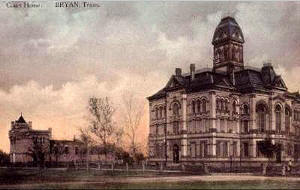
The 1892 Brazos
County Courthouse, Razed
Postcard courtesy texasoldphotos.com
|
| Way
back in 1954, before "urban renewal" entered the American vocabulary,
county commissioners of Brazos
County decided that they needed a new courthouse. The one they
were using was sixty-two years old and was looking every month of
it. Besides, it had always been considered a little "fussy" to some
Brazos Countians. All that rough-cut stone was distracting and the
tower was downright... Victorian. Tower-less buildings of smooth concrete
and glass bricks were going up all across the country. Why should
Brazos County be
stuck with this old eyesore? |
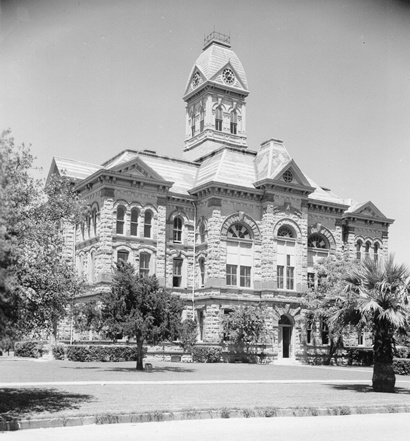
The courthouse
in 1939
Photo courtesy TXDoT |
As
in most courthouse replacements - the new building was to occupy the
same space as the former. In mid-August, 1954, shortly before demolition
was to begin in earnest, the Bryan Daily Eagle interviewed the man
who was to supervise the work. The story was right there on page one
- right alongside the articles "Studebaker Workers Vote to Take Pay
Cut," "Japan Has Risen from Ruins, But Near Broke" and "Controversial
Anti-Red Bill Goes to House."
The story ran under the headline "Wrecking Boss Likes His Work." Ted
Hall, was a beefy Iowan that had turned in his bid to demolish the
courthouse without even looking at the building. He agreed to complete
the job within fourteen working days which surprised everybody involved.
Because of the sheer volume of the building, it was a Herculean feat
- if the deadline could be met. The contract (no monetary figure was
given) may have been awarded to Hall just to see if it could be done.
Hall, who had torn down buildings in 14 states (presumably with permission)
said that he had already razed over 300 buildings this size or larger.
He set up his trailer on the north side of the square and with his
crew of six started dismantling. When interviewer Ray McGehee asked
about equipment, Hall asked "What equipment?" He explained that it
was cheaper to hire a local bulldozer by the day and extra local laborers.
At the peak of destruction, Hall had 30 workers pounding, prying,
pushing and pummeling the old courthouse into gravel.
Neither Hall nor his interviewer had much to say about the doomed
building. Not even a single "they-don't-build-'em-like-that-anymore"
remark. A few days into the operation reporter McGehee said "thus
far in his Bryan operation Hall has had only minimal accidents - cut
hands and mashed feet." None of the aforementioned appendages belonged
to Mr. Hall who kept a safe distance from falling debris. Hall spent
his day answering requests for salvaged lumber and flooring. Although
he, himself was safe from injury, he pointed out that "Deep-sea diving
is the only business that carries a higher insurance rate than demolition."
|
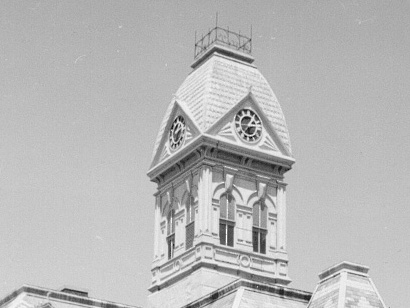 |
The Clock Tower
& Seth Thomas Clock
Photo courtesy TXDoT |
The
Seth Thomas Clock
But
Reporter McGehee did seem to get a little sentimental when speaking
of the old courthouse clock. "Old and tired, the clock gave up and
stopped several years ago. [But it] had gained a place in the hearts
of Bryan people with its time-telling
chimes that could be heard day and night..." But if this was true
sentiment, he snapped out of it with his next line: "so it is fitting
that this old masterpiece should be the first to come down." The Seth
Thomas clock was "unceremoniously" thrown off the top of the building
into a twisted mass of junk.
The timbers supporting the tower were found to be 6 x 14 inch heartwood
(although the tree species wasn't mentioned). This massive wood frame
slowed them a bit but McGehee reported that "after five official working
days the wreckers have rendered the building a broken twisted hulk."
The clippings of the courthouse's death and removal ended abruptly.
The paper went on to other, more pressing subjects. Nothing is known
of the clock's final resting place or if the building stone was sold
in cut form or simply used for fill. It seems that once the walls
were pulled down there was nothing to interest the public until construction
began on the new courthouse. But the casual, cold-hearted smashing
of the clock was noted by the National Association of Watch and Clock
Collectors Bulletin in their February 1988 edition.
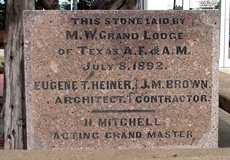
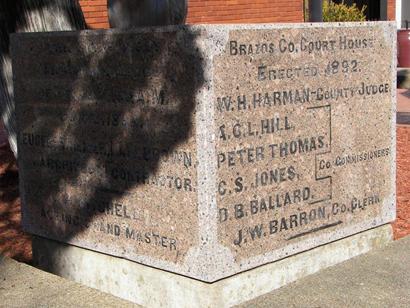
The Cornerstone & Bell
The
cornerstone is now on display in front of the main entrance of the
new courthouse, and the bell on display in the new courhouse lobby.
|
|
|
The 1892 Brazos County courthouse cornerstone on the courthouse grounds
today
TE Photo, 9-01 |
Cornerstone
from the 1892 courthouse
Photo courtesy Terry
Jeanson, January, 2014 |
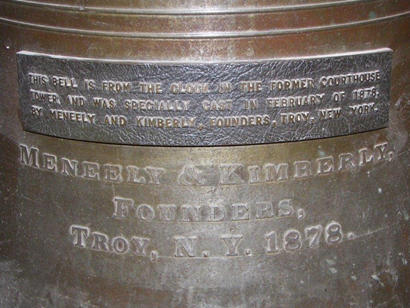
The
bell from the 1892 Brazos County courthouse actually predates that
courthouse by fourteen years.
Photo courtesy Terry
Jeanson, January, 2014 |
The plaque on
the bell reads: This bell is from the clock in the former courthouse
tower and was specially cast in February of 1878, by Meneely and Kimberly.
Founders, Troy, New York.
Photo courtesy Terry
Jeanson, January, 2014 |
|
|
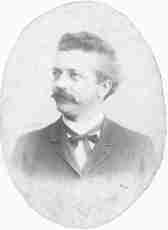
Eugene
Heiner, the building's architect, had died
only a few years after the building's completion so he was spared
witnessing the undignified end to his design.
Photo
courtesy Nesbitt Memorial Library, Columbus, Texas |
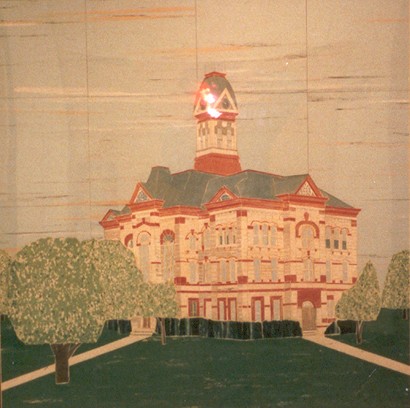
A
mosaic of the old courthouse, composed of tiles from the Heiner building
and arranged by a former Brazos
County Judge is on display in the current courthouse.
© John
Troesser |
The mosaic "made
from tile from the demolished 1892 courthouse in 1965."
Photo courtesy Terry
Jeanson, March 2005 |
Forum
Subject:
Brazos Courthouse Mosaic
I was at the Brazos
county courthouse recently and took a picture of the mosaic
made by one of the judges. It was made from tile from the demolished
1892 courthouse in 1965.
The courthouse bell from the 1892 courthouse is also displayed in
the lobby. - Terry
Jeanson, San Antonio, TX, March 22, 2005
|
|
|
 HOME
HOME