|
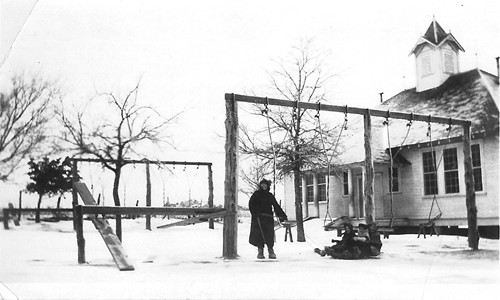
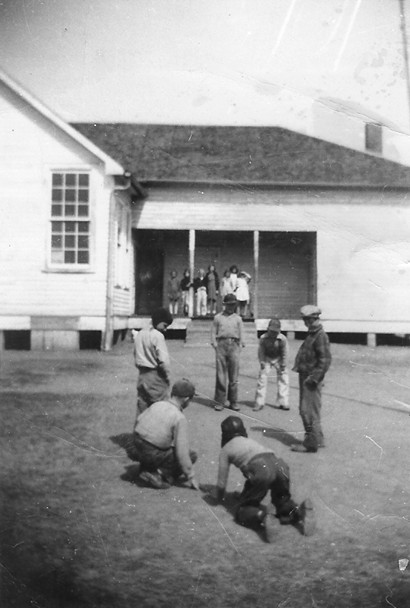
Pecan School
Playground, circa 1949
Courtesy Fayette County Hist. Comm.; submitted by Carolyn
Heinsohn |
History in
a Pecan Shell
The community formed
on land that had been part of a grant awarded to Jesse Burnam by Stephen
F. Austin in 1824. Burnam
operated a ferry across the Colorado River near Holman, which
was then named Pecan (after the creek of the same name).
The town consisted of the ferry, Burham’s home and trading post and
little else. After the
Alamo, Houston’s army used the ferry and burned it to delay Santa
Anna’s troops during the “Runaway
Scrape.”
John Holman married the daughter of Burnham and in time, the name
of the community was changed to Holman. Holman’s son Nat served in
F Company of Terry's
Texas Rangers.
From the 1850s through the mid 1870s, many of the Anglo settlers sold
their land to immigrating Czech and German families and moved westward.
The Galveston, Harrisburg and San Antonio Railroad arrived in 1873,
but instead of going through Holman, the community was bypassed in
favor of Weimar, drawing
population and businesses from Holman.
Nevertheless, Holman continued to grow and by 1891, the town had opened
its own post office (which closed in 1907). No population figures
are available for the early years of Holman, but after WWII
it was estimated to be around 75.
Holman’s gin closed its doors in the late 1950s and the population
remained just over 100 from the late 1960s through the year 2000.
Fayette County
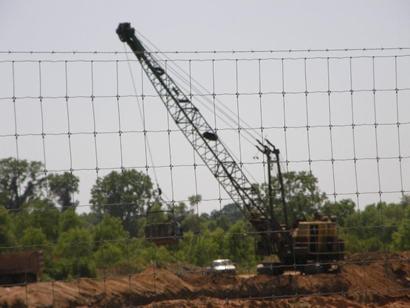
exported sand and gravel by the trainload from this area during the
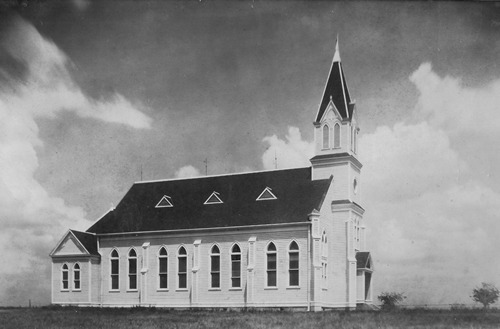
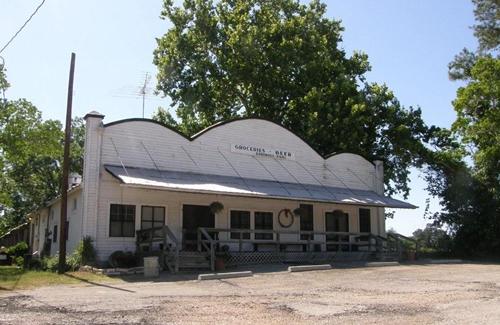
1980s and today only the store and church remain to remind visitors
that Holman was once a thriving community. |
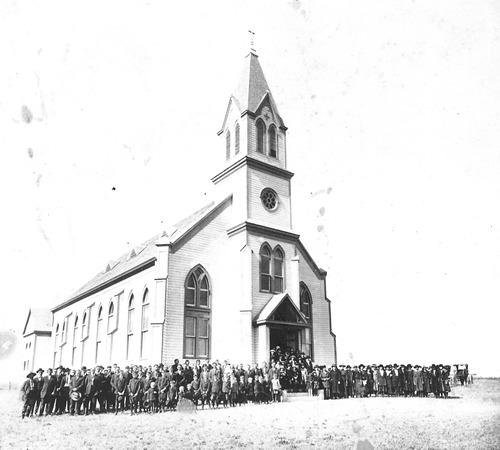 |
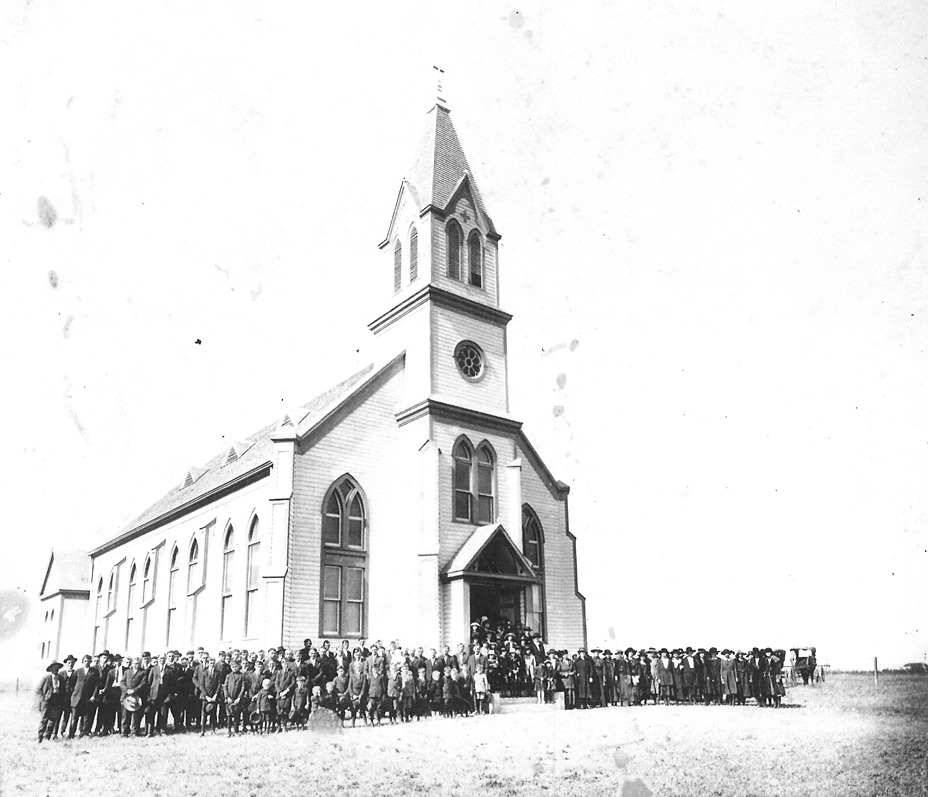
St. Wenceslaus
Catholic Church, 1919 dedication
Click on photo to enlarge
Courtesy Fayette County Hist. Comm.; submitted by Carolyn
Heinsohn |
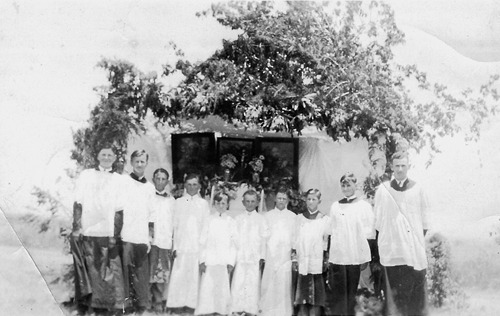
Corpus
Christi Day Celebration at the church
Courtesy Fayette County Hist. Comm.; submitted by Carolyn
Heinsohn |
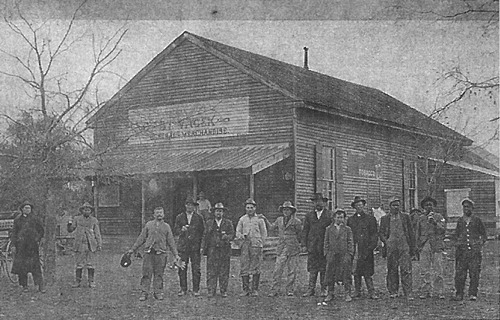
Staches Vacek
General Merchandise Store, circa 1902 - 1905
Courtesy Fayette County Hist. Comm.; submitted by Carolyn
Heinsohn |
The Long Story
of Holman, Texas
External Link:
Holman,
Texas - Looking Back by Carolyn
Heinsohn
Rural Fayette County is noted for its many distinctly ethnic communities.
The mailboxes and county road signs reflect the Central European heritage
of the descendants of Moravians, Bohemians, Germans and German-Moravians,
who began emigrating to this area in the mid-1850s. Most of the small
towns disappeared from Texas maps years ago, but their heritage lives
on with the families that still live in the rural environs settled
by their immigrant ancestors.
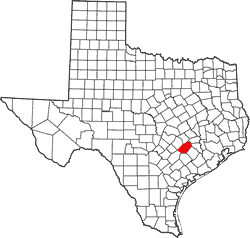
Holman, Texas is one of these communities. Located in Holman Valley,
it is picturesquely situated on Pecan Creek, about thirteen miles
southwest of La Grange on FM 155, two miles away from the Colorado
River. The country is very rich and fertile black land prairie, which
was attractive to the early American settlers, who owned large cotton
plantations that were worked by slaves. more
|
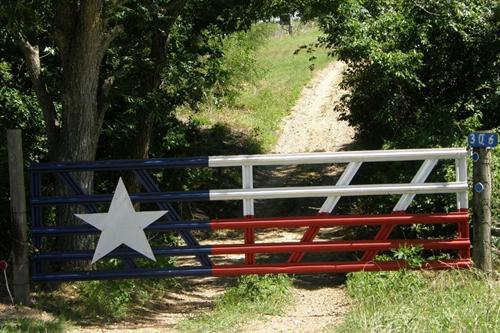
Texas Flag Gate
TE Photo, May 2008 |
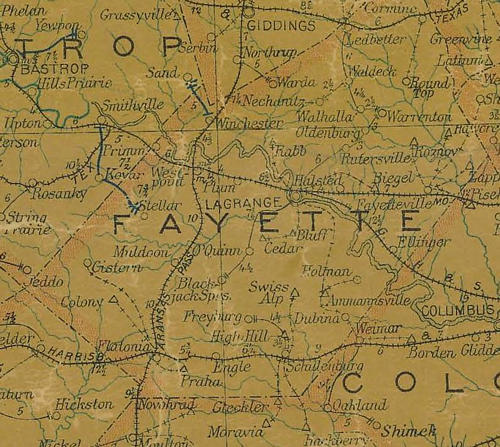
1907 postal map
showing Holman in SE Fayette
County
From Texas state map #2090
Courtesy
Texas General Land Office |
| Texas
Escapes, in its purpose to preserve historic, endangered and vanishing
Texas, asks that anyone wishing to share their local history, stories,
landmarks and recent or vintage photos, please contact
us. |
|
|
 HOME
HOME