|
| Let’s
talk about mules. Horses are quick to grab Texas history’s glamour
and glory, leaving little attention for their homelier, obstinate
cousin. Can you imagine the Lone Ranger charging to the rescue on
a mule? While acknowledging the mule’s notable lack of charisma, old-timers
are quick to point out that the horse/ donkey half-breed is a forgotten
hero. |
| “A
lot of people never think about it, but mules made the United States,”
says Clements W. “Speedy” Duncan in the book Harder Than Hardscrabble,
an oral history about growing up on the lands now occupied by Fort
Hood. “They [mules] built all the railroads, and they did all the
farming, and they pulled them wagon trains across the country. They
don’t get their just credit, mules don’t. The cotton-picking old mule
is the most unappreciated thing that ever happened to this country.”
|
|
Christopher Columbus
appreciated mules enough to take some on a 1493 voyage to what is
now Haiti. George Washington bred horses, but started the mule industry
in this country when the King of Spain gave him a mule as a gift.
Washington felt that horses “ate too much, worked too little, and
died too young” to be of much use on the farm.
To early Texas farmers, buying mules was as important as buying a
car or truck is today, but mules did not come with a 100,000-mile
warranty or cash-back rebates. Texas led the country for a few years
in the production of mules—well over a million of them in 1926,
about the time that newfangled internal combustion engine really started
catching on.
Willie Huber of Belfalls, 96 when I interviewed him a few years ago,
recalled that his first, most important purchase when he started farming
for himself seven decades ago was a team of mules. He found four for
sale at a farm about 10 miles west of Gatesville
and went to have a look. He liked what he saw in three of the mules,
but he had his doubts about the fourth one. He was right about the
first three.
Unfortunately, he was right about the fourth one, too.
“That fourth mule wasn’t no count,” he ruefully admitted some 70 years
later.
In Harder than Hardscrabble, T.A.Wilhite described the traits
he looked for back in his mule-trading days.
“You wanted them to have muscle, and you wanted them to have the right
kind of disposition,” he said. “You might get scalped many times ’til
you learned what to look for.” |
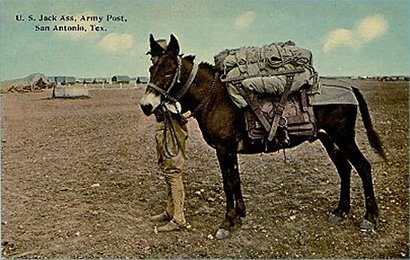 |
A mule in San
Antonio U.S. Army Post
Postcard courtesy www.rootsweb.com/ %7Etxpstcrd/ |
The
U.S. Army recognized the value of mules early on. Mules served in
every American conflict between 1820 and 1945. They were essential
to both the North and the South in the Civil War. A thousand marching
soldiers required at least 25 wagons to carry supplies and haul heavy
artillery from one battle site to another, and mules pulled most of
those wagons.
When told that Confederate soldiers had captured 40 mules and a Union
general, Abraham Lincoln reportedly responded, “I’m sorry to lose
those mules.” |
In
Shavetails and Bell Sharps: History of the U.S. Army Mule,
author Emmett M. Essin writes that the Army found mules to be stronger
and more agile than either a horse or a donkey, able to carry heavier
loads longer distances over more difficult terrain.
“Mules were also sensitive, intelligent animals, more so than their
parent stock. They quickly recognized approaching danger and knew
by instinct how to avoid it,” he wrote.
|
|
On
the battle lines, however, mules often became conscientious objectors,
recognizing the high probability of death the battlefield presented.
Maybe that’s why you never saw a lot of mules charging into battle.
Gradually,
tractors replaced mules on the farm, leaving them with nothing more
than a reputation for being stubborn. But a few places still pay homage
the mule’s contribution. Texas is one
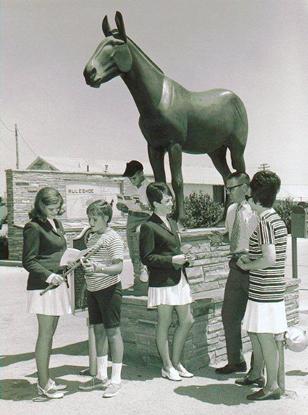
of those places. The National Mule Memorial is in — where else? —
Muleshoe, and was
financed with private donations, including 25 cents from a mule driver
in Uzbekistan. The mule gets its just credit in Muleshoe. |
The Mule in Muleshoe
Vintage photo courtesy TXDoT |
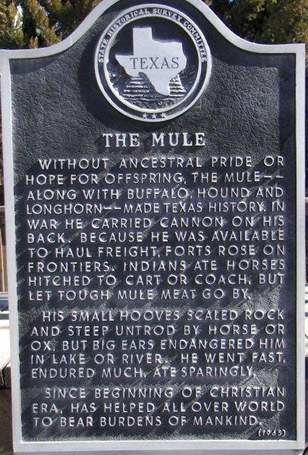
The Mule historical
marker
Photo courtesy Terry
Jeanson, February, 2007 |
The mule is recognized
also in the Coryell
County town of Topsey,
which is named for an early farmer’s favorite mule. Mule Ear Peaks,
in the Chisos Mountains of West
Texas, is an easily recognizable and aptly named geographic feature.
Still, even with its own monument, even with towns and landmarks named
in its honor, the mule remains the Rodney Dangerfield of the animal
world, getting no respect. To make matters worse, it is often confused
with other equine critters, like donkeys.
Remember: a donkey is just a donkey; a mule is a cross
between a horse and a donkey, usually a male donkey and a female horse,
but not necessarily. A cross between a male horse and a female donkey
is called a hinny.
Just don’t be a jackass and call a mule a donkey. Mules deserve a
little more respect than that.
© Clay Coppedge
"Letters from Central Texas"
January
2, 2009 Column |
|
|
 HOME
HOME