|
|
After
our accidental discovery of the gravesite of Dallas Stoudenmire
in Colorado
County, we were reminded that Bill
Longley was buried in (relatively) nearby Giddings
(Lee County).
Pay no attention to your spell checker when it suggests Giddiness.
We remembered reading that Bill
was from a good family but took a liking to demon rum (actually it
was Brandy). We also remembered that he went out in a cheerful manner,
even though he had to ride to the gallows on the same wagon as his
coffin.
The Giddings Cemetery is just west of the town on Hwy 290 - the cemetery
has unpaved entrances on Highway 290 and if you decide to visit, it
is safer to enter from the street that borders the cemetery on the
east.
Bill Longley's name isn't as familiar
as other "wild-west" gunmen because his motivation for killing was
not personal gain, but instructing others on how to properly show
respect. It may also be because most of the 32 or 33 men he is reported
to have killed were Black Union soldiers and the shootings were done
during reconstruction,
which was not the happiest time in Texas
history. Striking back against the "occupying forces" in any way
was heroic to many. |
|
|
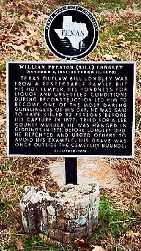
Historical
Marker Text:
William Preston
(Bill) Longley
(October 6, 1851 - October 11, 1878)
Texas outlaw Bill Longley was from a respectable family, but his hot
temper, his fondness for liquor, and unsettled conditions during Reconstruction
led him to become one of the most daring gunslingers of his day. He
was said to have killed 32 persons before his capture in 1877. Tried
for a Lee County murder, he was hanged in Giddings in 1878. Before
Longley died, he repented and urged others to avoid his example. His
grave was once outside the cemetery bounds.
Longley's Grave with new plaque and the original petrified wood marker
TE photo, 2000 |
It
was a cold December day back in the year 2000, when we entered the
cemetery and went searching for Longley's
grave. We nearly gave up looking for it, when the Rodriquez family
of Giddings appeared
and pointed it out to us. Mr. Rodriquez, who works for a local
funeral home and disposes of the extra dirt from burials remembered
the grave because of the huge fuss that was made not that long ago
when the experts came in with all their surveying, digging, and camera
equipment. We're sure that's a story in itself. We were later told
that it was the Smithsonian Institution that was doing the locating
and exhumation and that when the skeleton was finally found, the bones
were taken away.
The reason the grave was lost is that sometime in the 1970s the cemetery
people widened a road and since Longley's grave was outside
the cemetery proper, it was the only one in the way of the widening.
What may have happened was that the petrified wood marker was moved,
but not the bones. While the petrified wood is now only about 8 inches
tall, a photo in the Giddings
library shows that in the 70s, the marker was about 20 to 24 inches
tall. It appears as though souvenir hunters have been at work.
|
|
|
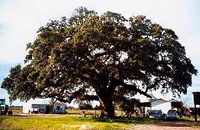
The
Big Tree in Evergreen today
TE photo, January, 2001 |
| We needn't go
into all of Bill
Longley's wild and short life. Suffice it to say that William
was a dangerous man in dangerous times. We're sure that after all
the forensic tests are completed, it will be officially announced
that Bill
was bad to the bone. |
If
you're interested in Wild
Bill's story, we were told by a chamber of commerce representative
that you can pick up Bill's Biography "at any bank in town."
A short and very readable account of the Life and Hangings of Bill
Longley is contained in Richard Zelade's Hill Country (Gulf
Publishing, 1999).
Longley is listed in the index and also under the heading of Evergreen.
Evergreen
was Longley's home and just seven miles from both Lexington
and Giddings. |
|
|
William
Longley escaped death by hanging twice, although Robert Ripley
reported in 1931 that it was three times. Rumors persist to
this day that the hanging was performed with an ingenious rigging
harness. You can believe Ripley - Or not.
The first time Bill
was hanged it was as half of a pair of horse or cattle thieves.
Bill
was travelling with a horse and/or cattle thief and it was clearly
a case of guilt by association. According to most stories, the two
men were strung up and several shots were fired in the general direction
of the two as the lynch party rode off. One bullet hit Bill
in the face and broke a tooth, while another frayed the taut rope.
Bill's
gyrating bulk and the weakened rope caused a break and William
was spared.
We find it strange behavior to ride off after going to all the trouble
to lynch someone. There weren't a lot of diversions back then and
you have to assume that hanging a man wasn't an everyday occurrence,
even in Lee
County. Just the novelty of the event would dictate that at
least some of the posse would stick around longer than a person
could hold their breath. But anyway, that was the story we heard.
Bill's
second encounter with a rope was in Giddings.
After his capture over in East
Texas he was sent back to the Lee
County seat. The jurors of Lee
County deliberated for only 11/2 hours before they sentenced
William
to death by hanging. While appeals were being made, Longley
was transferred to Galveston
where the authorities felt he would be safer from a mob of Longley's
victim's survivors. When he kept his appointment with the hangman,
he gave a memorable warning to youth from the gallows and apologized
for being such a disagreeable neighbor. He sent letters of apology
to many Texas newspapers and one account even has him kissing the
sheriff (men were hanged for this in other parts of Texas).
On the day of Bill's
not-so-excellent adventure, he was escorted to the gallows by 50
Infantry Troops and an additional 150 guards who were local citizens
who just wanted to help out in some way. He insisted that the wobbly
stairs be tightened before ascending to the top. He made some lighthearted
remark about not wanting to break his neck.
The novice hangman cut Longley
some slack (literally) and he landed feet first beneath the gallows.
This extended his life for the few minutes it took to correct the
embarrassing situation. Bill's
third hanging went off without a hitch (but with a sheepshank).
According to one account, the sheriff and some of the guards lifted
Bill's
feet off the ground so that the rope could strangle him.
Bill
had always been close to the Lee
County soil. Now he was under it. Due to a long standing tradition
concerning consecrated ground and murderers, Mr.
Longley was placed outside the boundries of the cemetery. Ironically,
the cemetery has expanded with time so that his grave came to be
well inside the boundaries. We were told in the excellent and entertaining,
Myra Hargrave McIllvain's Six Central Texas Auto Tours, Eakins
Press, 1980, that the judge who sentenced him to hang lies not
far away, although since they moved Bill's
marker, that no longer applies.
See Giddings,
Texas
© John
Troesser
January, 2001
|
|
|
 HOME
HOME